
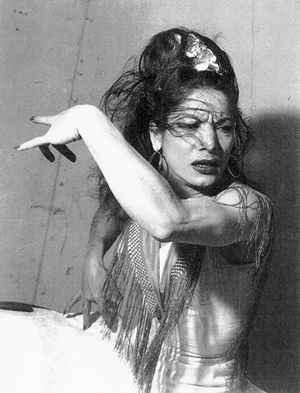
Carmen Amaya
Source: Gypsy Heart
Flamenco dancer (bailaora), Carmen Amaya, joins Sabicas in the distinction of taking flamenco international, making it famous on both sides of the Atlantic. Born with a passion, no doubt, on 2 November 1918 in Barcelona, there was a cave near Granada where Carmen liked to dance as a child. She later danced with her father on guitar in waterfront bars in Barcelona, appearing at the Bar de Maquet at age ten. Amaya was a vocalist, though that hardly at all in comparison to gypsy dance for which she is a major figure in Spain's cultural history.
In 1929 when Carmen was about age ten she joined a dance troupe called the Amaya Trio with her cousin, María la Pescatera, and aunt, Juana la Faraona. They not only performed in Paris but were featured in the film, 'La Bodega' ('The Winery'). This was a silent film to which sound was later added.
'La Bodega' ('The Winery')
Film w Carmen Amaya (age 10 or 11)
Film released 26 Feb 1930
Directed by Benito Perojo
The Trio Amaya: Carmen / Maria / Juan la Faraona
After dancing in 'La Hija de Juan Simón' in 1935 Carmen filled a starring role in 'Maria de la O' as Maria de la O in 1936. Filmographies indicate that wasn't released in Spain until 1939, following the three-year Spanish Civil War that began on 18 July of 1936. The war ceased on 1 April 1939, resulting in Nationalist dictator, Francisco Franco, assuming his position as Caudillo (Head of State). 'Maria de la O' didn't premiere in the United States until 1942, eight years after its filming. In an excerpt of that below Carmen dances multiple sevillanas [Swanson / Wikipedia], a common form of flamenco springing from Seville. She finishes with a solea, a form originating in the Cadiz-Seville region.
'La Hija de Juan Simón' ('La Daughter de Juan Simón')
Film w Carmen Amaya (age 16)
Released 16 Dec 1935
Directed by José Luis Sáenz de Heredia
IMDb Wikipedia English Wikipedia Spanish
'Maria de la O' Film w Carmen Amaya
Filmed 1936 Released Spain 1939 Released US 25 Sep 1942
Directed by Francisco Elías
Upon the outbreak of the Civil War Amaya had headed for Buenos Aires, Argentina, with Sabicas, also joining much older Ramon Montoya there who had arrived from Paris. Touring in South America led to Mexico City where her career in dance was supported by Sabicas, they eventually taking a trip to New York City in 1941 to play Carnegie Hall [numerous sources though not listed at the CH timeline]. In the meantime she appeared in the short film, 'El Embrujo del Fandango', in Cuba in 1939. Soon thereafter in March of 1941 she appeared in the short film, 'Original Gypsy Dances'.
'El Embrujo del Fandango' ('The Bewitching Fandango')
Film w Carmen Amaya 1939
Directed by Jean Angelo
Music by José María Palomo
'Original Gypsy Dances' Film w Carmen Amaya
Released 12 March 1941
DAHR finds Amaya in sessions in New York on 1 and 4 of June 1941 toward releases like 'Tondero (Decca 23227)', 'La Tana' (Decca 23227), 'Corazone de Acero' (Decca 23228) and 'Fiesta Jerenzana' (Decca 23228). Those were family recordings on which she was joined by Jose Amaya (El Chino - father), Leonor Amaya (sister), Paco Amaya (brother) and Antonio Amaya (unidentified).
'Fiesta Jerezana' Carmen Amaya 1941
1 June 1941 in NYC Matrix 69279 Decca 23228 / DL-8027
Guitar: José Amaya / Paco Amaya
In early 1944 'Knickerbocker Holiday' saw release in which Carmen displayed the zambra. "Zambra" derives from Arabic "zumra" meaning "party." Zambra is a style of flamenco dance that had once been common at weddings. A zambra gitano indicates origination in Gitano, a quarter of Granada. The fusion of flamenco with the Arabic belly dance is more properly called the zambra mora.
'Knickerbocker Holiday' Film w Carmen Amaya
Released 17 March 1944
Directed by Harry Joe Brown
In 1944 Amaya performed for Franklin Roosevelt at the White House. She returned to Spain in 1947, the year Franco declared Spain to be a monarchy. By that time Carmen was commanding $2,000 a week in New York City, $14,000 in Rio de Janeiro. Marrying the guitarist, Juan Antonio Agüero, in 1951, she visited the White House again to dance for Harry Truman in 1953.
Though compilations abound, Amaya did very little recording. Among her albums were 'Flamencan Songs and Dances' (1950), 'Flamenco!' with Sabicas (1958) and her final, 'Furia!' (1965 posthumous). In 1958 she appeared in the film, 'Musica en la noche', in which she danced an alegrias, a palo (form) of flamenco originating in Cadiz. "Alegria" translates to "joy" in English. In 1961 she performed bulerias in the film, 'Bailaoras de flamenco'.
'Musica en la noche' ('Music in the Night')
1958 film w Carmen Amaya
Directed by Tito Davison
'Bailaoras de flamenco' ('Dancers of Flamenco')
1961 film w Carmen Amaya
Amaya's last film was 'Los Tarantos', which released on 5 November 1963. She died a couple weeks later in Barcelona of kidney failure on 19 November 1963 at only 45 years of age. Her plate with Sabicas, '¡Inolvidable Carmen Amaya¡', saw issue posthumously in 1964 with 'El Garrotin' on side A and 'Colombiana Flamenca' on B. The garrotin is a form of flamenco generally credited to Ramon Montoya, made famous by Faico who combined it with dance in Madrid. Montoya derived the garrotin from out of the flamenco tango (which may or may not be related to the more widely known Argetine tango). That is disputed, however, by two schools of thought that would place its conception, not in Andalusia, but northern Spain. The one has garrotin birthed in the Asturias-Galicia region in northwest Spain off the Atlantic, arriving to Andalusia by sea (along Portugal) at Cadiz on the Mediterranean (short of Gibraltar eighty some miles). Another theory has garrotin developed by Catalan gypsies in northeast Spain. Relevantly, though the flamenco tango may or may not be related to the Argentine tango, one palo of flamenco which does share roots with dance across the Atlantic is the rumba flamenca, conceived from the Cuban guaracha. As for the Colombiana, Pepe Marchena is thought to have invented that in 1931, though that is also moot.
'Los Tarantos' Final film by Carmen Amaya
Released 5 Nov 1963
Directed by Tito Davison
'El Garrotín' Carmen Amaya w Sabicas in NYC 1963
From '¡Inolvidable Carmen Amaya¡' Brunswick EPB 10741 1964
Composition: Sabicas / Amaya
'Colombiana Flamenca' Carmen Amaya w Sabicas in NYC 1963
From '¡Inolvidable Carmen Amaya¡' Brunswick EPB 10741 1964
Composition: Sabicas / Amaya
Sources & References for Carmen Amaya:
VF History (notes)
Audio of Amaya: Internet Archive
Documentaries:
Queen of the Gypsies by Jocelyn Ajami / 2004 / Greece:
Filmography: IMDb
Palos of Flamenco (mentioned herein):
The Colombiana:
Rina Orellana Flamenco Richter Guitar
The Tango (not the Argentine):
Ravenna Flamenco Rina Orellana Flamenco
The Zambra:
Puela Lunaris Oasis Backpackers Hostels
Recordings: Albums:
Decca Presents Carmen Amaya / Decca 269 / 1941/42:
Recordings: Catalogs:
Recordings: Sessions:
DAHR (1941)
Further Reading:
Foro Flamenco Papeles Flamencos Tablao de Carmen
Bibliography:
Carmen Amaya (Montse Madridejos & David Pérez Merinero / Edicions Bellaterra / 2013)
Queen of the Gypsies / Paco Sevilla / Sevilla Pr / 1999):
Authority Search: BNF Data VIAF
Sources & References for Flamenco:
Britannica Donald Clarke Roberto Lopez
New World Encyclopedia VF History Wikipedia
Flamenco Composition and Ownership: Peter L. Manuel
Flamenco Culture: Earlham College Matthew Machin-Autenrieth
Flamenco Dance: DanceSportWiki
Flamenco Fusions: Earlham College
Flamenco Guitar: Appleby Fairground ClassicalGuitarMidi
Flamenco History (University of California-San Diego):
Flamenco Musicians: CTV Imninalu
Flamenco Palos:
The Malagueña (flamenco style derived of the fandango):
The Seguiriya
(form of the cante jondo):Flamenco Rhythms: Compas Flamenco
Flamenco Terms:
Further reading: Andalucia DonQuijote DeFlamenco
Classical Main Menu Modern Recording
|
|