
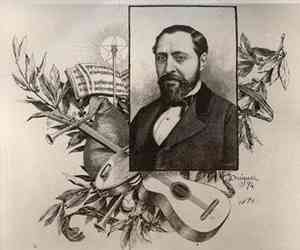
Francisco Barbieri
Source: Wikipedia
Born on 3 August 1823 in Madrid, Francisco Barbieri is an obscure composer compared to others of his period. Though hardly absent from from the realm of classical music, Spain was of less influence than the rest of Europe, particularly in comparison to France, Germany and Italy. What such as happened on the Continent where everything gravitated to Paris generally found export to England an easier and more favorable destination than the Iberian Peninsula. That excepting Italian dictate in Spain, which Barbieri was born to mute in manner more distinguishably Spanish. Barbieri was among a number of Spanish composers who at his time were beginning to make a notable contribution to both classical and Spanish music (Arrieta, Gaztambide, Oudrid). The means of this was largely via the zarzuela [Spanish] concerning which Barbieri composed above sixty, a form of drama in speech and song originating in Spain in the latter 17th century, eventually to employ elements from Italian opera, dance and popular song until it became so Italian that it wasn't Spanish anymore. Barbieri's significance in the annals of music is the replacement of the Italian influence on the zarzuela with a firm Spanish identity.
Barbieri entered the Madrid Conservatory in 1837 where with other studies he developed his skills in clarinet, piano and singing baritone. He supported his early career as a clarinetist in the Banda de Quinto Batallón de la Milicia Nacional. Also singing at fiestas, teaching piano, conducting choirs and composing songs, come the latter forties he was working as a journalist, critic and copyist. His 'Il Buontempone' of 1847 was also his debut as an operatic vocalist, though in the Italian fashion and less than successful. Barbieri later that year founded La España Musical in the interest of developing dramas distinguishably Spanish.
Barbieri's first zarzuela, 'Gloria y Peluca' ('Glory and Wig'), appeared on 9 March 1850 at the Teatro Variedades in Madrid with libretto by José de la Villa del Valle. This is the story of a hairdresser, Marselo Peluca, who too loves music for his wife, Maria, who detests it so much that she burns his scores. In this work Barbieri distinguishes the Italian from the Spanish style. Marcelo, for example, represents the Italian while Maria represents the Spanish.
'Gloria y Peluca' 1st zarzuela by Francisco Barbieri 1 act
'Glory and Wig'
Premiere 9 March 1850 at the Teatro Variedades in Madrid
Libretto: José de la Villa del Valle
Direction: Octavio J. Peidro
Marcelo: Javier Rubio Maria: Maria Macia
Castelar Theater Elda, Spain 6 April 2014
He wrote and premiered three more zarzuelas in 1850 before 'Jugar con fuego' ('Playing with Fire') was performed at the Teatro del Circo (Circus Theater) in Madrid on 6 October 1851. Somewhat alike a French opera comique, 'Jugar con Fuego' with libretto by Ventura de la Vega is identified as the first significant zarzuela in three acts of the revived form that is Spanish rather than Italian.
'Fuera, pícaro sastre' from Act 3 of 'Jugar con fuego'
5th zarzuela by Francisco Barbieri 3 acts
'Get out, you rogue tailor' from'Playing with fire'
Premiere 6 Oct 1851 at the Teatro del Circo (Circus Theater) in Madrid
Libretto: Ventura de la Vega
Coro de Locos (Chorus of Madmen) w Antonio (Julio Uribe)
Coro de Cámara del Orfeón Donostiarra de San Sebastián
Gran Orquesta Sinfónica 1955
Christopher Webber Wikipedia English Wikipedia Spanish Zarzuelarias
Barbieri premiered seven more zarzuelas before 'Los Diamantes de la Corona' was performed at the Teatro del Circo on 15 September 1854. The libretto by Francisco Camprodón was borrowed from the original opera comique of 1841 by Eugène Scribe and Jules-Henri Vernoy de Saint-Georges set to music by Daniel Auber. This tale concerns Catalina who is underage Queen Maria of Portugal who wishes to convert the crown jewels into money to help alleviate poverty in her realms. She does this, however, with phony jewels during which process the real gems are stolen. The bolero is a dance in triple time.
'Niñas que a vender flores' Bolero from 'Los Diamantes de la Corona'
13th zarzuela by Francisco Barbieri 3 acts
'Girls selling flowers' from 'The Diamonds of the Crown'
Premiere 15 Sep 1854 at the Teatro del Circo (Circus Theater) in Madrid
Libretto: Francisco Camprodón
Coro Cantores de Madrid Gran Orquesta Sinfónica Ataúlfo Argenta
En Clave de Niños IMSLP Christopher Webber
Wikipedia English Wikipedia Spanish Wikiwand
In 1856 he helped found the Teatro de la Zarzuela [Wikipedia] where he premiered his 'The Devil in Power' on 14 December. In 1861 he completed his incidental music in three acts for 'Don Quijote'. Written to commemorate the death of Miguel de Cervantes on 22 April 1616, All Music has this premiering on 23 April 1861. The bailete below is a dance in triple time.
Bailete from Act 2 of 'Don Quijote de la Mancha'
Incidental music by Francisco Barbieri 3 acts
Premiere 23 April 1861
Orquesta de la Comunidad de Madrid José Ramón Encinar
Come 'Pan y Toros' ('Bread and Bulls') at the Teatro de la Zarzuela on 22 Dec 1864. This work surrounds the Spanish painter, Goya, in the context of two rival political factions, the one being that of the patriotic Jovellanos, the other that of King Charles IV's Chief Minister, Godoy, who favors signing a treaty with the French which others contest, including Goya. As events dealing with such transpire so do both love and troubles grow between Captain Peñeranda and the Princess of Luzanne. "Bulls" in the title refer to the role of the bullfighter, Pepe-Hillo, who gets gored. Per 'Seguidillas Manchegas' below, the seguidilla [M5 Music] is a Spanish dance in triple time. "Manchega" means that it's a seguidilla from La Mancha, a region in southern central Spain.
Introducción with Seguidillas Manchegas from 'Pan y toros'
30th zarzuela by Francisco Barbieri 3 acts
'Bread and bulls'
Premiere 22 Dec 1864 at the Teatro de la Zarzuela in Madrid
Libretto: José Picón
Goya: Patricio Sabaté
Coro del Teatro Municipal Jorge Klastornick
Orquesta Filarmónica de Santiago José Fabra
Compañía de Danzas Españolas
Teatro Municipal Santiago, Chile 2008
Muziekuitgeverij Partitura IMSLP Christopher Webber
Barbieri formed the Sociedad de Conciertos de Madrid with Joaquín Gaztambide in 1866. His 'Robinson' premiered in 1870 in Madrid, that from Daniel Defoe's 1719 'Robinson Crusoe' about the desert island cast away on in the Caribbean. Barbieri's 'El Barberillo de Lavapiés' saw staging at the Teatro de la Zarzuela on 18 December 1874. Luis Mariano de Larra wrote the libretto for this romantic adventure between a barber and dentist named Lamparilla and his love who is the seamstress, Paloma.
'Ya estamos en tierra' from 'Robinson'
35th zarzuela by Francisco Barbieri 3 acts
'We're already on land'
Premiere 18 March 1870 at the Teatro del Circo (Circus Theater) in Madrid
Libretto: Rafael García Santisteban
Escolanía del Orfeón Pamplonés
Orquesta de la Comunidad de Madrid
Cristóbal Soler
Teatro de la Zarzuela Madrid 2014
'El Barberillo de Lavapiés' 42nd zarzuela by Francisco Barbieri 3 acts
Premiere 18 March 1874 at the Teatro de la Zarzuela in Madrid
Libretto: Luis Mariano de Larra
C & O del Teatro de la Zarzuela
Rondalla Lírica de Madrid
Teatro de la Zarzuela Madrid 12 April 2019
Muziekuitgeverij Partitura Christopher Webber Wikipedia
Among Barbieri's works in prose was the didactical ''Las Castanuelas' ('The Castanets')' in 1878. In 1890 he published 'Cancionero Musical de los Siglos XV y XVI']. His 59th and last zarzuela, 'Señor Luis el Tumbón', was performed on 6 May 1891 at the Apolo Theatre in Madrid with libretto by Ricardo de la Vega'. Barbieri died not long later on 19 February 1894 in Madrid.
Additional Sources & References for Francisco Barbieri:
VF History (notes)
Audio of Barbieri:
UCSB (cylinders / 1904/1910)
Collections: Discantus
Compositions: Corpora:
Contemporaries Similar:
Emilio Arrieta (zarzuela composer / 1823-93)
Iconography: Wikimedia Commons
Librettos: Corpora: Internet Archive
Librettos: Individual:
Señor Luis el Tumbón (final zarzuela 1891):
Google Books (R. Velasco / Madrid / 1891)
Internet Archive (l to r)
Internet Archive (scroll)
Recordings of Barbieri: Catalogs:
DAHR (shellac 1906-1930)
Recordings of Barbieri: Select:
El Barberillo de Lavapies (BBC Chorus Gemischter Chor / Leslie Woodgate / Royal Philharmonic Orchestra / Stanford Robinson / 2019 / review by John Groves)
Scores / Sheet Music:
Musicalics (vendor)
Señor Luis el Tumbón (final zarzuela 1891)
The Seguidilla Manchega (Dance of La Mancha):
Junta de Comunidades de Castilla-La Mancha
Further Reading:
Gilbert Chase (Barbieri and the Spanish Zarzuela / Music & Letters / 1939)
Bibliography:
Emilio Casares (Francisco Asenjo Barbieri: El hombre y el creador / Editorial Complutense / 1994)
John E. Henken (Barbieri, Francisco Asenjo / 2001)
Lionel Salter (Pan y toros (Bread and Bulls))
Authority Search: BNF Data VIAF
Other Profiles (Español):
Corporación de Radio y Televisión Española
Classical Main Menu Modern Recording
|
|