
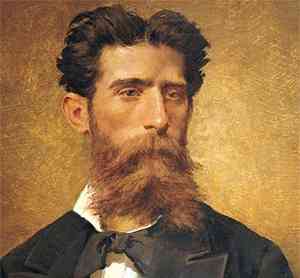
Tomás Bretón
Source: Biografia y Vidas
Born in Salamanca, Spain, on 29 December 1850, Tomás Bretón is now an obscure composer whose most immediate contemporaries were Manuel Fernández Caballero, Ruperto Chapí and Gerónimo Giménez. He wrote largely operas, zarzuelas, chamber and orchestral works. Bretón was schooled in music as a child and worked with small orchestras before heading to Madrid at age sixteen to study under Emilio Arrieta. IMSLP lists Bretón's earliest composition as 'String Quartet' in G major as of 1866. Come his symphony, 'La necesidad', in 1868. He wrote his 'Symphony No.1' dedicated to Arrieta in 1872, not to be performed until 1874.
Scherzo of 'Symphony No.1' No.3 of 4 movements G major Tomás Bretón
1872
Castilla y Leon Symphony Orchestra Jose Luis Temes
Bretón played in small outfits in Madrid while gaining exposure to zarzuela theatre. Zarzuelas [Wikipedia] are a form of drama peculiar to Spain, generally ascribed to Juan Hidalgo de Polanco as of 1658 upon his composition, 'El Laurel de Apolo'. The nationalistic zarzuela had arrived in association with the Palace of Zarzuela as an endeavor to lend the dominating Italian opera a more Spanish character. Bretón's first zarzuela is ascribed to 'Tic-Tac' of 1873.
'Guzmán el Bueno' was Bretón's initial opera, premiering at the Teatro Apolo on 25 November 1876 with libretto by Antonio Arnao. Bretón began conducting in 1878. A grant from the Academy of Fine Arts of San Fernando made it possible for him to study in Rome, Milan, Vienna and Paris from 1881 to 1884. During that time he composed both the music and libretto for his vocal oratorio 'El Apocalipsis' in 1882 followed by his 'Symphony No.2' the next year in 1883. Also composing for chamber, Bretón's 'Piano Trio' in E major was composed in 1887 toward publishing in London in 1891. Come his symphonic serenade, 'En la Alhambra', in 1888.
'El Apocalipsis' Oratorio by Tomás Bretón
1883 Libretto: Bretón
Soprano: E. Matos Contro-alto: R. Pierotti
Tenor: J. Ferrero Bass: S. Palatchi
Coral de Bilbao w the Orquesta Sinfonica de Madrid Andrés Zarzo 2000
'Symphony No.2' E-flat major Tomás Bretón
1883
Castilla y Leon Symphony Orchestra Max Bragado Darman
This album
'Piano Trio' E major Tomás Bretón
1887
Violin: Joan Orpella Piano: Daniel Ligorio Cello: José Mor
'En la Alhambra' A minor Symphonic serenade by Tomás Bretón
1888
Orquesta de la Comunidad de Madrid Miguel Roa
'Las Golondrinas' ('The Swallows') F major Song for piano and voice by Tomás Bretón
1888
Libretto: Gustavo Adolfo Bécquer
Soprano: Isabel Hernández Arrangement: Víctor Grande Escudero
Bretón's most famous zarzuela is his 28th per the list at IMSLP, and features the Spanish folk dance known as the seguidilla: 'La Verbena de la Paloma', premiering in Madrid on 17 February 1894 with a prose libretto by Ricardo de la Vega.
'La Verbena de la Paloma' ('The Shrub of the Dove') Zarzuela by Tomás Bretón
Premiere 17 Feb 1894 at the Teatro Apolo in Madrid
Libretto: Bretón
Orquesta y Coros Montilla Eugenio Marco Madrid 1994
'La Verbena de la Paloma' ('The Shrub of the Dove') Zarzuela by Tomás Bretón
Premiere 17 Feb 1894 at the Teatro Apolo in Madrid
Libretto: Bretón
Musical director: Jose A. Irastorza Calderón Theater Madrid 1995
Of Bretón's ten operas listed at IMSLP, his most highly regarded is his fourth, 'La Dolores', premiering at the Teatro de la Zarzuela in Madrid on 16 March 1895 with libretto by himself drawn from the 1892 eponymous drama by Josep Feliu i Codina. 'La Dolores' also includes a few jotas (dances), notably 'Si vas a Calatayud' from the last scene of Act I, more simply referred to as 'Le Gran' [live performance]. 'La Dolores' also includes an instrumental jota believed to have been recorded by the Trio Instrumental Arriaga in 1905 on cylinder per Edison Gold Moulded 18769 [audio].
'La Dolores' Opera by Tomás Bretón
Premiere 16 March 1895 at the Teatro de la Zarzuela in Madrid
Libretto: Bretón
Stage director: Jose Carlos Plaza Musical director: Antoni Ros-Marba
Choral director: Antonio Fauro
Choreography: Miguel Angel Berna Lighting: Francisco Leal
'Si vas a Calatayud' aka 'Le Gran' Jota by Tomás Bretón
'If You Go to Calatayud' from the opera 'La Dolores'
Premiere 16 March 1895 at the Teatro de la Zarzuela in Madrid
Monumental de Las Ventas in Madrid
Bretón was appointed Director of the Madrid Conservatory of Music in 1901, a position he would hold off and on until 1921. Among symphonic works completed during that period was 'Symphony No.3' in 1905. This work was an arrangement of his 'Piano Quintet' in G major of 1904, once thought lost but more recently found. Come Bretón's 'Violin Concerto' in A major in 1909.
'Symphony No.3' G major Tomás Bretón
1905
Castilla y Leon Symphony Orchestra Jose Luis Temes
'Violin Concerto' A minor Tomás Bretón
1909
Violin: Agustin Ara
Community Orchestra of Madrid Gloria Isabel Ramos
It was 1914 when Bretón premiered his opera with libretto by Tomás Luceño, 'Don Gil de las Calzas Verdes', at the Teatro Tívoli de Barcelona on 31 of July after three weeks of rehearsals beginning on the 9th [Sanchez / Tivoli Theatre]. It was either 1914 or 1916 when Bretón finished the opera with libretto by Jacinto Soriano, 'Las Cortes de Amor' ('El Trovador Lisardo') ['The Courts of Love' ('The Troubadour Lisardo'): score]. It was also 1914 or 1916 when he complete his fantasía musical, 'La Guitarra del Amor'. Bretón's symphonic poem, 'Salamanca', was first performed on 14 October of 1916, that dedicated to the Spanish city of Salamanca. IMSLP lists Bretón's last zarzuela as 'Fraile Fingido' ('Fake Friar') as of 1919 [score].
'Salamanca' F major Symphonic poem by Tomás Bretón
Premiere 14 Oct 1916 at St. James Hall in London w Parry conducting
Castilla y Leon Symphony Orchestra Max Bragado-Darman
Bretón was resigned from his post at the Madrid Conservatory in 1921, thereat to receive a small government pension of 3000 pesetas a year (around $20 with purchasing power at present of about $250). He died on 2 December 1923 in Madrid.
Sources & References for Tomás Bretón:
VF History (notes)
Audio of Bretón:
Classical Archives Europeana MuziekWeb
Naxos El Poder de La Palabra Presto
Compositions: Corpora: IMSLP (by genre)
Documents / Manuscripts: Europeana
Librettos:
La Dolores (opera 1895):
Biblioteca Digital de Castilla y León (1895)
CORE (1896)
CORE (1903)
Google Books (1895)
A Toda Zarzuela (1895)
Photographs: Gallica
Recordings of Bretón: Catalogs:
All Music Archiv DAHR (shellac 1901-51)
Music Brainz Rate Your MusicRecordings of Bretón: Select:
La Dolores
(opera / 1895 / Cor del Gran Teatre del Liceu and the Cor Infantil del Conservatori
de Badalona with
Rondalla y Orquestra Simfònica de Barcelona and the
Nacional de Catalunya / Antoni Ros Marbà / Elisabete Matos as Dolores / Decca / 1999)
Piano Trio in E Major | String Quartet in D Major (New Budapest String Quartet / György Oravecz / 1994):
La Verbena de la Paloma (zarzuela / 1894 / Graffiti Orchestra with the Orchestra and Chorus of the Comunidad of Madrid / Miguel Roa / Manuel Cloves at piano / Decca DVD 0743262 / 2008)
Scores / Sheet Music:
Abe Books (vendor)
Musicalics (vendor)
MusOpen (Chinese)
Further Reading:
IMDb (usage of Bretón in film)
Musical Expression and Spanish Nationalism in Selected Works of Tomás Bretón (Brent M. Darnold / Marshall University / 2018)
Authority Search: BNF Data
Other Profiles:
Spanish:
Wikipedia International: Catalan Dutch French German Portuguese
Classical Main Menu Modern Recording
|
|