
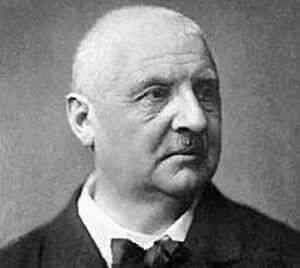
Anton Bruckner
Source: Wiener Sängerknaben
Born on 4 September 1824 in Ansfelden, Austria, Anton Bruckner's greatest influences would be Beethoven and Richard Wagner. The heroic qualities of some of his music much thereat derived, Bruckner joined Wagner as a composer sanctioned acceptable by the much later Nazi regime in Germany.
Bruckner had learned to play organ by the time he wrote his first composition which was the sacred motet, 'Pange Lingua' ('Tell, My Tongue') WAV 31 circa 1835 at age eleven [IMSLP]. Fifty six years later he would apply himself to its revision in 1891. In the meantime he would write another version in 1868. Text for the 'Pange lingua gloriosi corporis mysterium' is attributed to St. Thomas Aquinas (1225-74) for the Feast of Corpus Christie. Which is an apt way to commence this account of Bruckner, his major works other than symphonies being Catholic sacred music.
'Pange Lingua' WAB 31 Sacred motet by Anton Bruckner
First composition c 1835 For SATB
Text: St. Thomas Aquinas c 1264
b.choired of Linz / Hans Baumgartner / 26 April 2014
'Pange Lingua' WAB 31 Sacred motet by Anton Bruckner
19 April 1891 For SATB
Text: St. Thomas Aquinas c 1264
Chinese University of Hong Kong Chorus / Leon Chu
Bruckner's father had been a schoolmaster but died in 1837, prompting his mother to send him to an Augustinian monastery in Sankt Florian to become a choirboy at age thirteen. His first employment was as a teacher's assistant (not music) in Kronstorf in 1843. While there he wrote three settings to the 'Asperges Me' which is sung at High Mass with its text from 'Psalm 51'. The first of those was 'Asperges Me' WAB 4 composed sometime 1843-44 [IMSLP]. WAB 3 'Two Asperges Me' (3.1 & 3.2), followed sometime 1844-45 [IMSLP / score]. As can be seen, WAB numbers do not reflect chronological order, the source of which is the 'Werkverzeichnis Anton Bruckner' by Renate Grasberger 1977. Asperges is the rite of sprinkling the congregation with holy water.
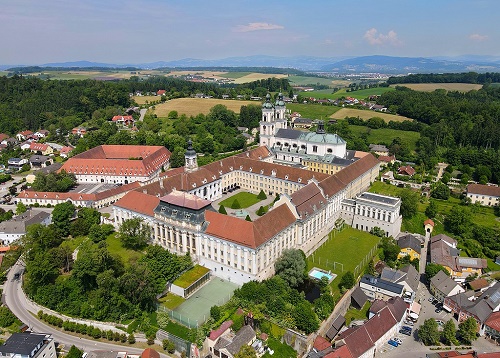
Saint Florian Monastery
Source: Wikipdia
'Asperges Me' WAB 4 Sacred motet by Anton Bruckner
Sometime 1843-44 in Kronstorf Text from 'Psalm 51'
Philipp von Steinaecker
Returning to Sankt Florian from Kronstorf in 1845, if not in Kronstorf then at St. Florian Bruckner composed his first of eight settings to the 'Tantum ergo', assigned to WAB 32 [IMSLP / Jameson] in autumn of 1845, about the same time as 'Tantum ergo' WAB 43 [IMSLP]. Other settings followed in 1846 to see revision in 1888 (WAB 41 and 42), and 1856 (WAB 44). 'Tantum ergo' is the incipit of the last two verses of the 'Pange Lingua'.
'Tantum ergo' WAB 43 Hymn by Anton Bruckner
C 1845 at either Kronstorf or St. Florian Abby
Latvian Radio Choir / Sigvards Kļava / 2020
Bruckner's 'Requiem' in D minor WAB 39 arrived in 1849. This was written in memory of a friend of his father's, Franz Sailor, who had left him a Bösendorfer piano when he died. Bruckner's earlier 'Requiem' WAB 135 of 1845 was lost. His later 'Requiem' WAB 141 of 1875 was left incomplete.
'Requiem' D minor WAB 39 Death mass by Anton Bruckner
15 September 1849 at the St. Florian Monastery
For the 1st anniversary of the death of Franz Sailer
Gemischter Chor Biberist / Contrapunkt Chor
Ad Hoc Orchester / Maija Breiksa
Soprano: Ilze Paegle
Bruckner's 'Missa solemnis' WAB 29 was performed on 14 September 1854 at the St. Florian Monastery for the installation of Friedrich Mayer as its new abbot. In 1855 Buckner became a student, largely via correspondence, of composer, Simon Sechter, though he also visited Sechter in Vienna (Wien).
'Missa solemnis' B-flat minor WAB 29
Solemn mass by Anton Bruckner
C & O of the Bamberg Symphony / Karl Anton Rickenbacher
Come Bruckner's first of three settings to the 'Ave Maria' WAB 5 in 1856, performed in Sankt Florian on 6 October. He met fellow Catholic, Franz Liszt, in 1861 before his most noted 'Ave Maria', WAB 6, his second, was performed in Linz on 12 May 1861. Bruckner wrote his third 'Ave Maria', WAB 7, in 1882.
'Ave Marie' WAB 5 'Hail Mary' by Anton Bruckner
Premiere 6 Oct 1856 at St. Florian
Dresdner Kreuzchor / Martin Flamig
Wikiwand
'Ave Marie' WAB 6 'Hail Mary' by Anton Bruckner
Premiere 12 May 1861 in Linz
C & O of the Berlin Philharmonic / Eugen Jochum
IMSLP Wikipedia Musical Musings Score Score
WAB 1, the first composition in the Grasberger directory, didn't arrive until 1861, that the offertory, 'Afferentur regi' in F major, premiering on 31 December at the St. Florian Abbey. The offertory in Roman Catholic services is the placement of the bread and wine on the alter. It often coincides with the collection of alms from the congregation.
'Afferentur regi' WAB 1 Motet by Anton Bruckner
Premiere 21 Dec 1861 at the St. Florian Abbey
SWR Vokalensemble Stuttgart / Marcus Creed
Bruckner's mother had died in 1860, after which he'd begun to study with Otto Kitzler in 1861, the year of his second 'Ave Maria' WAB 6. Among the results of working with Kitzler was his first symphony, the 'Study Symphony' in F minor No.00, composed between January and May of 1863. Although this work is highly regarded, Bruckner considered it a study and gave it small attention. It didn't see a performance until well after Bruckner's death, its second movement only played and published in 1913. The entire work was eventually performed in 1924 but not published until 1973.
'Symphony No.00' F minor WAB 99 Anton Bruckner
'Study Symphony' Composed 1863
Premiere of second movement 31 Oct 1913
Premiere of entirety 18 March 1924
Royal Scottish National Orchestra / Georg Tintner
Bruckner's 'Mass No.1' in D minor WAB 26 saw performance in Linz on 20 November 1864. This is another highly regarded work by Bruckner. His 'Mass No.2' followed in 1866 before his third in 1868, each of them subject to multiple revisions through the years.
'Mass No.1' D minor WAB 26 Anton Bruckner
Premiere 20 Nov 1864 in Linz
DePaul Community Chorus
Oistrach Symphony Orchestra / Stephen Blackwelder
Gloria to 'Mass No.2' E minor WAB 27 Anton Bruckner
1866 Revised 1869 / 76 / 82
C & O of the Russian State Symphonic / Valeri Polyansky
Bruckner set the 'Pange lingua' to music again in 1868, composing WAB 33 in Linz on 31 January. This piece was eventually published in 1885 but not performed until 18 August of 1890 in Steyr, Austria.
'Pange lingua' WAB 33 Anton Bruckner
31 Jan 1868 in Linz
Worcester Cathedral Choir / Donald Hunt
IMSLP Score Wikipedia Wikiwand
Bruckner's 'Symphony No.1' (aka 'The Saucy Maid') in C minor WAB 101 premiered in Linz on 9 May 1868, having written the first draft for that in 1865. Bruckner would bequeath this work to the Austrian National Library.
'Symphony No.1' C minor WAB 101 Anton Bruckner
'The Saucy Maid'
Premiere 9 May 1868 in Linz
Frankfurt Radio Symphony Orchestra Paavo Järvi
Due to Sechter's death in 1867 Bruckner was tempted beyond his accustomed realm to assume his post in music theory at the Vienna Conservatory in 1868. He took another plunge into less familiar waters in 1869, giving recitals in Paris, he a virtuoso at organ. Finding the water warm, he then took his talents to London in 1871. In the meantime came his 'Symphony No.0' in D minor WAB 100 of uncertain date in 1869 which he didn't like, giving it No.0 for an opus number.
'Symphony No.0' D minor WAB 100 Anton Bruckner
'Die Nullte' Composed 1869
Frankfurt Radio Symphony Orchestra Paavo Järvi 24 March 2017
Due to a couple of symphonies denied enough merit to officially exist by Bruckner, his fourth symphony was his 'Symphony No.2' (aka 'Symphony of Pauses') which premiered 26 October 1873 in Vienna. Bruckner wrote two versions of this work which didn't receive overmuch appreciation. Version 1 had been composed in 1872, revised in 1873 and 1876. Version 2 arrived in 1877 toward revision in 1892 when it was published. Liszt preferred that it not be dedicated to him, and Wagner preferred 'Symphony No.3' upon being presented a choice, so Bruckner dedicated it to no one.
'Symphony No.2' C minor WAB 102 Anton Bruckner
Version 2 composed 1877 Revised 1892
Saarbrücken Radio Symphony Orchestra / Stanislaw Skrowaczewski
IMSLP Michael Jameson Stephen Johnson
José Oscar de Almeida Marques Georg Predota Wikipedia
His fifth symphony, 'Symphony No.3' in D minor was composed in 1873, revised in 1877 and 1889. That was his 'Wagner Symphony', another highly regarded work which Wagner, a drinking companion, preferred to 'Symphony No.2'.
Finale to 'Symphony No.3' D minor WAB 103 Anton Bruckner
Premiere 16 Dec 1877 in Vienna Revised 1877 / 89
North German Radio Symphony Orchestra / Hans Schmidt-Isserstedt
Hamburg 1966
Alan Beggerow Hyperion IMSLP Michael Jameson Wikipedia
Bruckner's was a lifelong bachelor, though his diaries included long lists of teenage girls to whom he was attracted, such also notable on an 1874 calendar of his, the year he composed his 'Symphony No.4' (aka 'Romantic' as named by himself) in E-flat major WAB 104. Bruckner revised this until 1888 beyond its premiere by the Vienna Philharmonic conducted by Hans Richter on 20 February 1881.
'Symphony No.4' E-flat minor WAB 104 Anton Bruckner
'The Romantic'
Premiere 20 Feb 1881 in Vienna Revised to 1888
WDR Symphony Orchestra / Marek Janowski
Bryan Gilliam IMSLP LA Phil Wikipedia
In 1875 Bruckner began teaching at Vienna University. He began working on his 'Symphony No.5 in 1875 toward its completion in 1876. Bruckner referred to this tragic work as his "fantastic" but it didn't premiere until 20 April 1887 in Vienna, that on two pianos played by Joseph Schalk and Franz Zottmann. Its premiere by orchestra didn't arrive until 8 April 1894 in Groz conducted by Schalk who also revised it in 1896.
'Symphony No.5' B-flat minor WAB 105 Anton Bruckner
Composed 1875-76 Revised to 1878
Premiere 8 April 1894 in Graz
WDR Symphony Orchestra / Marek Janowski 24 Nov 2023
BBC Classical Music IMSLP Marlia Nash David Nice Wikipedia
Bruckner's 1876 'Symphonisches Praeludium' ('Symphonic Prelude') in C Minor was discovered in 1948 by Heinrich Tschuppik in the estate of Bruckner's pupil, Rudolf Krzyzanowski. Having been credited to Gustav Mahler for some years, it is since agreed to be by Bruckner, what uncertain portions of it that he wrote sufficient to reveal early traces of his ninth symphony and last composition, 'Helgoland'.
'Symphonisches Praeludium' C minor WAB add 332
Overture by Anton Bruckner
Composed sometime 1876
Luxembourg Military Band Lieutenant Colonel Jean Claude Braun
Benjamin-Gunnar Cohrs 2006 Benjamin-Gunnar Cohrs 2010 Wikipedia
Bruckner's song, 'Abendzauber' ('Evening Magic') WAB 57, premiered in Vienna on 13 February of 1878 with lyrics by Heinrich von der Mattig.
'Abendzauber' WAB 57 Song by Anton Bruckner
Composed 13 Jan 1878 in Vienna
Not performed in Bruckner's lifetime
Set to text by Heinrich von der Mattig
Camerata Musica Limburg w Christoph Prégardien (tenor)
Jan Schumacher
Bruckner began working on his 'Symphony No.6', WAB 106, on 24 September 1879 toward its completion on 3 September 1881. This he dedicated to his landlord, Anton van Ölzelt-Newin. The work wasn't performed until posthumously on 26 February 1899 in Graz conducted by Mahler.
'Symphony No.6' A major WAB 106 Anton Bruckner
Composed 1879-81 Revised 1896 by Shalk
Performed posthumously on 26 Feb 1899 in Vienna by Mahler
Frankfurt Radio Symphony Orchestra Christoph Eschenbach
Bruckner finished his third 'Ave Maria', WAB 7 [IMSLP], in Vienna on 5 February of 1882. Come his 'Symphony No.7' in 1883, revised in 1885. This is considered one of Bruckner's better symphonies, premiering on 30 December 1884 in Leipzig conducted by Arthur Nikisch.
'Ave Maria' WAB 7 'Hail Mary' by Anton Bruckner
Composed 5 Feb 1882 for alto and organ
Marie Keyrouz
'Symphony No.7' E major WAB 107 Anton Bruckner
Premiere 30 Dec 1884 at the Stadttheater in Leipzig
Staatskapelle Dresden Eugen Jochum Dec 1976
Steve Lacoste Marianne Williams Tobias Wikipedia
Bruckner's 'Te Deum' WAB 45 premiered at the Kleine Musikvereinssaal in Vienna on 2 May of 1885, a work he'd put to draft in 1881 toward dedication to the Society of Jesus (Jesuits). The 'Te Deum' (incipit: "Te Deum laudamus": "Thee, God, do we praise") is among the oldest Catholic hymns, believed to have been written in the 4th century by an unidentified author.
'Te Deum' E major WAB 107 Anton Bruckner
Premiere 30 Dec 1884 at the Stadttheater in Leipzig
Staatskapelle Dresden Eugen Jochum Dec 1976
Hyperion IMSLP Score Wikipedia
Bruckner's final completed symphony, 'Symphony No.8' in D minor WAB 108 arrived in 1887 toward an unsuccessful revision in 1888. A second version was finished in 1890 to premiere on 18 December 1892 in Vienna. It had already been published in March in dedication to Emperor Franz Joseph I of Austria.
'Symphony No. 8' C minor WAB 108 Anton Bruckner
Version 2 1890 Dedicated to Emperor Franz Joseph I of Austria
BBC Scottish Symphony Orchestra Donald Runnicles
Royal Albert Hall / 3 Aug 2012
Herbert Glass IMSLP Susan Lewis Tom Service Wikipedia
Bruckner's final symphony, 'Symphony No.9' in D minor had been left unfinished with parts of its finale missing in 1896, having been at work on it since 1887. He'd dedicated that to God.
'Symphony No. 9' D minor WAB 109 Anton Bruckner
Composed 1887-96 Unfinished with gaps in finale
Performed in 1903 in Vienna by Ferdinand Löwe
Orchestre National de France / Bernard Haitink
Franziska Gallusser Herbert Glass
IMSLP Aart van der Wal Wikipedia
Bruckner retired from Vienna University in 1891/92 with an honorary doctorate in philosophy. He completed his patriotic 'Der deutsche Gesang' WAB 63 in Vienna on 29 April 1892. This song with a text by Erich Fels (pseudonym of Aurelius Polzer) saw conducting in Salzburg by Raoul Mader on 5 June 1892. Bruckner's patriotic 'Helgoland' WAB 71 was his final composition as of April 1893 toward its performance on 8 October of 1893 at Vienna's Hofburg Palace by the Men's Choir of Vienna to which he dedicated the piece. Backed by the Vienna Philharmonic Orchestra conducted by Eduard Kremser, text had been supplied by August Silberstein.
'Der deutsche Gesang' WAB 63 Patriotic song by Anton Bruckner
Composed 29 April 1892
Premiere 5 June 1892 in Salzburg by Raoul Mader
Text by Aurelius Polzer as Erich Fels
Orchestre National de France / Bernard Haitink
'Helgoland' WAB 71 Patriotic song by Anton Bruckner
Final composition sometime April 1893
Premiere 8 Oct 1893 at the Hofburg Palace in Vienna
Text by August Silberstein
Ambrosian Male Voice Chorus / Symphonica of London / Wyn Morris
Bruckner died in Vienna on 11 October 1896.
Sources & References for Anton Bruckner:
VF History (notes)
Audio of Bruckner:
BBC Classical Archives Hyperion Idagio Naxos Presto
Der Deutsche Gesang (The German Song / WAB 63 / 1892)
O Lord Most Holy (from Ave Maria WAB 6 / 1861 / San Francisco Theological Semenary A Cappella Choir c 1949-50)
Tantum ergo (WAB 32 / 1845)
Chronology: Bruckner Online
Collections: Bruckner Online
Compositions:
ABRUCKNER (date to WAB)
ABRUCKNER (WAB to date)
Bruckner Online (WAB)
Bruckner Online (WAB: old v new cross reference)
Classic Cat (date / WAB)
IMSLP:
Pedia Press (date / genre / WAB)
RYM (date / genre / WAB)
Symphonies:
Wikipedia (date / genre / key / title / WAB)
Wikiwand (date / genre / key / title / WAB)
Wikizero (date / genre / key / title / WAB)
Recordings of Bruckner: Discos:
Ave Maria (WAB 6 / 1861)
Ave Maria (WAB 7 / 1882)
DAHR (shellac / 1935)
Recordings of Bruckner: Select:
Anton Bruckner: Missa Solemnis (Berlin RIAS Chamber Choir / Akademie für Alte Musik Berlin / Łukasz Borowicz / 2018):
All Music High Res Audio MusicWeb International
NaxosAnton Bruckner: Symphonisches Praeludium | Mass No. 3 (Houston Symphony Chorus / Moores School Symphony Orchestra / Franz Anton Krager / 2013)
Anton Bruckner: Symphony No.2 in C minor (Orchestre de la Suisse Romande / Marek Janowski / 2013)
Bruckner: Symphony 1 (Lucerne Festival Orchestra / Claudio Abbado / Accentus / 2016)
Bruckner: Symphony 2 (Cologne Radio Symphony Orchestra / Günter Wand / 1981)
Bruckner · Symphony No. 3 (Gewandhausorchester Leipzig / Andris Nelsons / Deutsche Grammophon 4797208 / 2017)
Mass No.2 & Te Deum (Collegium Vocale Gent / Orchestre des Champs-Élysées / Philippe Herreweghe / 2020)
Symphony D Minor "Nullte" WAB 100 (Beethoven Orchester Bonn / Stefan Blunier / 2011)
Symphony No. 00, Study Symphony (Royal Scottish National Orchestra / Georg Tintner / Naxos 8.554432 / 2000)
Saint Florian Monastery:
Keith Jenkins Karen Turner Michael Turtle Wikipedia
Scores / Sheet Music:
Abe Books (vendor)
(choral works)Musicological Publishing House (complete editions)
Musicalics (vendor)
(vendor)Further Reading:
Leon Botstein (Bruckner's Journey)
Gabriel Engel (The Life of Anton Bruckner)
David B. Hart (The Music of Eternity)
Yan Xing Lee (Why Listen to Bruckner? / video)
Tom Service (Sex, death and dissonance: the strange, obsessive world of Anton Bruckner / 2014)
Wikipedia (Bruckner Orchestra Linz)
Werner Wolff (Anton Bruckner: Rustic Genius / E.P. Dutton & Co. / 1942)
Yutaka Yamada (Anthropology of Japan)
Bruckner's Symphonies:
William Carragan (analysis: arch structure)
William Carragan (analysis: three-theme exposition)
William Carragan (timed analyses)
Ebbe Torring (Recapitulation Procedures in Bruckner's Symphonies / 2009)
Bibliography:
Paul Hawkshaw (The Date of Bruckner's "Nullified" Symphony in D Minor / 19th-Century Music Vol 6 No.3 / University of California /1983)
Howie / Hawkshaw / Jackson (Perspectives on Anton Bruckner / Routledge / 2017)
Authority Search: BNF Data VIAF
Other Profiles:
Bobb Edwards (Find a Grave)
Wikipedia International: French German Spanish
Classical Main Menu Modern Recording
|
|