
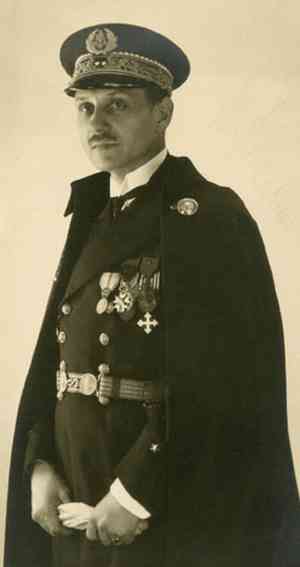
Jean Émile Paul Cras
Source: Dimitri Tiomkin
Born on 22 May 1879 in Brest, Brittany, Jean Émile Paul Cras composed largely for chamber, piano and voice, as well as some some orchestral pieces. Though he was a fringe composer he something personifies the post-Romantic as adventure, he himself in terms of the military, travel and the sea. Though more a melodic poet than composer of heroics, Cras actually did such as about which heroic Romantics made a fuss. He joined the French navy at age seventeen, such that his catalogue of works is relatively brief since his military career left him little time for composing. He was self-taught until age twenty when he acquired a mentor in Henri Duparc in 1900 who later recommended him to organist, Alexandre Guilmant.
Cras began writing songs in 1892. Paul-André Bempéchat includes 37 titles in 'Mélodies de Jeunesse 1892-1901'. Wikipedia finds Crass composing other titles prior to both meeting Duparc and the twentieth century. In 1899 he authored 'Panis Angelicus', a motet which he dedicated to his elder sister, Gabrielle, a soprano. He also completed 'Voyage Symbolique' in 1899, a piece for piano, violin and cello.
'Panis Angelicus' ('Bread Angelic') Jean Cras
Comp completed Aug 1899
Organ: Pierre Farago Soprano: Sophie Marin-Degor
Among works completed by Cras in 1900 were poems, sonatas and an 'Impromptu Pastoral'. In 1901 he set a couple of poems to music which would get published with five others in 'Sept Mélodies' in 1909. Those were 'Douceur du soir' by Georges Rodenbach and 'Correspondences' by Charles Baudelaire. 'Petite pièce en fa mineur' for piano and 'Andante religieux' for orchestra were also finished in 1901.
'Correspondences' Jean Cras Music set to Charles Baudelaire
No.7 of 'Sept Melodies' pub 1909
Comp completed Aug 1899
Organ: Pierre Farago Soprano: Sophie Marin-Degor
In 1902 Cras set music to a couple of poems which would get published with three others in 'Poèmes Intimes' ('Intimate Poems') of 1912.
'Poèmes Intimes' ('Intimate Poems') Jean Cras
1. 'En Islande' ('In Iceland') 1902
2. 'Preludio con Fughetta' ('Prelude with Fughetta') 1902
3. 'Au fil de l'eau' ('Along the Water') 1911
4. 'Recueillement' ('Contemplation') 1904
5. 'La maison du matin' ('The Morning House') 1911
Pub 1912 in Paris
Piano: Jean-Pierre Ferey
In 1903 Cras wrote a couple more songs later included in 'Sept Mélodies' of 1909. In 1904 'Recueillement' was composed toward later inclusion in 'Poèmes Intimes' of 1912. He also finished 'Valse en mi majeur' for piano and 'Chorale' for organ as well as 'Grande Marche Nuptiale'. In 1905 'Mains Lasses' was completed toward 'Intimate Poems' of 1912. He also composed 'Ave Verum' for voice, violin and organ or harmonium. In 1907 Cras wrote a "Trio in C' for piano, violin and cello, then began 'Deuxième messe à 4 voix' which he finished in 1908.
'Marche Nuptial' ('Wedding March') Jean Cras
Comp completed 1904
Organ: Vincent Rigot
'Main Lasses' ('Weary Hands') Jean Cras Music set to Georges Rodenbach
No.2 of 'Sept Melodies' pub 1909
Comp completed 1905
Baritone: Philippe Cantor Piano: Laurent Wagschal
Cras had seen battle on both sides of the Atlantic before being promoted to Lieutenant in 1908. The next year he authored 'Regina Coeli' ('Queen of Heaven') for voice and orchestra. Come 'Ave maria' for voice and organ in August 1910, the same year that Cras set four poems by Albert Samain to music in 'Elégies'.
'Regina Coeli' ('Queen of Heaven') Jean Cras
Comp completed 1909 Pub 1914
Le Madrigal de Paris / Pierre Calmelet Organ: Vincent Rigot
'Soir' ('Evening') Jean Cras Music set to Albert Samain
No.3 of 4 of 'Elégies'
Comp completed 1910 Pub 1912
Bretagne Orchestra / Claude Schnitzler Tenor: Philippe Do
In 1911 Crass completed a couple of songs toward 'Poèmes Intimes' published the next year. During World War I he worked in submarine defense, then commanded a torpedo boat as of 1916. In 1917 he composed 'Deux Paysages' ('Two Landscapes'), 'Danze'. 'Quatre Danze' and 'Âmes d'enfants' ('Souls of Children') for piano six hands which he orchestrated in 1918, then wrote a version for four hands in 1922.
'Maritime' Jean Cras
No.1 of 'Deux Paysages' ('Two Landscapes')
Comp completed 1917 Pub 1920
Piano: Eric Le Sage
'Champêtre' ('Rural') Jean Cras
No.2 of 'Deux Paysages' ('Two Landscapes')
Comp completed 1917 Pub 1920
Piano: Alain Jacquon 2004
'Quatre Danze' Jean Cras
1. 'Danza Morbida' ('Soft Dance')
2. 'Danza Scherzosa' ('Playful Dance')
3. 'Danza Tenera' ('Gentle Dance')
4. 'Danza Animata' ('Animated Dance')
Comp completed 1917 Pub 1920 in Paris
Piano: Alain Jacquon 2004
Cras had composed his opera with libretto by Albert Samain, 'Polyphème', during the Great War from 1912 to 1918, though it didn't premiere until December 1922 after winning the first Ville de Paris Prize in 1921. 'Polyphème' is a tale of love rejected by one Galatée who prefers Acis to Polyphème.
'Interlude' Opera by Jean Cras
From Act I of 'Polyphème' composed 1912-1918 Pub 1922
Luxembourg Philharmonic Orchestra / Bramwell Tovey
Cras wrote the first of 'Quatre petites pièces pour violon et piano' in 1926 in dedication to his 8 year-old son, Jean-Pierre. He wrote three more for his son in 1927, 1928 and 1929. Meanwhile, come Cras's impressionistic chamber rhapsody, 'Légende' for violoncelle et orchestra', in 1927.
'Habanera' ('Havana') Jean Cras
No.2 of 'Quatre petites pièces pour violon et piano' composed 1926-1929
Piano: Jean-Pierre Ferey Violin: Marie-Annick Nicolas
'Légende' A-flat major Jean Cras
Comp: 24 June 1929 Premiere 29 March 1930 at the Concert Pasdeloup in Paris Pub 1930
Luxembourg Philharmonic Orchestra / Jean-Francois Antonioli
Cello: Henri Demarquette
Cras was made Major General of the Port of Brest in 1931, the year he completed his 'Piano Concerto', and was later promoted to Rear Admiral. During the final year of his life he finished 'Trois Chansons Bretonnes' and 'Deux Chansons' consisting of 'Le Roi Loudivic' and 'Chanson du Barde'.
'Piano Concerto' Jean Cras
Comp: 1931 Pub: 1932
Luxembourg Philharmonic Orchestra / Jean-Francois Antonioli
Piano: Alain Jacquon
'Trois Chansons Bretonnes' Jean Cras 1932
1. 'La Rencontre' ('The Encounter')
2. 'L'Aveu' ('The Confession')
3. 'La Mort' ('The Death')
Piano: Aurélien Richard Soprano: Roxane Chalard
Musée de Pont-Aven 29 June 2023
'Le Roi Loudivic' Jean Cras Music set to Tanguy Malmanche 1932
No.1 of 'Deux Chansons'
Piano: Alain Jacquon Baritone: Lionel Peintre
'Chanson du Barde' Jean Cras Music set to Tanguy Malmanche 1932
No.2 of 'Deux Chansons'
Piano: Alain Jacquon Baritone: Lionel Peintre
Cras died in Brest on 14 September 1932.
Sources & References for Jean Émile Paul Cras:
VF History (notes)
Audio of Cras: Corpora: Classical Archives earsense Hyperion Naxos Presto YouTube
Audio of Cras: Individual:
Maritime (No.1 of Deux Paysages / 1917 / piano by Jean Dubé / 2012)
(No.2 of Deux Paysages / 1917 / piano by Jean Dubé / 2012)Autographs / Documents / Manuscripts: BNF Gallica
Compositions:
Paul-André Bempéchat (songs 1892-1901)
Fandom (by genre)
IMSLP (by title)
Klassika (by date / genre / title)
Wikipedia English (by genre)
Wikipedia Español (by genre)
ウィキペディア日本語版 (by genre)
Discussion: Good Music Guide
Iconography: Wikimedia Commons
Lyrics / Texts: Emily Ezust (LiederNet)
Recordings of Cras: Catalogs (see also Audio above):
Qobuz Rate Your MusicRecordings of Cras: Select:
Polyphème (opera / Luxembourg Philharmonic Orchestra / Bramwell Tovey / Timpani 3C3078 / 2003)
Scores / Sheet Music:
Abe Books (vendor / Amazon subsidiary)
Musicalics (vendor)
Bibliography:
Paul-André Bempéchat (Jean Cras: Polymath of Music and Letters / Routledge / 2017)
Wanda Brister (Mélodies de Jeunesse: The Early Songs, 1892–1901 / Music Library Association / Vol 79 No.2 / 2022)
Authority Search: BNF Data
Other Profiles: Robert Cummings (All Music) War Composers Википедия Русская
Classical Main Menu Modern Recording
|
|