
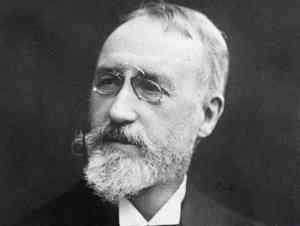
Théodore Dubois
Source: American Pink
Born on 24 August 1837 in Rosnay in northeastern France, Théodore Dubois wrote works for chamber, orchestra and operas along with a couple ballets and sacred music including masses. Among the more obscure composers, Dubois is an apt example of firm French academia during the Romantic period. He initially studied at Reims cathedral under Louis Fanart, then the Paris Conservatoire under composer, Ambroise Thomas ('Mignon', 'Hamlet'). Winning the Prix de Rome scholarship in 1861 found Dubois studying in Italy. Returning to Paris in 1866, Dubois became choirmaster at the Basilica of Sainte-Clotilde where he wrote his oratorio, 'The Seven Last Words of Christ' in 1867. The final movement of nine of that is the prayer, 'Adoramus te, Christe' ('Christ, We Do All Adore Thee'), the original Latin text of which may well precede 990 AD by an unknown author. It was translated into English by Theodore Baker in 1899.
'Adoramus te, Christe' ('Christ, We Do All Adore Thee') Théodore Dubois
Conclusion to the oratorio 'The Seven Last Words of Christ' 1867
Text by anonymous English by Theodore Baker 1899
The Diligam Ensemble / Chambersburg PA
General Board of Discipleship of the United Methodist Church IMSLP
'Adoramus te, Christe' ('Christ, We Do All Adore Thee') Théodore Dubois
Conclusion to the oratorio 'The Seven Last Words of Christ' 1867
Michael Eldridge
General Board of Discipleship of the United Methodist Church IMSLP
Dubois joined the National Guard upon the outbreak of the Franco-Prussian War in 1870. He became a founding member of the Société Nationale de Musique in 1871, the year he began teaching at the Paris Conservatoire, becoming choirmaster at the Church of the Madeleine as well. He there assumed his close friend, Saint-Saens', position as organist in 1877. Dubois premiered his oratorio, his 'Le Paradis Perdu', in Paris in 1878. Eight years later he published 'Douze Pieces pour Orgue' (Twelve Pieces for Organ') in 1886. Among his masses, he finished 'Messe Breve in F' in 1893 toward publishing circa 1900.
'Le Paradis Perdu' ('Paradise Lost') Oratorio by Théodore Dubois
Premiere 27 Nov 1878 in Paris
Libretto: Édouard Blau (1836-1906) after John Milton's eponymous poem of 1667
Les Siècles w Les Cris de Paris / Geoffroy Jourdain
'Toccata' G major Théodore Dubois 1889 Pub 1886
Organ: David Patrick
'Messa Breve' F major Mass by Théodore Dubois 1889 Pub c 1900
Camerata Instrumentale / Johanneschor Oldenburg
In 1896 Dubois relieved Thomas (above) as director of the Paris Conservatoire until 1905. His five prose works in theory include his academic 'Treatise on Counterpoint and Fugue' published in 1901 in Paris by Heugel [IMSLP]. Of Dubois' three symphonies, his first, 'Symphonie Francaise', arrived in 1908. His second saw print in 1913 (Heugel). He dedicated his third symphony to Saint-Saens in 1915.
'Piano Concerto No.2' F minor Théodore Dubois
Pub 1897 Premiere 30 Jan 1898 at the Paris Opea
Les Siècles / François-Xavier Roth
'Piano Quartet' A minor Théodore Dubois Pub 1904
Violin: Matthew Vousé Viola: Hannah Wendorf
Cello: Elmer Carter Piano: Tsz Yan Chau
San Francisco Conservatory of Music 1 Dec 2023
'Cello Sonata' D major Théodore Dubois 1905 Pub 1906
Cello: Yasutaka Takeuchi Piano: Satomi Hayakawa
San Francisco Conservatory of Music 1 Dec 2023
'Symphonie Française' F minor Théodore Dubois
Pub 1908 Premiere Nov 1909
Les Siècles / François-Xavier Roth
Bru Zane Palace Classical Music Guide Fugue for Thought
IMSLP Musikproduktion Jürgen Höflich
'Symphonie No.2' D major Théodore Dubois
1911 Pub 1913
Brussels Philharmonic / Hervé Niquet
'Symphonie No.3 A minor Théodore Dubois
Pub 1915
Jupiter Symphony Orchestra / Jens Nygaard
Dubois authored several more works including a quartet, a waltz and some hymns before passing away on 11 June 1924 in Paris, preceded by his wife the year before, by Saint-Saens in 1921.
Sources & References for Théodore Dubois:
VF History (notes) Wikipedia English
Audio of Dubois: Corpora:
Dubois Association (Français)
MuziekWeb (Dutch)
Authorship (5 works in theory): Wikipedia
Treatise on Counterpoint and Fugue / 1901:
Gallica Google Books IMSLP Internet Archive
Compositions: Corpora:
Bru Zane Mediabase (Français)
Dubois Association (Français)
Klassika (Deutsch)
Iconography: Dubois Association (Français) Wikimedia Commons
Recordings of Dubois: Catalogs:
DAHR (shellac / 1906-33)
Dubois Association (Français)
Recordings of Dubois: Select:
Concerto-capriccioso / Piano Concerto No 2 / Suite for piano and string orchestra (BBC Scottish Symphony Orchestra / Andrew Manze / Cédric Tiberghien at piano)
Musique de Chambre (Benôit Loiselle [cello] / Stéphane Lemelin [piano] / Anne Robert [violin] / ATMA Classique 2008)
Scores / Sheet Music:
Abe Books (vendor)
(Français) (w iconography)Musicalics (vendor)
Authority Search:
BMLO (Bayerischen Musiker-Lexikon Online) BNF Data
Other Profiles:
Dubois Association (Français)
Musica et Memoria (Français)
Riemann's Dictionary of Music (Pусский)
Wikipedia: Español Français Italiano Pусский
Classical Main Menu Modern Recording
|
|