
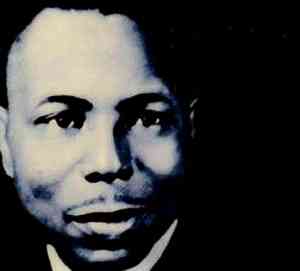
Jazz Gillum
Source: Zen Guitar Blues
Harmonica player, William McKinley, who recorded as Bill Gillum aka Jazz Gillum, was born in Indianola, Mississippi, on 11 September 1904. In Gillum one heard early blues transitioning toward modern about the period that swing jazz was at its height. Gillum ran away from home at age seven to Charleston, Mississippi, where he began busking. He left Mississippi for Chicago in 1923 where he began his professional career with Big Bill Broonzy. Broonzy likely backed Gillum with Black Bob on June 14, 1934, to record 'Early in the Morning' / 'Harmonica Stomp' (Bluebird B5565).
'Early In the Morning' Bill Gillum
14 June 1934 in Chicago Matrix 80612-1 Bluebird B-5565
Piano: Black Bob Guitar: Bill Broonzy
Composition: Bill Gillum
'Harmonica Stomp' Bill Gillum
14 June 1934 in Chicago Matrix 80612-1 Bluebird B-5565
Piano: Black Bob Guitar: Bill Broonzy
Composition: Bill Gillum
American Music (AM) finds Gillum with the State Street Boys on January 10 of 1935 for 'She Caught the Train' (OKeh 8962) and 'Crazy About You' (OKeh 8964). At this point Wirz begins to list Bill Gillum as Jazz Gillum. Members of the band on those titles were variously Broonzy, Bill Settles, Black Bob, Carl Martin or Zeb Wright. In 1936 Gillum issued his name titles 'Jockey Blues' / 'Don't Scandalize My Name' (Bluebird B6409) and 'Sarah Jane' / 'I Want You By My Side' (Bluebird B6445). Broonzy again assisted on all of those.
Gillum traded Broonzy's guitar for Blind John Davis' piano at the Leland Hotel in Aurora, IL, on October 11, 1937, for 'My Old Lizzie' / 'My Old Suitcase' (Bluebird B7253) and 'Alberta Blues' / 'Birmingham Blues' (Bluebird B7341). To go by AM, Davis and an unknown drummer were Gillum's first configuration of his Jazz Boys. His next was a different kind of crew on March 14, 1938, also at the Leland Hotel. Along with Broonzy joining him again, Gillum employed Washboard Sam and jazz guitarist, George Barnes, on electric. Those would be among the first recordings of electric guitar, as well as among Barnes' first recordings at age sixteen: 'New Sail On, Little Girl' / 'Sweet Sweet Woman' (Bluebird B7524), 'Gillum's Windy Blues' / 'Boar Hog Blues' (Bluebird B7563) and 'Just Like Jesse James' / 'Reefer Head Woman' (Bluebird B7615).
'Reefer Head Woman' Jazz Gillum and his Jazz Boys
14 March 1938 at the Leland Hotel in Chicago Matrix 020157-1 Bluebird B-7615
Guitar: Bill Broonzy / George Barnes (electric) Washboard: Washboard Sam
Composition: Bill Gillum / Lester Melrose / Joe Bennett
'Windy City' Jazz Gillum and his Jazz Boys
14 March 1938 at the Leland Hotel in Chicago Matrix 020158-1 Bluebird B-7563
Guitar: Bill Broonzy / George Barnes (electric) Washboard: Washboard Sam
Composition: Bill Gillum
'New Sail On, Little Girl' Jazz Gillum and his Jazz Boys
14 March 1938 at the Leland Hotel in Chicago Matrix 020159 Bluebird B-7524
Guitar: Bill Broonzy / George Barnes (electric) Washboard: Washboard Sam
Composition: Bill Gillum
'Sweet Sweet Woman' Jazz Gillum and his Jazz Boys
14 March 1938 at the Leland Hotel in Chicago Matrix 020160-1 Bluebird B-7524
Guitar: Bill Broonzy / George Barnes (electric) Washboard: Washboard Sam
Composition: Bill Gillum
Gillum continued into 1938 and into the forties on numerous tracks both with and without Broonzy. The Segar and Broonzy composition, 'Key to the Highway', was first recorded by blues pianist, Charlie Segar, on February 23, 1940. Next came Broonzy and Gillum's rendering on May 9, 1940, that to become the standard.
'I'll Get Along Somehow' Jazz Gillum and his Jazz Boys
16 Dec 1938 at the Leland Hotel in Chicago Matrix 030827-1 Bluebird B-8287
Guitar: Bill Broonzy Piano: Joshua Altheimer Bass: Ransom Knowling
Composition: Bill Gillum
'Key to the Highway' Jazz Gillum
9 May 1940 in Chicago Matrix 044972-1 Bluebird B-8529
Guitar: Bill Broonzy Bass: Alfred Elkins or Al Collins (improvised)
Composition: Broonzy from Charlie Segar
'Me and My Buddy' Jazz Gillum
24 July 1941 in Chicago Matrix 064742-1 Bluebird B-8872
Guitar: Bill Broonzy Bass: Alfred Elkins (improvised) Washboard: Amanda Sorter
Composition: Broonzy from Charlie Segar
'It's All Over Now' Jazz Gillum
5 Dec 1941 in Chicago Matrix 070440-1 Bluebird B-8975
Guitar: Bill Broonzy Piano: Horace Malcolm Bass: Alfred Elkins or Al Collins (improvised)
Composition: Bill Gillum
Gillum served in the Army from 1942 to 1945. American Records has him recording 'Water Pipe Blues' and 'You're Tearing Your Playhouse Down' on 30 July 1942 in Chicago with a gap until 26 February 1946 when he put away 'Five Feet Four' with 'Go Back to the Country'.
'Water Pipe Blues' Jazz Gillum
30 July 1942 in Chicago Matrix 074652-1 Unissued See Document DOCD-5199
Guitar: Bill Broonzy Piano: Blind John Davis Bass: Alfred Elkins (improvised?)
Composition: Bill Gillum
'Tell Me Mama' Jazz Gillum
30 July 1942 in Chicago Matrix 074653 Bluebird 34-0707
Guitar: Bill Broonzy Piano: Blind John Davis Bass: Alfred Elkins (improvised?)
Composition: Louis Lasky
'Go Back to the Country' Jazz Gillum
26 Feb 1945 in Chicago Matrix D5AB 312 Bluebird 34-0730
Guitar: Bill Broonzy Piano: Roosevelt Sykes Bass: Ransom Knowling
Composition: Robert Brown (Washboard Sam)
'All In All Blues' Jazz Gillum
18 Feb 1946 in Chicago Matrix D6AB 1818 RCA Victor 20-2232
Guitar: Leonard Caston Piano: Big Maceo Merriweather Bass: Alfred Elkins
Composition: Bill Gillum
'Look on Yonder Wall' Jazz Gillum
18 Feb 1946 in Chicago Matrix D6AB 1820 RCA Victor 20-1974
Guitar: Leonard Caston Piano: Big Maceo Merriweather Bass: Alfred Elkins
Composition: James Clark
'Roll Dem Bones' Jazz Gillum
18 Sep 1946 in Chicago Matrix D6VB 1950 RCA Victor 20-2580
Guitar: Willie Lacey Piano: James Clark
Bass: Ransom Knowling Drums: Judge Riley
Composition: Bill Broonzy
n
'The Blues What Am' Jazz Gillum
24 April 1947 in Chicago Matrix D7VB 704 RCA Victor 20-2580
Guitar: Willie Lacey Piano: Eddie Boyd
Bass: Ransom Knowling Drums: Judge Riley
Composition: Robert Brown (Washboard Sam)
m\
'Hand Reader Blues' Jazz Gillum
2 Oct 1947 in Chicago Matrix D7VB 1056 RCA Victor 20-2964
Guitar: Willie Lacey Piano: Bob Call
Bass: Ransom Knowling Drums: Judge Riley
Composition: Robert Brown (Washboard Sam)
m
'Take a Little Walk With Me' Jazz Gillum
2 Oct 1947 in Chicago Matrix D7VB 1059 RCA Victor 20-3250
Guitar: Willie Lacey Piano: Bob Call
Bass: Ransom Knowling Drums: Judge Riley
Composition: Robert Lockwood Jr.
Gillum's 'Signifying Woman' went down in November of 1947. In black slang of the time, to signify was (is) wordplay, more particularly to substitute one thing for another [Wikipedia]. It's common, for instance, to use "banana" to signify a particular male organ. Used to misdirect, the term comes from Yoruba mythology, one version in which a monkey insults a lion but gets away with it by claiming he is only repeating what an elephant said, which gets the lion into trouble with an elephant [Wikipedia]. Brown's signifying woman is simply a liar. Literary critic, Henry Louis Gates Jr., explores signification in his 1988 'The Signifying Monkey' [review].
'Signifying Woman' Jazz Gillum
10 Nov 1947 in Chicago Matrix D7VB 1146 RCA Victor 20-3250
Guitar: Willie Lacey Piano: Bob Call
Bass: Ransom Knowling Drums: Judge Riley
Composition: Robert Brown (Washboard Sam)
'Jazz Gillum's Blues' Jazz Gillum
10 Nov 1947 in Chicago Matrix D7VB 1148 RCA Victor 22-0005
Guitar: Willie Lacey Piano: Bob Call
Bass: Ransom Knowling Drums: Judge Riley
Composition: Robert Brown (Washboard Sam)
After numerous titles in 1947, Bill recorded nothing in 1948, only two songs in 1949 and four unissued titles on 21 March of 1950. He attempted a comeback in 1961 with the album, 'Blues by Jazz Gillum', for Folkway Records, also featuring Memphis Slim and Arbee Stidham. But the effort didn't take, such that he retired from the public a couple years later. Not long after, Gillum was shot in the head in Chicago during a street argument on March 29, 1966.
'The Race of the Jim Lee and the Katy Adam' (riverboats) Jazz Gillum
1961 in NYC Folkways FS 3826
Guitar: Arbee Stidham Piano: Memphis Slim
'Gillum Blues' Jazz Gillum
1961 in NYC Folkways FS 3826
Guitar: Arbee Stidham Piano: Memphis Slim
Sources & References for Jazz Gillum:
VF History (notes) Wikipedia
Audio of Gillum:
YouTubeCompositions: Music Brainz Second Hand Songs
Recordings by Gillum: Catalogs:
45 Worlds Discogs Internet Archive Rate Your Music
Recordings by Gillum: Select Compilations:
Complete Recorded Works Vol. 1 (1936-1938 / 1994)
Key to the Highway 1935-1942 (Blues Collection / 1996)
Recordings by Gillum: Sessions:
DAHR (1934-49)
Tom Lord: 2 sessions 1940 / 1961
Stefan Wirz (American Music / 1934-61)
Bibliography:
Guido van Rijn (The Chicago Blues of Jazz Gillum / Agram Blues Books / 2023)
Other Profiles: All About Blues Music Jason Ankeny Harmonica Blog
Classical Main Menu Modern Recording
|
|