
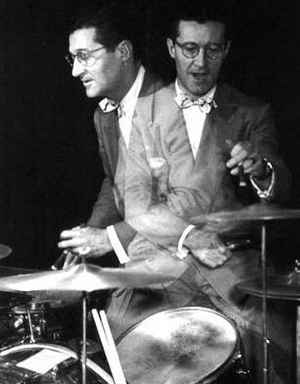
Ray McKinley
Photo: William P. Gottlieb
Source: Jazz Wax
Drummer, Ray McKinley, was born in Fort Worth, Texas on 18 June 1910. He is believed to have met Glenn Miller in Dallas in 1929 when Miller was with Smith Ballew. Miller already had studio experience, having first recorded in 1926, largely with Ben Pollack. Glenn and Ray found themselves together on McKinley's first issued recordings in 1931 for Red Nichols: 'Just a Crazy Song', 'You Rascal You' and 'Moan You Moaners'. A second session in June the same year with Nichols yielded 'How Long Blues' and two takes of 'Fan It'.
'Just a Crazy Song' Red Nichols and His Five Pennies
26 May 1931 in NYC Matrix E-36830-A Brunswick 6133
Trumpet: Red Nichols Trombone: Glenn Miller
Clarinet / alto sax: Jimmy Dorsey Tenor sax: Babe Russin
Piano: Jack Russin Guitar: Perry Botkin
Bass: Art Miller Drums: Ray McKinley
Composition: Bessie Smith / Clarence Williams
'You Rascal You' Red Nichols and His Five Pennies
26 May 1931 in NYC Matrix E-36831-A Brunswick 6133
Trumpet: Red Nichols Trombone: Glenn Miller
Clarinet / alto sax: Jimmy Dorsey Tenor sax: Babe Russin
Piano: Jack Russin Guitar: Perry Botkin
Bass: Art Miller Drums: Ray McKinley Vocal: Red McKenzie
Composition: Sam Theard
In the summer of 1932 McKinley and Miller recorded 'Let's Try Again' and 'The Lady I Love' with Ballew before joining the Dorsey Brothers in 1934 together. Doing session work while with the Dorseys, McKinley soon began backing such as Ethel Waters, the Boswell Sisters and Louis Armstrong. When the Dorsey Brothers Orchestra made its last recording in September of 1935 McKinley continued onward with the Jimmy Dorsey Orchestra. He had first recorded with Jimmy in 1931 with Nichols (above).
'Cowboy from Brooklyn' Jimmy Dorsey and His Orchestra
22 April 1938 in NYC Matrix 63658-A Decca 1799
Trumpet: Ralph Muzzillo / Shorty Sherock
Trombone: Bobby Byrne / Sonny Lee / Don Matteson
Alto sax: Jimmy Dorsey (clarinet) / Milt Yaner / Leonard Whitney
Tenor sax: Charlie Frazier (flute) / Herbie Haymer
Piano: Freddie Slack Guitar: Roc Hillman
Bass: Jack Ryan Drums / vocal: Ray McKinley
Composition: ?
Tom Lord's discography has McKinley putting away his first tracks as a bandleader in Los Angeles on March 31, 1936 with two takes of 'Shack in the Back' among those titles. In 1939 McKinley exchanged Jimmy for Will Bradley's operation, sharing leadership of Bradley's band as a drummer and vocalist. McKinley's partnership with Bradley was significant among big band swing approaches to boogie woogie, early driving toward rock n roll. One such example is tunes gone down in the early forties toward the 1947 release of the album on 10" shellac, 'Boogie Woogie'. McKinley recorded the boogie woogie tune, 'Down the Road a Piece', in 1940, with his Ray McKinley Trio consisting of Freddie Slack on piano and Doc Goldberg at bass issued as the Will Bradley Trio.
'Down the Road a Piece' Will Bradley and Trio
12 Aug 1940 Matrix 27872-1 Columbia 35707
Piano: Freddie Slack Bass: Doc Goldberg
Drums / vocal: Ray McKinley Vocal: Will Bradley
Composition: Don Raye
'Chicken Gumboogie' Will Bradley and His Orchestra
Short film: 'Barnyard Bounce' 1941
Trumpet: Pete Candoli Trombone: Will Bradley
Drums / vocal: Ray McKinley
Composition: Joan Whitney
See 'Swinging Flicks' on Kaydee Records KD-8 / 1979
McKinley began recording with his Quartet in 1941, then with his full orchestra in 1942 with Imogene Lynn at vocals. Like his close friend, Miller, McKinley wanted to contribute to the effort of World War II, joining the army in 1942 to be recruited into the Glenn Miller Army Air Force Band. His first recordings with that operation were for CBS at Yale University in Connecticut on June 5, 1943. I don't know what were McKinley's financial circumstances before he joined the army, but Miller had sacrificed a weekly income ranging from $15,000 to $20,000. He then lost his life on 15 December 1944 over the English Channel due to a faulty plane carburetor. McKinley and Jerry Grey then ran the Army Air Force Band until discharged from service in latter 1945. In 1946 Tex Beneke, Miller's saxophonist and vocalist, assumed leadership of the Glenn Miller ghost band until 1950. Henry Mancini had been an arranger and pianist in that organization. McKinley meanwhile formed his own orchestra upon release from the army, but his career meandered until Miller's widow, Helen, asked him to lead a Glenn Miller legacy band in 1956. He hired his comrade, Will Bradley, to play trombone and that orchestra choo chooed down the track until 1966.
'Big Boy' Ray McKinley and His Orchestra
16 July 1942 in NYC Matrix NY 501 Capitol 131
Trumpet: Larry Brooks / Dick Cathcart / Jack Steele / Pete Candoli
Trombone: Jim Harwood / Brad Gowans (valve)
Alto sax: Mahlon Clark (clarinet) / Herb Tompkins
Tenor sax: Jerry Feld / Paul Thatcher Baritone sax: Walt Wegner
Piano: Lou Stein Guitar: Dennis Sandole
Tuba: Joe Park Bass: Gus Van Camp Drums: Ray McKinley
Vocal: Imogene Lynn
Composition: Jack Yellen / Milton Ager
'Hard Hearted Hannah' Ray McKinley and His Orchestra
16 July 1942 in NYC Matrix NY 502 Capitol 131
Trumpet: Larry Brooks / Dick Cathcart / Jack Steele / Pete Candoli
Trombone: Jim Harwood / Brad Gowans (valve)
Alto sax: Mahlon Clark (clarinet) / Herb Tompkins
Tenor sax: Jerry Feld / Paul Thatcher Baritone sax: Walt Wegner
Piano: Lou Stein Guitar: Dennis Sandole
Tuba: Joe Park Bass: Gus Van Camp Drums / vocal: Ray McKinley
Composition: Charles Bates / Jack Yellen / Milton Ager/ Robert Wilcox Bigelow
'Hoodle-Addle' Ray McKinley Quartet
12 August 1946 in NYC Matrix CT867-6 Majestic 7207
Piano: Lou Stein Guitar: Mundell Lowe
Bass: Ward Erwin Drums / vocal: Ray McKinley
Composition: Ray McKinley
'Jiminy Crickets' Ray McKinley and His Orchestra
18 Dec 1946 in NYC Matrix T-1022 Majestic 7216
Composition: Ray McKinley Arrangement: Eddie Sauter
'A Man Could Be a Wonderful Thing' Ray McKinley and His Orchestra
17 Dec 1947 in NYC Matrix D7VB2818 Victor 20-2768-B
Vocal: Marcy Lutes
Composition: Leo Corday / Leon Cary
'Rhythm-A-Tic' Ray McKinley and His Orchestra
22 July 1953 in NYC Matrix 84738-A Decca 28788
Trumpet: Billy Butterfield / Chris Griffin / Yank Lawson
Trombone: Will Bradley / Cutty Cutshall / Lou McGarity
Clarinet: Peanuts Hucko Alto sax: Toots Mondello / Bill Stegmeyer
Tenor sax: Al Klink
Piano: Lou Stein Guitar: Tony Mottola
Bass: Jack Lesberg Drums: Cliff Leeman Drums / vocal: Ray McKinley
Music: Gene de Paul Lyrics: Don Raye
'Pennsylvania 6-5000' Television 1961
Ray McKinley and the New Glenn Miller Orchestra
'Glenn Miller Time' on CBS
Music: Jerry Gray Lyrics: Carl Sigman
'A String of Pearls' Television 1965
Ray McKinley and the New Glenn Miller Orchestra
Music: Jerry Gray Lyrics: Eddie DeLange
McKinley's last recordings are thought to have gone down on June 5, 1977, with just Lou Stein at piano in New York City for Chiaroscuro, 'Stompin' 'Em Down' the title of that album.
Medley Ray McKinley Television 1984
Host: Tony Martin
McKinley died on 7 May of 1995.
Sources & References for Ray McKinley:
VF History (notes)
Scott Yanow (All Music)
Audio: Internet Archive YouTube
Collections: Smithsonian Institution (PDF)
Compositions: Second Hand Songs
Bradley in film / television: IMDb
Interviews: 2 June 1994 (audio w Dan Del Fiorentino)
Recordings: Albums:
Stompin' 'Em Down (last-known recordings w Lou Stein at piano on Chiaroscuro CR 173 / 1977)
Recordings: Catalogs:
Music Brainz RYMRecordings: Compilations:
The Best of Will Bradley with Ray McKinley: Eight to the Bar (1939-41)
Recordings: Sessions:
DAHR (Ray McKinley / 1934-62)
DAHR (Ray McKinley Orchestra / 1947-50)
Tom Lord: leading 68 of 406 sessions 1931-77
Further Reading:
Steven A. Cerra ("Jazz Drumming As a Rhythmic Presence" / 2018)
Authority Search: VIAF
Classical Main Menu Modern Recording
|
|