
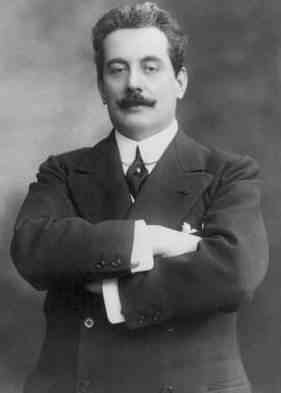
Giacomo Puccini
Source: Britannica
Born in Lucca, Tuscany, on 22 December 1858, opera composer, Giacomo Puccini was the great-great grandson of opera composer, Jacapo Puccini (1712-81). Though he wrote other music, opera was the rabbit in his hat, often above an odoriferous Toscano cigar. Giacomo was only six when his father died, thus the first in his family to not become maestro di cappella at the Cattedrale di San Martino, a position that had been handed father to son for well over a century. Puccini would instead develop into a post-Romantic composer, some of his work, 'Tosca' in particular, identified with verismo (naturalism, realism).
Puccini took his diploma from the Pacini School of Music in 1880. Among his first compositions was 'Messa a Quattro Voci' ('Messa di Gloria'), his graduation exercise begun in 1878 toward its first performance on 12 July 1880. He then studied composition for three years at the Milan Conservatory. Puccini's first professional opera, 'Le Villi' ('The Willis'), premiered at the Teatro Dal Verme in Milan on 31 May 1884 with libretto by Ferdinando Fontana. This opera is set in Black Forest in southern Germany. Le Villi are fairies in Slavic folklore who are tasked in this story with forcing one Roberto to dance to death by exhaustion because he has caused one unforgiving Anna to die of a broken heart. "SC" numbering is per Dieter Schickling's 'Giacomo Puccini: Catalogue of the Works' published by Bärenreiter in 2003.
'Messa a Quattro Voci' SC 6 Graduation exercise by Giacomo Puccini
Composed 1878-80 Premiere 12 July 1880 Pub 1951
Orchestre et Choeur de la Fondation Gulbenkian / Michel Corboz
'Le Villi' SC 60 First opera by Giacomo Puccini
Composed 1884 Premiere 26 Dec 1884 at the Teatro Regio in Turin
Libretto: Ferdinando Fontana
Vienna Academy Chamber Chorus / Vienna Volksoper Orchestra / Anton Guadagno 1972
Aria Database IMSLP Libretto Wikipedia
Puccini's second opera, 'Edgar', appeared at the Teatro alla Scala in Milan with another libretto by Fontana on 21 April 1889 to a discouraging so-so reception. Edgar is a soldier caught between a life of debauchery with one Tigrana and the more pure love of one Fidelia.
'Edgar' SC 62 Second opera by Giacomo Puccini
Composed 1889 Revised 1890/91/1905 Premiere 12 April 1889 at the Teatro alla Scala in Milan
Libretto: Ferdinando Fontana
Orchestra Sinfonica & Coro di Torino della RAI / Carlo Felice Cillario
Edgar: Veriano Luchetti Fidelia: Mietta Sighele Tigrana: Bianca María Casoni
Torino 1971
Aria Database Gianmaria Griglio IMSLP Georg Predota Wikipedia
Puccini's third opera, 'Manon Lescaut', put Puccini on the map, premiering to highly positive results at the Teatro Regio in Turin on 1 February 1893 with libretto by Luigi Illica, Marco Praga and Domenico Oliva. Set in France during the latter eighteenth century, Manon Lescaut is bound for a convent when her coach stops at an inn where Chevalier Renato des Grieux falls in love with her. She ends up, however, as the mistress of old Geronte di Ravoir. In an attempt to flee Geronte the latter has her arrested and deported to French Louisiana. Des Grieux is allowed to board the ship as well, such that Manon ends up dying of thirst in a desert whilst des Grieux dramatically grieves to The End.
'Manon Lescaut' SC 64 Third opera by Giacomo Puccini
Composed 1893 Premiere 1 Feb 1893 at the Teatro Regio in Turin
Libretto:
Ruggiero Leoncavallo / Marco Praga / Domenico Oliva / Giulio Ricordi / Luigi Illica / Giuseppe Giacosa
Orchestra e Coro del Teatro Alla Scala di Milano / Tullio Serafin
Chevalier des Grieux: Giuseppe di Stefan
Geronte di Ravoir: Franco Calabrese
Manon Lescaut: Maria Callas
Aria Database IMSLP Met Opera NPR Opera Online Wikipedia
Puccini painted his wagon and took it to town with 'La Bohème' premiering at the Teatro Regio in Turin on 1 February 1896 with libretto by Luigi Illica and Giuseppe Giacosa after Henri Murger's 'Scènes de la vie de bohème' of 1851. Set in Paris about 1830, one Rudolfo, a poor poet, falls in love with Mimi, a seamstress. Unfortunately Mimi has tuberculosis which Rudolfo is unable to bear. Mimi breaks up with him to spare him the troubles of her condition, then dies.
'La Bohème' SC 67 Fourth opera by Giacomo Puccini
Composed 1896 Premiere 1 Feb 1896 at the Teatro Regio in Turin
Libretto: Luigi Illica / Giuseppe Giacosa
After Henri Murger's 'Scènes de la vie de bohème'
Directed by Leo Nucci
Coro Lirico di Modena / Stefano Colò
Orchestra Filarmonica Italiana / Aldo Sisillo
Mimi: Maria Teresa Leva Rudolfo: Matteo Desole
Set: Carlo Centolavigna Costumes: Artemio Cabassi Lights: Claudio Schmid
Fondazione Teatro Comunale di Modena
Aria Database Aaron Green IMSLP Met Opera Opera Online Bruce Scott Wikipedia
Puccini then plumed his hat with 'Tosca' premiering at the Teatro Costanzi in Rome on 14 January 1900 with libretto by Luigi Illica and Giuseppe Giacosa. Set in Rome about 1800, Floria Tosca is a singer in love with the painter, Mario Cavaradossi. Unfortunately the chief of police, Baron Scarpia, has designs on Tosca whilst at once intending to arrest Cavardossi for political reasons. Tosca stabs Scarpia to death before Cavardossi meets a firing squad, Tosca thus to kill herself as well. Included in Act II of 'Tosca' is Puccini's favored aria for soprano, 'Vissi d’Arte' ('I Lived for Art').
'Tosca' SC 69 Fifth opera by Giacomo Puccini
Composed 1895-99 Premiere 14 Jan 1900 at the Teatro Constanzi in Rome
Libretto: Luigi Illica / Giuseppe Giacosa after Victorien Sardou's 'La Tosca'
Directed by Brian Large 1984
Orchestra and Chorus of the Arena di Verona
Cavaradossi: Giacomo Aragall Scarpia: Ingvar Wixell Floria Tosca: Eva Martin
Aria Database Richard Cavendish IMSLP
Met Opera Susan Vandiver Nicassio Bruce Scott Wikipedia
'Vissi d’Arte' ('I Lived for Art') Aria by Giacomo Puccini
From Act II of 'Tosca" SC 69 (above)
Maria Callas Covent Garden 1964
On 25 February 1903 Puccini was in a serious auto accident, the car his chauffer was driving leaving the road and flipping over atop Puccini. His wife and son escaped severe injury, but he and his chauffer fractured a femur. Puccini nevertheless premiered the work for which he is most famous fifty-one weeks later at la Scala on 17 February 1904, 'Madame Butterfly' with its setting in Japan, to text by Luigi Illica and Giuseppe Giacosa. Set in Nagasaki, Cio-Cio-San is a Japanese geisha who marries one Lieutenant Pinkerton of the U.S. Navy. "Cio-Cio" (chocho) translates to "Butterfly" in Japanese. "San" is a suffix to which "Madam" is an equivalent. So devotedly does Cio-Cio marry Pinkerton that she converts from Buddhism to Christianity for which she is condemned. As Pinkerton is called to duty elsewhere, he must leave Japan, though not before impregnating Cio-Cio with a son. Three years pass when Pinkerton finally returns to Japan. Devout Cio-Cio is quite excited that she and her husband will be together again soon. But divorce is easy in Japan, and Pinkerton has returned, not for Cio-Cio, but for his and her young son, to be raised by his new wife, Kate. Cio-Cio then ends her own life by dagger. Puccini's fifth revision as of 1907 is the standard.
'Madame Butterfly' SC 74 Sixth opera by Giacomo Puccini
Composed 1903-04 Premiere 17 Feb 1904 at La Scala in Milan Pub 1904
Libretto: Luigi Illica / Giuseppe Giacosa
Aria Database Cincinnati Opera Columbia University English National Opera Kunio Hara
IMSLP Met Opera Logan Martell Ana María Martínez Annilese Miskimmon
NPR Opera Online Matthew Ozawa Wikipedia Robin Yong
Filmed in Tunisia Directed by Frédéric Mitterrand Released in France 22 Nov 1995
Cio-Cio-San: Huang Ying (soprano) Lieutenant Pinkerton: Richard Troxell (tenor)
IMDb Letterboxd Variety Wikipedia
Puccini embarked on his first boat to New York in 1907, there to present both 'Manon Lescaut' and 'Madam Butterfly' at the Metropolitan Opera. Another trip in 1910 saw 'La Fanciulla del West' ('The Maiden of the West') with its setting in America premiering at the Metropolitan Opera in New York on 10 December. The libretto for that was written by Guelfo Civinini and Carlo Zangarini from the play of 1905 by American author, David Belasco, 'The Girl of the Golden West'. 'La Fanciulla del West' is set at a mining camp during the California Gold Rush in the mid nineteenth century. The Polka Saloon is run by one gun-toting Minnie who falls in love with one Dick Johnson before discovering that he is the bandit, Ramerrez, whom Ashby, a Wells Fargo agent is hunting. Johnson is caught at Minnie's cabin by Jack Rance, the sheriff, but Minnie manages to save him by cheating at poker. Yet Johnson is caught again and about to be hung when Minnie saves him again, this time with a pistol.
'La Fanciulla del West' ('The Damsel of the West') SC 78 Seventh opera by Giacomo Puccini
Composed 1907-10 Premiere 10 Dec 1910 at the Metropolitan Opera in NYC Pub 1910
Libretto: Guelfo Civinini / Carlo Zangarini after David Belasco's 'The Girl of the Golden West'
Metropolitan Opera Chorus & Orchestra / Marco Armiliato
Minnie: Eva-Maria Westbroek 2018
Aria Database IMSLP NPR Ellise Pierce David Salazar Wikipedia
Puccini weathered the Great War seemingly apolitical, it appearing, anyway, that it mattered not to him which powers won. One source speculates that he may have been a monarchist if anything. It was during that conflict that 'La Rondine' ('The Swallow') arrived to either the Grand Théâtre de Monte Carlo or the Théâtre du Casino in Monte Carlo on 27 March 1917 with libretto by Giuseppe Adami. 'La Rondine' is the tale of a courtesan, Magda, who falls in love with one Ruggero from whom she hides her past. However, when the time arrives to marry she leaves him. Though Ruggero loves her yet, even after revealing her past, Magda feels that she doesn't belong with him, nor his family, and returns to her old life, leaving Ruggero overwhelmed by loss of her.
'La Rondine' ('The Swallow') SC 83 Eighth opera by Giacomo Puccini
Composed 1917 Premiere 27 March 1917 in Monte Carlo Pub 1917
Libretto: Giuseppe Adami
Directed by Denis Krief
Orchestra e Coro del Maggio Musicale Fiorentino / Valerio Galli
Magda: Ekaterina Bakanova Ruggero: Matteo Desole
Opera di Firenze Oct 2017
David Salazar Wikipedia
Another trip to America only one month after the end of World War I saw 'Gianni Schicchi' SC 88 premiering at the Metropolitan Opera on 14 December 1918 with libretto by Giovacchino Forzano. This was one of 'Il Trittico', a collection of three one-act operas all performed together at the Metropolitan on that date. The other two were 'Il Tabarro' ('The Cloak') SC 86 and 'Suor Angelica' ('Sister Angelica') SC 87, 'Gianni Schicchi' the most popular of the three. Schicchi is a poor but clever man who impersonates one Buoso Donati who has died and left his wealth to a monastery, that to the dismay of relatives hoping for an inheritance. Schicchi's impersonation of Buoso gets a new will made via fooling a notary, much to the delight of greedy relatives until they realize that "Buoso" has drawn a new will which leaves the greater portion of his wealth to his friend, Gianni Schicchi. 'Gianni Schicchi' includes another of Puccini's popular arias for soprano, 'O Mio Babbino Caro' ('O My Dear Papa').
'Gianni Schicchi' SC 88 Eleventh opera by Giacomo Puccini
Composed 1918 Premiere 14 Dec 1918 at the Metropolitan Opera in NYC
Libretto: Giovacchino Forzano
Opera Online Wikipedia
'O Mio Babbino Caro' ('O My Dear Papa') Aria by Giacomo Puccini
From 'Gianni Schicchi" SC 88 (above)
Berliner Philharmoniker / Ion Marin
Soprano: Renée Fleming
Berlin 27 June 2010
Classic FM Aaron Green Wikipedia
In 1924 Puccini became a senatore a vita in Italy, hoping to erect a theatre in Viareggio. A senatore viva is an honorary senator chosen by the President of the Italian Republic, the practice continuing to this day. In Puccini's time it required him to twice meet the young Benito Mussolini in 1923. Mussolini had been prime minister for about a year at that time. Puccini died on 29 November 1924 before Mussolini's fascist dictatorship took control in December (announced in January 1925). Puccini's death was due to radiation treatment for throat cancer, that surgery followed by a heart attack the next day. Puccini was working on 'Turandot', his final opera, at the time with libretto by Giuseppe Adami and Renato Simoni. The last part of Act III was completed by Franco Alfano for its first posthumous performance at la Scala in Milan conducted by Arturo Toscanini on 25 April 1926. Turendot refers to Persian Turāndokht (توراندخت) meaning daughter of Turan or, more broadly, Turkish princess. It is usually pronounced Turen-doe with the "t" silent. In this opera Turendot is an imperial princes who riddles her suitors. Who give wrong answers are executed.
'Turandot' SC 91 Tweflth opera by Giacomo Puccini
Composed 1926 Premiere:
Puccini's largely completed fragment: 25 April 1926 at the Teatro alla Scala in Milan
Franco Alfano's completion: 26 April 1926
Pub 1926 in Milan by Ricordi
Libretto: Giuseppe Adami / Renato Simoni
Directed by Shayna Leahy
Wichita Grand Opera Orchestra & Chorus / Martin Mazik
Set: Margaret Ann Pent / Shayna Leahy
Costumes: Charles Caine / John Leymeyer
Lights: Sean Roberson
Wichita Grand Opera 28 Aug 2015
Aria Database Nicholas Fuller Aaron Green IMSLP Met Opera
Opera Online Opera Philadelphia David Salazar Score Wikipedia
Sources & References for Giacomo Puccini:
Robert Cummings (All Music)
VF History (notes)
Audio of Pfitzner: Corpora:
UCSB (cylinders c 1890?-1923)
Compositions:
IMSLP (alphabetical)
IMSLP (by genre)
IMSLP (operas)
Klassika (by date / genre / title)
Klassika (by SC [Dieter Schickling / Bärenreiter / 2003])
Puccini (by date)
Puccini (by genre)
Puccini (operas)
Rate Your Music (by genre / date)
Wikipedia English (by date / genre / premiere / title)
Wikipedia English (by genre)
Criticism:
(Giacomo Puccini, I Suoi Detrattoris [Giacomo Puccini, His Detractors])David Salazar (Giacomo Puccini, One of Opera’s Icons)
David Salazar (Ranking Giacomo Puccini’s Operas from Least to Best)
Documents /Manuscripts: Europeana
Tosca (opera / 1900)Iconography: Wikimedia Commons
Lyrics / Texts: Emily Ezust (LiederNet)
Recordings of Puccini: Catalogs: 45 Cat Arkiv Music DAHR (1900-1952) Discogs Music Brainz
La Bohème (opera / 1896)
Tosca (opera / 1900)
La Fanciulla del West (opera / 1910)
La Rondine (opera / 1917)
Turendot (opera / incomplete upon death in 1924)
Recordings of Puccini: Select:
Gianni Schicchi (opera / 1918 / Málaga Philharmonic Orchestra / Alexander Rahbari / Naxos 8.660111 / 2003)
Scores / Sheet Music:
(vendor / Amazon subsidiary)CPDL (choral works)
(vendor) (vendor / Europe)Further Reading:
American Center for Puccini Studies
IBDB (Puccini on Broadway)
IMDb (Puccini in film)
Ricordi Historical Archive Milan
Bibliography:
Dieter Schickling (Giacomo Puccini: Catalogue of the Works / Bärenreiter / 2003)
Authority Search: Deutsche Nationalbibliotek
Other Profiles:
Alfredo Bonaccorsi (Enciclopedia Italiana / 1935)
(Enciclopedia dei ragazzi / 2006) (Dizionario Biografico degli Italiani / Vol 85 / 2016)Wikipedia: Catalan Cebuano Deutsch Español Finnish Français Italian Norwegian
Classical Main Menu Modern Recording
|
|
About Contact Privacy