
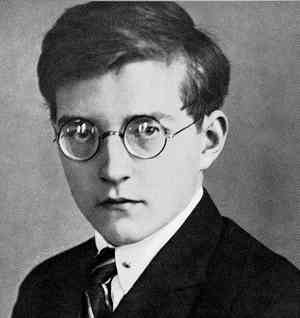
Dmitri Shostakovich
Source: Wikipedia
Born on 25 September 1906 in St. Petersburg, Dmitri Shostakovich thought it not enough that Russian composition nigh owned the Romantic period but for a German here and there (Beethoven, Wagner, et al) or a Polish Chopin. With Shostakovich, Russia can make a strong claim to the modern period as well, albeit not without considerable competition. Shostakovich began piano at age nine and was composing at age twelve with a happy theme for piano called 'Funeral March for the Fallen Heroes of the Revolution' ('Traurnyi marsh pamyati zhertv revolyutsii') concerning Kadets murdered by Bolsheviks during the Red Terror of the Russian Revolution [piano by Catone]. Shostakovich enrolled at the Petrograd Conservatory [Wikipedia] the next year where, nevertheless, he showed little interest in the politics that would later present him with problems as a Russian composer.
Dmitri's Op 1, 'Scherzo' for orchestra in F sharp minor, appeared in 1919 [interpretation by the USSR Ministry of Culture Symphony Orchestra conducted by Guennadi Rosdhestvenski]. On 4 December 1920 Shostakovich finished No.1 of 'Three Fantastic Dances' Op 5, completing the latter two in 1922. Those appear to be the earliest pieces that Shostakovich himself recorded, that in September of 1958. Those are not, however, his earliest recordings. Shostakovich had been filmed performing at piano sometime in the thirties. He was also filmed in 1974 at a production of 'The Nose', but neither of those occasions cited by Wikipedia have I found. His earliest official recordings appear to have been in circa 1946, neither with a known session date: 'Cello Sonata' in D minor Op 40 composed in 1934, recorded with cellist, Daniil Shafran [Discogs] and ' Piano Trio No.2 In E Minor" Op 67 of 1946 recorded with Sergei Shirinsky at cello and Dimitri Tsyganov at violin. The next year Shostakovich documented 'Piano Trio No.2' at the Prague Festival on 26 May 1947 with Czech cellist, Miloš Sádlo, and violinist, David Oistrakh [Discogs]. Also going down in 1947 were portions of '24 Preludes and Fugues' Op 87, 'Children’s Notebook' Op. 69, a polka from the ballet, 'The Golden Age' Op 2, and 'Three Fantastic Dances' Op 5 [Melodiya].
In 1954 Dmitri recorded 'Symphony No 10' in E minor Op 93 in an arrangement for two pianos with pianist, Mieczysław Weinberg. The next year he put up 'Piano Concerto' No.2 in F major Op 102 with the Moscow Philharmonic Orchestra and 'Piano Quintet' in G minor Op 57 with the Beethoven Quartet. Pieces from 'Jewish Folk Poetry' Op 79 arrived in 1956. On 27 November of 1957 Shostakovich recorded his 'Piano Concerto No.1' in C minor Op 94 with the Moscow Radio Symphony Orchestra and trumpeter, Josif Volovnik. 'Concertino' in A minor for two pianos Op 94 composed in 1953 was recorded by Dmitri in 1958 with his son, pianist, Maxim Shostakovich. In May and September of 1958 in Paris he put away 'Concerto No. 1' in C minor for piano, trumpet and strings Op 35, 'Concerto No.2' in F major Op 102 and 'Three Fantastic Dances' Op 5. All titles from 1954 to 1958 can be found on Melodiya. In 1959 Shostakovich and cellist, Mstislav Rostropovich, recorded 'Cello Sonata' in D minor Op 40 composed in 1934 [Supraphon]. Nigh a decade later in December of 1968 Dmitri and violinist, David Oistrakh, made a private recording of 'Violin Sonata' Op 134 [Melodiya]
.
'Three Fantastic Dances' Nos.1-3 of 3 Op 5 in C major Dmitri Shostakovich
Comp No.1 4 Dec 1920 at Petrograd Conservatory / Nos.2-3 1922
Premiere 31 July 1922 at the Petrograd Conservatory Pub 1926
Piano: Dmitri Shostakovich 1947
Of the large oeuvre that Shostakovich left behind, this profile will follow his fifteen symphonies. Shostakovich's first, 'Symphony No.1' in F minor Op 10, appeared in Leningrad on 12 May 1926 by the Leningrad Philharmonic conducted by Nikolai Malko. Wikipedia has its premiere in the United States sometime in 1928. It also saw performing in December 1928 by the Chicago Symphony Orchestra with Frederick Stock conducting.
'Symphony No.1' Op 10 in F minor Dmitri Shostakovich
Comp 1923-25
Premiere 12 May 1926 in Leningrad Pub 1927 Moscow
Russian National Orchestra / Vladimir Jurowski
Roger Dettmer Exhaustive Shostakovich Houston Symphony
'Symphony No.2' ('To October') in B major Op 14 was written for the 10th anniversary of the October Revolution, commissioned by Muzsektor of the Propaganda Department of the State Music Publishing House.
'Symphony No.2' ('To October') Op 14 in B major Dmitri Shostakovich
Comp 1927 Libretto by Aleksandr Bezymensky
Premiere 5 Nov 1927 in Moscow Pub 1927 Moscow
Dedicated to Lenin and the Bolsheviks
Azusa Pacific University / Christopher Russell 15 Nov 2012 Pomona Baptist Church
IMSLP LA Philharmonic Freya Parr Wikipedia
Shostakovich's debut film score (WoO) was for the silent 'The New Babylon' released to theaters on 18 March 1929. His opera, 'The Nose' Op 15, had been finished in 1928, but didn't premiere in Leningrad until 18 January 1930 to poor result, that based on the 1836 tale concerning social status in Russia by Nikolai Gogol. in 'The Nose' one Kovalyov visits his barber, Yakovlevich. All is sane until the next morning when Yakovlevich discovers a nose in his bread. Led to believe that he has accidentally shaven it from some customer's face, he attempts to be done with it by throwing it into the Neva River. Meanwhile Kovalyov awakes to learn that his nose is missing, so he sets out to find the thing. What do you know, but that he locates his nose at the Kazan Cathedral. It is not only the size of a human now, but has become an inapproachable State Councillor. Soon everyone including the police are searching for Kovalyov's nose. He eventually awakens with his nose returned to his visage, even as Yakovlevich arrives to give him another shave, released from jail for his suspicious role in the missing of Kovalyov's nose.
'The Nose' Op 15 Opera by Dmitri Shostakovich
Premiere 18 Jan 1930 in Leningrad
Libretto: Shostakovich / Yevgeny Zamyatin / Georgy Ionin/ Alexander Preis
Orchestra of the Royal Opera House / Ingo Metzmache
Directed by Barrie Kosky Chorus directed by William Spaulding
Choreography: Otto Pichler Costumes: Bui Shiff Lighting: Klaus Grunberg
Exhaustive Shostakovich IMSLP Met Opera La Monnaie Wikipedia
'The New Babylon' Op 18 Silent film score by Dmitri Shostakovich
Film released 18 March 1929
Russian State Symphony Orchestra / Valeri Polyansky 1998
DSCH Exhaustive Shostakovich Wikipedia
Dmitri's 'Symphony No.3' ('First of May') Op 20 arrived to Leningrad on 21 January 1930, its finale set to text by Semyon Kirsanov applauding May Day which is also International Workers' Day in the Russian Federation (formerly USSR) corresponding to Labor Day in the United States celebrated on the first Monday of September.
'Symphony No.3' ('The First of May') Op 20 in E-flat major Dmitri Shostakovich
Premiere 1 Jan 1930 in Saint Petersburg Pub 1932
Libretto: Semen Kirsanov
Orchestra of the USSR Ministry of Culture / Gennadi Rozhdestvensky
Russian State Academic Choir Cappella
IMSLP LA Philharmonic Wikipedia
On 19 May 1933 Shostakovich married the first of three wives, Nina Varzar, who would bear Galina in 1936 and Maxim in 1938. Nina would die in 1954. Dmitri's betrothal to Margarita Kainova in 1956 ended in divorce after five years, upon which a happier marriage was made in 1962 with 27 year-old Irina Supinskaya nearly three decades younger than he. Not long after his first wedding Dmitri premiered his 'Piano Concerto No.1' in C minor for trumpet Op 35 on 15 October 1933.
'Piano Concerto No.1' Op 35 in C minor Dmitri Shostakovich
Premiere 15 Oct 1933 by the Leningrad Philharmonic Orchestra w Shostakovich at piano
Orchestre National de la Radiodiffusion Française / André Cluytens
Piano: Shostakovich May 1958
Boston Symphony Orchestra DSCH IMSLP Wikipedia
It was 22 January 1934 when Shostakovich premiered his opera, 'Lady Macbeth of the Mtsensk District' Op 29, with libretto by Alexander Preys and himself based on the 1865 horror novella by Nikolai Leskov. He added a 'Suite' for that in 1934 as well. This opera is another story about all the best people, concerning itself with the tragic fate of one Katerina who is unhappily married to a flour merchant whom she murders with the help of her lover, a womanizing Sergei, that after poisoning a rival to Sergei, one Boris who gets Sergei jailed for burglary. Katerina ends up in a convict train where she murders a rival for Sergei's attentions, but accidentally kills herself as well.
'Lady Macbeth of Mtsensk' Op 29 Opera by Dmitri Shostakovich
Premiere 22 Jan 1934 in Leningrad
Libretto: Shostakovich / Aleksandr Germanovič Prejs
Magyar Állami Operaház Directed by Rendezo
2005Tim Ashley DSCH Exhaustive Shostakovich Gorky Media Hollywood Bowl
IMSLP Melomano Opera Online Ed Vulliamy Wikipedia
Suite to 'Lady Macbeth of Mtsensk' Op 29a Dmitri Shostakovich 1934
Gürenzich Cologne Orchestra / James Conlon
DSCH LA Philharmonic Wise Music Classical
Dmitri's ballet, 'The Limpid Stream' ('The Bright Stream') Op 39 premiered at Leningrad's Mikhaylovsky Theatre in 1935 with its 'Suite' of 1945 designated Op 39a. In January of 1936 Joseph Stalin visited a performance of 'Lady Macbeth' which earned it his condemnation along with that of 'Pravda' (leading Communist newspaper) and the Politburo. 'The Limpid Stream' was rejected as well. To receive a negative rating from Stalin was a big deal not only since it came with a huge plunge in income, but because Stalin's Great Purge started in 1936, during which artists, musicians, intellectuals, scientists and the like with unacceptable views were imprisoned or shot [Britannica / Library of Congress]. Shostakovich was working on 'Symphony No.4' Op 43 at the time, which he thought better to withdraw before its intended premiere in December 1936. The work didn't see a performance for a quarter century until 30 December 1961 by the Moscow Philharmonic Orchestra with Kirill Kondrashin eight years after Stalin's death.
Suite to 'The Limpid Stream' Op 39a Ballet (Op 39) in 3 acts by Dmitri Shostakovich
'Suite' by Konstantin Titarenko
Comp Op 39 1935 / Op 39a 1945
National Symphony Orchestra of Ukraine / Theodore Kuchar
DSCH Exhaustive Shostakovich Solomon Volkov Wikipedia Wise Music Classical
'Symphony No.4' Op 43 in C minor Dmitri Shostakovich
Comp 1935-36
Premiere 30 Dec 1961 by the Moscow Philharmonic Orchestra led by Kirill Kondrashin
National Symphony Orchestra of Ukraine / Theodore Kuchar
DSCH Exhaustive Shostakovich Hollywood Bowl
IMSLP LA Philharmonic Wikipedia Wise Music Classical
Presented with the problem of needing both money and a safer profile, Shostakovich composed 'Symphony No.5' Op 47 in form more pleasing to powers that be. His 'Symphony No.6' Op 54 arrived to Leningrad on 21 November 1939.
'Symphony No.5' Op 47 in D minor Dmitri Shostakovich
Comp April-July 1937
Premiere 21 Nov 1937 by the Leningrad Philharmonic Orchestra led by Yevgeny Mravinsky
Mariinsky Orchestra / Valery Gergiev
Colorado Symphony OrchestraHouston Symphony Orchestra IMSLP LA Philharmonic
PBS SF Symphony Orchestra Wikipedia Wise Music Classical
'Symphony No.6' Op 54 in B minor Dmitri Shostakovich
Premiere 5 Nov 1939 by the Leningrad Philharmonic Orchestra led by Yevgeny Mravinsky
WDR Sinfonieorchester Köln / Rudolf Borisovich Barshai
Boston Symphony Orchestra DSCH Herbert Glass IMSLP
LA Philharmonic Listener's Club Wikipedia Wise Music Classical
In 1939 Shostakovich composed 'Suite on Finnish Themes', a work of imagination in more ways than one which had been intended for Russia's triumphal entry to Helsinki as of the Winter War of 30 November 1939 to 13 March 1940. The Soviets thought Finland would be an easy take, the latter vastly overpowered in military might. But Stalin's Terror (Purge) had by then imprisoned or executed some 30,000 experienced officers, toward the result of having a lot of big guns but few who knew how to use them. The result of the Winter War for the Fins were some huge concessions (: 11 percent territory, 30 percent economy), but for the Soviets the war had been a great strain and Helsinki remained independent. 'Suite on Finnish Themes' consequently saw no premiere until 2001, Shostakovich himself having no interest in it.
'Suite on Finnish Themes' WoO Dmitri Shostakovich 1939
Ostrobothnian Chamber Orchestra / Juha Kangas 2001
Soprano: Anu Komsi Tenor: Tom Nyman
'Piano Quintet' Op 57 in G minor Dmitri Shostakovich 1940
Beethoven Quartet w Shostakovich at piano 1955
Violin: Vasily Shirinsky Violin: Dmitri Tsyganov
Viola: Vadim Borisovsky Cello: Sergei Shirinsky
MusicWeb International SLLMF Wikipedia
Come the Siege of Leningrad on 8 September 1941 which killed about 500,000 civilians alone until 27 January 1944 during which period Shostakovich wrote his next two symphonies. 'Symphony No.7' ('Leningrad') in C major Op 60 premiered on 2 March 1942, having been composed in Samara [1, 2, 3, 4; interpretation by the Chicago Symphony Orchestra with Leonard Bernstein; live performance by the WDR Sinfonieorchester Köln with Semyon Bychkov; film of Shostakovich at piano 1941]. Shostakovich's 'Symphony No.8' in C minor Op 65 premiered in Moscow on 4 November 1943 by the USSR Symphony Orchestra led by Yevgeny Mravinsky. A tragic rather than triumphal work, it was unofficially banned until 1956.
'Symphony No.7' Op 60 in C major Dmitri Shostakovich
Premiere 2 March 1942 Pub 1942
Dedicated to the city of Leningrad
Royal Liverpool Philharmonic Orchestra / Vasily Petrenko
Britannica Jason Caffrey DSCH Rebecca Franks Fugue for Thought
IMSLP John Mangum Chris Myers Tom Service Wikipedia
'Symphony No.8' Op 65 in C minor Dmitri Shostakovich
Premiere 4 Nov 1943 in Moscow by the USSR Symphony Orchestra led by Yevgeny Mravinsky
WDR Sinfonieorchester Köln / Rudolf Borisovich Barshai
ABC Classic Boston Symphony Orchestra DSCH Herbert Glass
IMSLP Prufrock's Dilemma SF Symphony Wikipedia
World War II had come to end in both the Asian and European theatres by the time Shostakovich premiered his 'Symphony No.9' in E-flat major Op 70 on 3 November 1945, deemed by one critic as too "childish" to be expressive of Nazi defeat which had been its purpose.
'Symphony No.9' Op 70 in E-flat major Dmitri Shostakovich
Premiere 3 Nov 1945 by the Leningrad Philharmonic Orchestra led by Yevgeny Mravinsky
WDR Sinfonieorchester Köln / Rudolf Borisovich Barshai
Orchestral Bassoon Howard Posner Redwood Symphony
Mark Wigglesworth Wikipedia WQXR
Shostakovich found his works banned again in 1948 per the Zhdanov Doctrine, which intent was to sterilize Russia of foreign influences, including in musical composition. Summoned to apologize before the Central Committee for writing unacceptable (anti-proletarian) works, Shostakovich then watched his income fall away. Russia wasn't making it easy for one of its greatest composers. Facing a compromising situation, in 1949 he was given opportunity to redeem himself as a representative of Soviet Russia at the Cultural and Scientific Congress for World Peace in New York City. Publicly asked by Russian composer, Nicolas Nabokov [Wikipedia], who was a United States citizen since 1939, if he agreed with the Soviet denunciation of Igor Stravinsky, Shostakovich saw little choice but confirm, even as Stravinsky was among his favorite composers. Nabokov then published that Shostakovich was a tool of the Soviet government. Shostakovich was then compelled to write the oratorio, 'Song of the Forests' Op 81, in the summer of 1949 in which Stalin is praised for forestation projects in the Russian Steppes. Premiered by the Leningrad Philharmonic led by Yevgeny Mravinsky on 15 November 1949, it won Dmitri a Stalin Prize in 1950 [interpretations by the Estonian National Symphony Orchestra with Paavo Jaervi & the USSR State Symphony Orchestra with Yevgeny Mravinsky; live performance by the USSR State Symphony Orchestra with Evgeny Svetlanov].
'Song of the Forests' Op 81 Oratorio by Dmitri Shostakovich
Comp: summer of 1949
Premiere 15 Nov 1949 by the Leningrad Philharmonic Orchestra led by Yevgeny Mravinsky
USSR State Symphony Orchestra / Evgeny Svetlanov
Moscow Radio Chorus / Little Spiritual Fantastic Singers
Tenor: Aleksei Maslennikov Bass: Alexandre Vedyornikov
Live in Tokyo 21 Oct 1978
In 1950-51 Shostakovich composed '24 Preludes and Fugues' for solo piano Op 87 after JS Bach's 'The Well-Tempered Clavier', one for each major and minor key of the chromatic scale. Those were dedicated to pianist, Tatiana Nikolayeva, who premiered them in 1952, then recorded them in 1962, 1987, 1990 and 1992.
'24 Preludes and Fugues' Book I (1-12) Op 87 Dmitri Shostakovich
Premiere 23 Dec 1952 at Leningrad Philharmonia in Saint Petersburg w piano by Tatiana Nikolayeva
Television broadcast by Nikolayeva 21-30 Dec 1992
celestial harmonies DSCH earsense
IMSLP Marcus Langin Robert Markow Wikipedia
'24 Preludes and Fugues' Book II (13-24) Op 87 Dmitri Shostakovich
Premiere 23 Dec 1952 at Leningrad Philharmonia in Saint Petersburg w piano by Tatiana Nikolayeva
Television broadcast by Nikolayeva 21-30 Dec 1992
celestial harmonies DSCH earsense
IMSLP Marcus Langin Robert Markow Wikipedia
In 1951 Shostakovich found himself a deputy in the Supreme Soviet (legislative body) of the Soviet Union. His 'Symphony No.10' Op 93 premiered on 17 December of 1953 by the Leningrad Philharmonic Orchestra led by Yevgeny Mravinsky, Stalin having died the previous March.
'Symphony No.10' Op 93 in E minor Dmitri Shostakovich
Premiere 17 Dec 1953 by the Leningrad Philharmonic Orchestra led by Yevgeny Mravinsky
New England Conservatory Philharmonia / Hugh Wolff
DSCH Aida Huseinova Aida Huseinova
SF Symphony Marianne Tobias Wikipedia
'Symphony No.10' Op 93 in E minor Dmitri Shostakovich
Premiere 17 Dec 1953 by the Leningrad Philharmonic Orchestra led by Yevgeny Mravinsky
Simon Bolivar Youth Orchestra of Venezuela / Gustavo Dudame
DSCH Aida Huseinova Aida Huseinova
SF Symphony Marianne Tobias Wikipedia
It was 1957 when Dmitri came up with 'Piano Concerto No.2' in F major Op 102 for his son's (Maxim) 19th birthday. That was first performed on 10 May 1957 at the Moscow Conservatory by the USSR Symphony Orchestra led by Nikolai Anosov. Shostakovich recorded it twice in 1958, though I'm not certain which came first. That May he documented it with the Orchestra National de la Radiodiffusion Francaise with André Cluytens conducting in sessions including 'Piano Concerto No.1'. I can find no date for session(s) with the Moscow Radio Symphony Orchestra led by Alexander Gauk. Britten & Pears proffer a broad date of 1958 for that as well.
'Piano Concerto No.2' Op 102 in F major Dmitri Shostakovich
Premiere 10 May 1957 at the Moscow Conservatory w Shostakovich at piano
Orchestra National de la Radiodiffusion Francaise / André Cluytens
Piano by Shostakovich Recorded 24-26 May 1958 at the Salle Wagram in Paris
Boston Symphony Orchestra Classic fM Vitaly Katsenelson
IMSLP Wikipedia Wind Repertory Project
'Piano Concerto No.2' Op 102 in F major Dmitri Shostakovich
Premiere 10 May 1957 at the Moscow Conservatory w Shostakovich at piano
Moscow Radio Symphony Orchestra / Alexander Gauk
Piano by Shostakovich Recorded sometime unidentifed 1958
Boston Symphony Orchestra Classic fM Vitaly Katsenelson
IMSLP Wikipedia Wind Repertory Project
'Symphony No.11' ('The Year 1905') in G minor Op 103 was first performed by the USSR Symphony Orchestra with Natan Rakhlin on 30 October 1957. Sir Malcolm Sargent led a performance by the BBC Symphony Orchestra at Royal Festival Hall on 22 January 1958. It reached the Houston Symphony Orchestra in the U.S. on 7 April 1958 beneath Leopold Stokowski. 'The Year 1905' refers to the First Russian Revolution of 1905. It had been the Russo-Japanese War of 1904-05 large on the mind of Tsar Nicholas II when Bloody Sunday arrived closer to home in St. Petersburg on 22 Jan 1905, the day Nicholas spelled the doom of monarchical Russia by opening fire on protesting workers at his gates, perhaps several hundred killed.
'Symphony No.11' ('The Year 1905') Op 103 in G minor Dmitri Shostakovich
Premiere 30 Oct 1957 in Moscow by the USSR Symphony Orchestra w Natan Rakhlin
New England Conservatory Philharmonia / Hugo Wolff
Boston Symphony Orchestra Tomasz Cyz Houston Symphony Orchestra
IMSLP Neil Kurtzman Chris Myers Howard Posner Wikipedia
'Cello Concerto No.1' Op 107 in E-flat major Dmitri Shostakovich
Comp July 1959 Premiere 4 Oct 1959
Dedicated to Mstislav Rostropovich
Philadelphia Orchestra / Eugene Ormandy
Cello: Mstislav Rostropovich
Boston Symphony Orchestra Jeff Counts Herbert Glass
IMSLP Thomas May Georg Predota Wikipedia
In 1960 Shostakovich became a member of the Communist Party under Nikita Khrushchev succeeding Stalin, less than apparently by blackmail, making that one of the saddest periods of his life. Articles appeared in 'Pravda' which he didn't write denouncing individualism in music. Twisted one way and the other like one's appendages caught in a Chinese finger trap, he spent three days in July composing 'String Quartet No.8' ('Ghost Quartet') dedicated to "the victims of fascism and war" by which he meant totalitarianism, according to his son, Maxim, making that a ghost reference even as the work refers to himself become a burdened man.
'String Quartet No.8' ('Ghost Quartet') Op 110 in C minor Dmitri Shostakovich
Premiere 2 Oct 1960 in Leningrad
Emerson Quartet
Violin: Eugene Drucker Violin: Philip Setzer
Viola: Lawrence Dutton Cello: Paul Watson
Alexander String Quartet Stephen Harris
IMSLP Neil McCalmont Chris Myers Howard Posner Wikipedia
Prior commitment found Shostakovich dedicating his 'Symphony No.12' ('The Year 1917' [Bolshevik Revolution]) Op 112 to Vladimir Lenin, that premiering in October 1961. Shostakovich's 'Symphony No.13' ('Babi Yar'; see the Babi Yar Ravine) Op 113 was finished on 20 July 1962 toward its premiere in December, that concerning the Nazi slaughter of 33,000 Ukrainian Jews in Kiev in a period of 24 hours during World War II.
'Symphony No.12' ('The Year 1917') Op 112 in D minor Dmitri Shostakovich
Premiere 1 Oct 1961 by the Leningrad Philharmonic Orchestra led by Yevgeny Mravinsky
American Youth Symphony / Carlos Izcaray
24 Sep 2017 Royce Hall at the University of California Los Angeles
Boston Symphony Orchestra Michael Clive DSCH
John Henken IMSLP Kindred Spirits Orchestra Wikipedia
'Symphony No.13' ('Babi Yar') Op 113 in B-flat minor Dmitri Shostakovich
Comp 20 July 1962
Premiere 18 Dec 1962 by the Moscow Philharmonic Orchestra led by Kirill Kondrashin
Text: Yevgeny Aleksandrovich Yevtushenko
WDR Symphony Orchestra Cologne / Rudolf Barshai
Chorus: Choral Academy Moscow Bass: Sergei Aleksashkin
The Conversation DSCH Herbert Glass IMSLP Text Wikipedia
Come Dmitri's 'Symphony No.14' for soprano and bass Op 135 in 1969 setting texts to music by García Lorca, Guillaume Apollinaire, Wilhelm Kuchelbecker, et al. Shostakovich's last symphony was 'Symphony No.15' in A major Op 141 which was first performed in Moscow on 8 January 1972 by the All-Union Radio and Television Symphony Orchestra led by Maxim Shostakovich.
'Symphony No.14' Op 135 in G minor Dmitri Shostakovich
Premiere 29 Sep 1969
Mariinksy Theatre Orchestra / Valery Gergiev
Soprano: Teresa Kubiak Bass: Isser Bushkin
BBC DSCH Herbert Glass Good Music Guide Kindred Spirits Orchestra
Georg Predota Moscow Chamber Orchestra Texts Wikipedia
'Symphony No.15' Op 141 in A major Dmitri Shostakovich
Comp: 29 July 1971
Premiere 8 Jan 1972 by the All-Union Radio Symphony Orchestra led Maxim Shostakovich (son)
Royal Concertgebouw Orchestra / Bernard Haitink
Boston Symphony Orchestra Steve Holtje IMSLP
Timothy Judd Hugh Macdonald Moscow Chamber Orchestra Wikipedia
On 23 December 1974 Dmitr's 'Suite on Verses of Michelangelo' Op 145 for bass voice and piano was performed, its orchestrated version designated as Op 145a following on 31 January 1975. Texts without headings by Michelangelo were given titles by Shostakovich. He is thought to have considered Op 145a his sixteenth symphony.
'Suite on Verses of Michelangelo' Op 145a (orchestrated version) Dmitri Shostakovich
Premiere 31 Jan 1975 by the All-Union Radio Symphony Orchestra led Maxim Shostakovich (son)
Moscow Radio Symphony Orchestra led by Maxim Shostakovich
Bass: Evgeny Nesterenko
1976
Shostakovich's final Opus which is 147 was also his last completed composition: 'Sonata' for viola and piano in C major, which he didn't live to hear its first private performance on 25 September 1975 by violist, Fyodor Druzhinin, and pianist, Mikhail Muntyan, who also gave its public premiere on 1 October 1975.
'Viola Sonata' Op 147 Dmitri Shostakovich
Comp 5 July 1975
Premiere private 25 Sep 1975 Premiere public: 1 Oct 1975
Viola: Isabelle van Keulen Piano: Ronald Brautigam
Shostakovich died in Moscow on 9 August 1975 of lung cancer.
'Oremus' D minor Francisco Tárrega 1909
Guitar: Giulio Tampalini March 2020
Txxxxxxxxxxxxxxxxxxxxxxxxxxxxxxxxxxxxxxxxxxxxxxxxxxxxx.
Sources & References for Dmitri Shostakovich:
Aryeh Oron (Bach Cantatas)
VF History (notes)
Audio of Shostakovich: Corpora:
Audio of Shostakovich: Individual:
10 Most Beautiful Piano Pieces
Cello Concerto No.1 Op 107 / 1959:
Philadelphia Orchestra / Eugene Ormandy (Mstislav Rostropovich at cello w score)
Piano Concerto No.1 Op 35 / 1933:
New York Philharmonic / Mstislav Rostropovich (Martha Argerich at piano w Philip Smith at trumpet)
Song of the Forests Op 81 / oratorio / 1949: Moscow Philharmonic / Aleksander Yurlov (1971)
String Quartet No.8 Op 110 / 1960: Borodin Quartet Fitzwilliams String Quartet (1975)
Symphony No.2 Op 14 / 1927:
Moscow Philharmonic Orchestra / Kirill Kondrashin
Royal Philharmonic Orchestra / Alexander Biezymiensky
Symphony No.3 Op 20 / 1929: WDR Radio Chorus & Symphony Orchestra Cologne / Rudolf Barshai
Symphony No.4 Op 43 / 1936: Royal Scottish National Orchestra / Neeme Järvi
Symphony No.5 Op 43 / 1937: Leningrad Philharmonic Orchestra / Yevgeny Mravinsky (Tokyo 1973)
Symphony No.6 Op 54 / 1939: Wiener Philarmoniker / Leonard Bernstein
Symphony No.7 Op 60 / 1939:
New York Philharmonic / Leonard Bernstein (1962)
Symphony No.8 Op 65 / 1943: Moscow Philharmonic Orchestra / Kirill Kondrashin
Symphony No.9 Op 70 / 1945: Philharmonic-Symphony Orchestra of New York / Efrem Kurtz (1947)
Symphony No.11 Op 103 / 1957:
Houston Symphony Orchestra / Leopold Stokowski (1958)
WDR Sinfonieorchester Köln / Rudolf Barshai
Symphony No.12 Op 112 / 1961:
Gewandhaus Orchestra Leipzig / Ogan Durjan (1967)
Leningrad Philharmonic Orchestra / Evgeny Mravinsky
Moscow Philharmonic Orchestra / Kirill Kondrashin
Symphonieorchester des Bayerischen Rundfunks / Mariss Jansons
Symphony No.13 Op 113 / 1962:
Michigan State University Symphony Orchestra / Christopher James Lees
Symphony No.15 Op 141 / 1972:
Viola Sonata Op 147 / final complete work / 1975:
Viola: Gilad Karni w the Tonhalle Orchestra Zurich
Viola: Sara Kim Piano: Andrés Atala-Quezada (South Korea)
Viola: Lýdia Majlingová Piano: Milan Telecky
Autobiography: Testimony: Memoirs of Dmitri Shostakovich (Harper 1979)
Chronologies:
Dmitri Dmitriyevich Shostakovich (performances)
Dmitry Shostakovich Publishing House
Collections:
Association Internationale "Dimitri Chostakovitch"
Compositions: Corpora:
Alphabetical:
All Music
By Chronology / Genre / Opus / Title:
Klassika
Wikipedia Spanish
By Chronology / Instrumentation / Opus / Title:
IMSLP
Wikipedia Japanese
By Chronology / Opus:
Dmitri Dmitriyevich Shostakovich
Exhaustive Shostakovich
By Genre:
Belcanto
(Russian)
Rate Your Music
Wikipedia English
Wikipedia Finnish
Wikipedia French
Wikipedia Russian
By Opus:
Onno van Rijen
Symphonies:
IMSLP
Compositions: Individual (not referenced above):
Recuerdos de la Alhambra (1899):
IMSLP
Savarese
Score
Wikipedia
Documents / Newspaper Articles:
Gallica
Filmographies:
Dmitri Dmitriyevich Shostakovich
IMDb
Iconography:
Wikimedia Commons
Recordings by Shostakovich:
Rostropovich plays Shostakovich
(Supraphon SU 4101-2 / 2013)
Shostakovich Plays Shostakovich
(Melodiya / 2019)
Shostakovich Plays Shostakovich
(Praga Digitals / 2017)
Shostakovich Plays Shostakovich
(World Records SH 293 / 1959)
Recordings by Shostakovich: Select:
Shostakovich
(Paris 1958 / EMI Classics / 1993)
Recordings of Shostakovich: Catalogs:
45 Worlds
Arkiv
Discogs
Music Brainz
Recordings Online
Recordings of Shostakovich: Select:
24 Preludes & Fugues Op 87
(Tatiana Nikolayeva at piano in Leipzig in 1950 / 1990)
New Babylon (Mark Fitz-Gerald conducting the Basel
Sinfonietta / Naxos 8.572824-25 / 2011)
Suite on Finnish Themes | Chamber Symphonies
(Juhu Kangas conducting the Ostrobothnian Chamber Orchestra / BIS CD1256 /
2002)
Scores / Sheet Music:
Association Internationale "Dimitri Chostakovitch"
(DSCH Publishers)
Musicalics
(vendor)
Viola Sonata
(Op 147 / 1975)
Song Texts:
Lieder Net
Further Reading by Source:
Allan B. Ho / Dmitry Feofanov (The Shostakovich Wars / 2014)
Steven Jackson (Dmitri Shostakovich: An Essential Guide / 1997)
Ian MacDonald (Shostakovichiana)
Further Reading by Topic:
Ballets (The Golden Age Op 22 1930 / The Bolt Op 27 1931 / The Limpid Stream Op 39 1935)
(operetta unfinished as of 1932)Leningrad Philharmonic Orchestra (now the St. Petersburg Philharmonic Orchestra):
Orchestrations (Nikolai Rimsky-Korsakov 1921 / Vincent Youmans 1927 / Scarlatti 1928)
Piano Concerto No.1 (Op 35 / 1933)
Politics:
Federico Hernández (Shostakovich: Chaos Instead of Music / 2010)
Freya Parr (The Politics of Dmitri Shostakovich / 2019)
The Shostakovich Debate (Shostakovichiana)
Pravda (Truth / leading Communist gazette established 1911): Wikipedia
Songs (Two Fables after Krylov Op 4 1922 / Six Romances on Japanese Poets Op 21 1932 / Four Romances on Pushkin Op 46 1947)
Analyses by Mark Wigglesworth:
Winter War of 1939-40 (Finland v Soviet Union):
Expiration of the Treaty of Tartu (1920-39)
Bibliography:
Dmitri Dmitriyevich Shostakovich
Andrew Kirkman (Contemplating Shostakovich: Life, Music and Film / Taylor & Francis / 2016)
Sofia Moshevich (Dmitri Shostakovich, Pianist / McGill-Queen's University Press / 2004)
Authority Search: DBpedia
Other Profiles:
Belcanto (Russian)
Communist Party of Great Britain
Bob Edwards (Find a Grave)
Musicologie (French)
RadioBlago (Russian)
Wikipedia International: Finnish French German Japanese Russian Spanish
Classical Main Menu Modern Recording
|
|
About Contact Privacy