
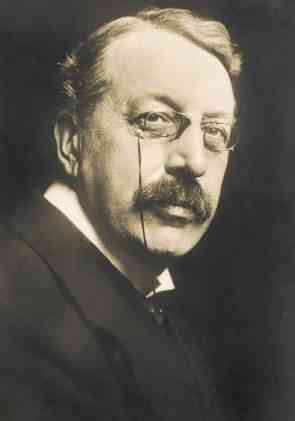
Charles Stanford
Source: Hyperion
Born on 30 September 1852 in Dublin, Sir Charles Villiers Stanford is the first Irish composer to see these histories and is squarely representative of the Victorian Era in the United Kingdom. Excluding all works prior to 1875 from his catalogue, Stanford had written seven symphonies, nine operas, eleven concertos, 28 chamber works, 40 choral works and a few Masses in addition to incidental music, pieces for piano and organ as well as songs. Stanford was a conservative Anglican.
Stanford, whose father was a prominent lawyer, was composing by age eight, a march in D flat appearing in September 1860, performed at the Royal Theatre in Dublin three years later, eventually published in an 1898 issue of 'Musical Times' [Dibble]. Entering into the Royal Academy of Music at age ten, he later attended a couple of colleges while continuing to compose before entering Cambridge in 1870. Becoming a member of the Cambridge University Musical Society (CUMS) that year.
Stanford was instrumental to gaining the admittance of women by creating a vocal guild in 1872 that included females, putting the CUMS choir, without them, to task. Finally recognizing that not a few compositions did indeed call for women in a chorus, those in Stanford's Amateur Vocal Guild were admitted to the CUMS as associates and the two choirs were combined.
Stanford's Opus 1 is assigned to '8 Songs from The Spanish Gypsy' from the recent prose-poem by George Eliot. Stanford likely composed these songs from 1872 to 1875, published in portions beginning in 1873, first performed in 1877. Stanford's 'Symphony No.1' in B flat major is a WoO (Without Opus) composed in 1876 toward its first performance on 8 March 1879 at the Crystal Palace. It was neither performed again nor published in Stanford's lifetime. Charles had written this symphony for a competition presented by the Alexandra Palace. Out of 46 competitors Stanford was rewarded with five pounds at second place, equivalent to £794 today [Webster].
'Blue Wings' from '8 Songs from The Spanish Gypsy' No.1 of 8 of Op 1
Song by Sir Charles Stanford
Composition 1872-75 Premiere 1877
Text: George Eliot 1868
Piano: Helmut Deutsch Mezzo-soprano: Stella Grigorian
'The Radiant Dark' from '8 Songs from The Spanish Gypsy' No.8 of 8 of Op 1
Song by Sir Charles Stanford
Composition 1872-75 Premiere 1877
Text: George Eliot 1868
Piano: Helmut Deutsch Mezzo-soprano: Stella Grigorian
'Symphony No.1' WoO B-flat major Song by Sir Charles Stanford
Composition 1876 Premiere 8 March 1879 at the Crystal Palace Review
Bournemouth Symphony Orchestra David Lloyd-Jones
Land of Lost Content Wikipedia
Stanford's Op 10 was his Anglican 'Service' for Morning (starting with 'Te Deum'). Communion and Evening were first performed in 1879. Initially authored for choir and organ, it was reworked in 1903 for choir and orchestra. Come 'The Veiled Prophet', an opera WoO first performed auf Deutsch at the Hoftheatre in Hanover, Germany, on 6 February 1881 with libretto by William Barclay Squire based on Thomas Moore's 'Lalla Rookh' of 1817. Its single performance in the UK was given in Italian at the Royal Opera House in London in 1893. The prophet in this work is a Persian named McKanna who is so ugly that he must hide his visage. McKanna's enemy is Caliph Mahadi against whom he desires a warrior named Azim to lead in battle. Problem is, Azim is in love with Zelika with whom he'd prefer to flee McKanna's palace altogether.
'Te Deum' from 'Morning, Communion and Evening Service' Op 10
Church setting by Sir Charles Stanford
Composition choir and organ: 1879 Choir and orchestra: 1903
Premiere of 'Te Deum' 25 May 1879 at Trinity College Chapel in Cambridge
Text: Speculative / 4th century
Organ: Geraint Bowen
Hereford Cathedral Choir Roy Massey
Overture to 'The Veiled Prophet of Khorassan' WoO Sir Charles Stanford
Premiere 6 Feb 1881 at the Hoftheatre in Hanover, Germany
Libretto: William Barclay Squire
National Symphony Orchestra of Ireland Colman Pearce 1997
Boosey IMSLP Opera Wire Wikipedia
Stanford's 'Symphony No.2' ('Elegiac') in D minor is another WoO that saw performance in 1882 but wasn't published until 1921. Stanford became a founding professor at the Royal College of Music (RCM) in 1883. From 1885 to 1902 he conducted the Bach Choir in London. 'Symphony No.3' ('The Irish') in F minor Op 28 saw conducting by Hans Richter at St. James Hall in London on 27 June 1887. Stanford began teaching at Cambridge later that year, succeeding George Alexander Macfarren upon the latter's death in October.
'Symphony No.2' WoO D minor Sir Charles Stanford
Premiere 1882
Ulster Orchestra Vernon Handley
'The Lord is My Shepherd' WoO Anthem by Sir Charles Stanford
1886
Magdalen College Choir Oxford John Harper
'Symphony No.3' Op 28 F minor Sir Charles Stanford
Premiere conducted by Hans Richter 27 June 1887 at St. James Hall in London
Ulster Orchestra Vernon Handley
American Symphony Orchestra IMSLP Land of Lost Content Wikipedia
'Symphony No.4 Op 31 F major Sir Charles Stanford
Premiere conducted by Stanford 14 Jan 1889 in Berlin
Ulster Orchestra Vernon Handley
Classical Source IMSLP Wikipedia
'Symphony No.5 Op 56 D major Sir Charles Stanford
1894 Premiere 1895
Ulster Orchestra Vernon Handley
In 1898 Stanford composed another setting for 'Te Deum', that Op 66 in B flat major toward publishing the next year in 1998 by Boosey in London and Breitkopf und Härtel in Leipzig. Stanford's seventh opera, 'Much Ado About Nothing' Op 76a, saw conducting by Luigi Mancinelli at the Royal Opera House on 30 May 1901. That was with libretto by Julian Sturgis after Shakespeare's eponymous play of 1600.
'Te Deum laudamus' from 'Te Deum' No,1 of 6 of Op 66 Church setting by Sir Charles Stanford
1897 Published 1898
Text: Speculative / 4th century
Zürich Camerata Cantabile Orchester Stephan Fuchs Fraumünster 2023
IMSLP MusicWeb International Score
'Tell me, who told you so?' from 'Much Ado About Nothing' Op 76a
Opera by Sir Charles Stanford
Premiere conducted by Luigi Mancinelli on 30 May 1901 at the Royal Opera House in London
Libretto: Julian Sturgis after William Shakespeare
Soprano: Daire Halpin Baritone: Wolfgang Resch
European Union Youth Orchestra Laurent Pillot London 2013
'Clarinet Concerto' Op 80 A minor Sir Charles Stanford
1902 Premiere June 1904 at Queen’s Hall in London Published 1977
Clarinet: Robert Plane
Bournemouth Symphony Orchestra David Lloyd-Jones
'Stabat Mater' Op 96 A minor Sir Charles Stanford
1906 Libretto: Jacopone da Todi
Soprano: Ingrid Attrot Leeds Philharmonic Chorus BBC Philharmonic
Wikipedia
Stanford's Easter anthem, 'Ye Choirs of New Jerusalem' Op 123 is thought written in 1910-11:
'Ye Choirs of New Jerusalem' Op 123 Anthem by Sir Charles Stanford
Setting to Easter hymn of 1850 by Robert Campbell
1910 or 1911
Choir of New College in Oxford
'Ye Choirs of New Jerusalem' Op 123 Anthem by Sir Charles Stanford
Setting to Easter hymn of 1850 by Robert Campbell
1910 or 1911
Trinity Church Choir in Esbjerg, Denmark
'Symphony No.7' Op 124 D minor Sir Charles Stanford
Finished 6 Feb 1911 Premiere conducted by Stanford on 22 Feb 1912
Ulster Orchestra Vernon Handley
'Irish Rhapsody No.3' Op 137 D major Sir Charles Stanford
For cello and orchestra 1912 Premiere 20 Oct 1987
Cello: Raphael Wallfisch
Ulster Orchestra Vernon Handley
Sometime during World War I (1914-18) Stanford moved from London to Windsor to evade aerial bombing. During the War he composed 'The Critic' or 'An Opera Rehearsed' Op 144 in 1915, his fifth 'Irish Rhapsody' Op 147 in 1917, works for piano, sonatas for organ and his 'Magnificat' Op 164 in B-flat major in 1918.
'Organ Sonata No.1' Op 149 F major Sir Charles Stanford
Finished May 1917
Cello: Raphael Wallfisch
Ulster Orchestra Vernon Handley
'Magnificat' Op 164 B-flat major Sir Charles Stanford
Finished Sep 1918
Choir of Winchester Cathedral
'Magnificat' Op 164 B-flat major Sir Charles Stanford
Finished Sep 1918
Trinity Episcopal Cathedral Choir
Stanford's final opera, 'The Travelling Companion' Op 146, was published in London by Stainer & Bell in 1919 six years before its first performance, posthumous, at the David Lewis Theatre in Liverpool on 30 April 1925. Henry Newbolt wrote the libretto for that from the eponymous fairy tale of 1835 by Hans Christian Andersen. The traveling companion in this work is a spirit who begins to accompany a young John who has prevented a couple of men from robbing a corpse by giving them all his recently inherited money. This companion then helps John win the love of a riddling Princess by decapitating a troublesome wizard. This wasn't a popular work at the time and has been ignored ever since.
Prelude to 'The Travelling Companion' Op 146 Opera by Sir Charles Stanford
Premiere 30 April 1925 at David Lewis Theatre in Liverpool
Libretto: Henry John Newbolt after Hans Christian Andersen
New Sussex Opera Orchestra Toby Purser
Bachtrack IMSLP New Sussex Opera
Opera Today Planet Hugill Score Stanford Society
Another of Stanford's ignored works is his 'Mass via Vitrix' in F minor Op 173 dated 14 December 1919. Around 1921 Stanford began to give public lectures, one in January of 1921 titled 'On Some Recent Tendencies in Composition' in which his conservatism is apparent in his treatment of younger composers. That was published as Chapter 7 of his 1922 'Interludes'. Stanford gave his last public performance on 5 March of 1921, conducting his cantata, 'At the Abbey Gate' in C major Op 177. 'At the Abbey Gate' had been composed the year before with a libretto by Charles John Darling.
Gloria to 'Mass via Vitrix' Op 173 F minor Sir Charles Stanford
Finished 4 Dec 1919 Premiere 27 Oct 2018
BBC National Chorus and Orchestra of Wales Adrian Partington
Church Times IMSLP Seen and Heard International WTJU Wyastone
'At the Abbey Gate' Op 177 C major Cantata by Sir Charles Stanford
For baritone / chorus / orchestra
1920 Premiere 5 March 1921
Text: poem by C. J. Darling
Baritone: Gareth Brynmor John
BBC National Chorus and Orchestra of Wales Adrian Partington
According to the author(s) at Wikipedia Stanford's final composition was, 'Irish Rhapsody 6' Op 191 for violin dated 17 September 1922. His last Opus, however, is assigned to '3 Idylls' for organ Op 194 of unidentified date.
'Irish Rhapsody No.6' Op 191 C major Cantata by Sir Charles Stanford
Published 1923
Violin: Lydia Mordkovitch
Ulster Orchestra Vernon Handley
'The Angelus' from 'Three Idylls' No.3 of Op 194 Final Opus by Sir Charles Stanford
Date unknown
Organ: Daniel Cook
Stanford's health had begun to decline about the time he turned seventy. He died of stroke in London on 29 March 1924, having composed some 260 works in addition to several arrangements or educational projects as well as several books addressing music history or theory.
Sources & References for Charles Stanford:
Blair Johnston (All Music)
VF History (notes)
Audio of Stanford: Corpora:
Contemporary Music Centre Ireland
Hyperion (England)
MuziekWeb (Netherlands)
UCSB (cylinders / 1910-17)
Audio of Stanford: Individual:
Ye Choirs of New Jerusalem (Op 123/ 1911 / Choir of Clare College Cambridge / Graham Ross / organ by Matthew Jorysz / 2016)
Authorship: Chronological:
Studies and Memories (Constable / 1908)
Musical Composition (Macmillan / 1911 / 1949)
Pages from an Unwritten Diary (Edward Arnold / 1914 / IMSLP)
History of Music (Macmillan / 1918 / 1926)
On Some Recent Tendencies in Composition (Proceedings of the Musical Association / Taylor & Francis / 1921)
Interludes (John Murray / 1922)
The Bach Choir (London / 1876):
The Bach Choir Wikipedia YouTube
See also The Bach Choir (Bethlehem, Pennsylvania / 1900)
Compositions: Corpora:
Classic Cat (by genre)
CPDL (by genre)
IMSLP (by Opus)
Klassika (by genre)
John F. Porte (by Opus)
QWerty (by genre / Russian)
Rate Your Music (by genre)
The Stanford Society (by genre)
Wikipedia (by genre)
Wikipedia Template (by genre)
Iconography: Wikimedia Commons
Lyrics: Lieder Net
Recordings of Stanford: Catalogs:
DAHR (shellac 1900-41)
Ye Choirs of New Jerusalem Op 123 / 1910 or 11)Recordings of Stanford: Select:
The Complete Organ Works - 1 (Daniel Cook on the organ of Westminster Abbey / 2012)
The Complete Organ Works - 4 (Daniel Cook on the organ of Westminster Abbey / 2017)
Mass Via Victrix (Op 173 / 1919 / BBC National C & O of Wales / Adrian Partington / 2019)
Requiem (Op 63 / 1897 / RTÉ Philharmonic Choir / RTÉ National Symphony Orchestra / 2004)
Stanford: Sonatas for Organ (Joseph Payne / 1994)
Stanford: A Song for Agincourt (Op 168 / Ulster Orchestra / Howard Shelley / 2004)
Stanford: Te Deum | Elegiac Ode (Op 66 | Op 21 / BBC National Chorus of Wales / Adrian Partington / 2024)
Scores / Sheet Music: Corpora:
Abe Books (vendor)
bokus (vendor)
Musicalics (vendor)
Free-scores (vendor)
Scores / Sheet Music: Individual (not listed above):
At the Abbey Gate (Op 177 / 1920): CPDL MusOpen
Ye Choirs of New Jerusalem (Op 123 / 1910 or 11): CPDL James and Claire
Further Reading:
Adèle Commins (Charles Villiers Stanford’s Experiences with and Contributions to the Solo Piano Repertoire)
Christopher Howell (Stanford's Couples / duality of compositions / 1997)
IMDb (usage of Stanford in film)
Jonathan White (The Symphonies of Charles Villiers Stanford: Constructing a National Identity?)
Bibliography:
Jeremy Dibble (Charles Villiers Stanford: Man and Musician / Oxford University Press / 2001)
(Charles Villiers Stanford: Some Aspects of His Work and Influence / Proceedings of the Musical Association / 1926-27) (Stanford and the Gods of Modern Music / The Musical Times / 1890)Paul Rodmell (Charles Villiers Stanford / biography / Routledge / 2017)
Authority Search: BMLO BNF Data
Other Profiles:
George Predota (Interlude)
Wikipedia International: Dutch Italian
Classical Main Menu Modern Recording
|
|