
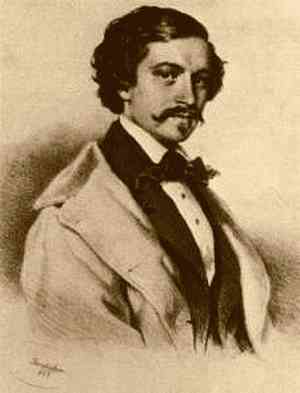
Johann Strauss II
Source: Wikipedia
Born on 25 Oct0ber 1825 in Ulrich near Vienna, Johann Strauss II (also Junior, the Younger or simply Johann Strauss) was son to Johann Strauss I of the Strauss musical dynasty behind not the waltz, but the Viennese waltz. The Strauss musical dynasty yet exists in rock guitarist, Nita Strauss. Strauss II composed more than 500 works including fifteen complete operettas, some eleven quadrilles, numerous waltzes and polkas, as well as a couple marches [the operetta, quadrille, polka and march].
Strauss II (aka the "Waltz King") was a legitimate son, his father having more children by his mistress than his wife. He received a whipping at age seven for playing violin, his father intending him to become a banker, the life of a musician too much a gamble with ruin. Upon Strauss I taking a mistress Strauss II obtained his mother's blessing to pursue music. He then acquired a succession of a few teachers, composing a sacred gradual in 1844: 'Tu qui regis totum orbem'. Strauss also made his debut professional performance that year at the Donmayer Casino in Heitzing where he performed his Op 1, a waltz titled 'Sinngedichte'. That was highly popular, calling for nineteen more performances.
'Sinngedichte' ('Epigrams') Op 1 Waltz by Johann Strauss II
1844
Austrian Radio Symphony Orchestra Peter Guth 1992
Young Strauss lived during a period when all Europe was coming to odds with the monarchical system of the Austro-Hungarian Habsburgs, the same which had powered the Holy Roman Empire for centuries before Napoleon shut it down. Among Johann's first confrontations with such the scenario was getting arrested, then acquitted, for performing the revolutionary anthem, 'La Marseillaise' (1792).
Upon his father's death in 1849 Strauss joined his father's orchestra to his own and toured Austria-Hungary, Poland and Germany, popularly waltzing along alike his father. Shortly before a tour of Germany he wrote the waltz, 'Mephistos Höllenrufe' ('Mephistopheles Cries from Hell') in 1851. Its performance at the Vienna Volksgarten was likeable enough to be repeated thrice. Johann's waltz, 'Liebslieder' ('Love Songs') arrived to the Vienna Volksgarten on 18 June 1852.
'Mephistos Höllenrufe' Op 101 Waltz by Johann Strauss II
'Mephistopheles Cries from Hell'
1851
Wiener Philharmoniker Zubin Metha
'Liebeslieder' ('Love Songs') Op 114 Waltz by Johann Strauss II
Premiere 18 June 1852 at the Vienna Volksgarten
Wiener Philharmoniker Riccardo Muti
Strauss experienced a nervous breakdown in 1853. He made the first of his annual trips to Russia in 1856, touring there each year until 1865. During that period he wrote the 'Tritsch-Tratsch-Polka' ('Chit Chat Polka' referring to gossip) toward its premiere in Vienna on 28 November 1858. The waltz, 'Hell und Voll' ('Bright and Full'), was performed at a medical students ball at the Sofiensaal in Vienna on 25 January 1859. Come his waltz, 'Morgenblatter' (Morning Journals'), to the Sofiensaal in Vienna on 8 January 1863.
'Tritsch-Tratsch-Polka' Op 214 Waltz by Johann Strauss II
'Chit Chat Polka'
Premiere 28 Nov 1858 at the Zum Großen Zeisig in Vienna
Slovak Radio Symphony Orchestra Ondrej Lenard
'Hell und voll' Op 216 Waltz by Johann Strauss II
'Bright and Full'
Premiere 25 Jan 1859 at the Sofiensaal in Vienna
Slovak State Philharmonic Christian Pollack
'Morgenblätter' Op 279 Waltz by Johann Strauss II
'Morning Journals'
Premiere 12 Jan 1864 at the Sofiensaal in Vienna
Wiener Philharmoniker Nikolaus Harnoncourt
Strauss premiered the waltz, 'An der schonen blauen Donau' ('On the Beautiful Blue Danube') in Vienna on 15 February 1867. Only three days later he premiered 'Künstlerleben' ('Artist's Life') on 18 February 1867. The next year he published the waltz, 'G'schichten aus dem Wienerwald' ('Tales from the Vienna Woods'). His 'Egyptian March' Op 335 was commissioned for the inauguration of the Suez Canal officiated by Emperor Franz Joseph I of Austria (1830-1916) on 17 November 1869. It was performed, however, not at Port Said, but earlier in St. Petersburg on 6 July 1869 as the 'Tscherkenssen-Marsch' ('March of the Circassians'). This march is representative of the alla turca style, being less Turkish than interpretive of Turkish by European composers.
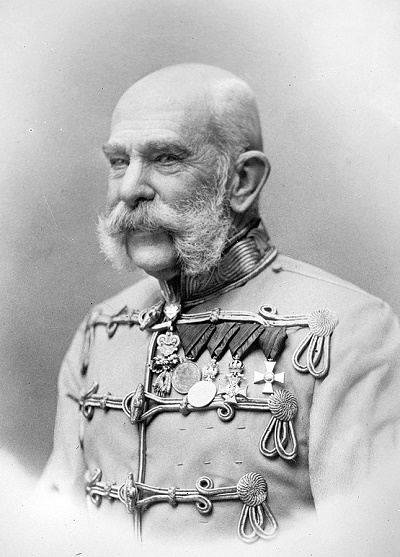
Emperor Francis Joseph I of Austria
C 1892
Source: Wikipedia
'An der schonen blauen Donau' Op 314 Waltz by Johann Strauss II
'On the Beautiful Blue Danube'
Premiere 15 Feb 1867 in Vienna
Symphony Orchestra of the Józef Marcin Żebrowski Music School
Zygmunt Nitkiewicz
Polish National Opera House in Warsaw 27 Sep 2016
'Künstlerleben' Op 316 Waltz by Johann Strauss II
'Artist's Life'
Premiere 18 Feb 1867 in Vienna
Austrian Radio Symphony Orchestra Peter Guth
'G'schichten aus dem Wienerwald' Op 325 Waltz by Johann Strauss II
'Tales from the Vienna Woods'
Composed and published 1868
Wiener Philharmoniker Willi Boskovsky
'Egyptischer Marsch' Op 325 March by Johann Strauss II
Premiere as the 'Tscherkenssen Marsch' on 6 July 1869 in St. Petersburg
Polish Youth Symphony Orchestra in Bytom Maciej Tomasiewicz
Strauss II composed fifteen complete operettas, three unfinished. The first two of the latter were 'Die lustigen Weiber von Wien' (c 1868) and 'Romulus' (c 1871). His initial operetta to see stage was 'Indigo und die vierzig Räuber' at the Theater an der Wien on 10 February 1871. The libretto was supplied by Maximilian Steiner borrowing from 'Ali Baba and the Forty Thieves'.
Overture to 'Indigo und die vierzig Räuber'
('Indigo and the Forty Thieves')
Operetta by Johann Strauss II
Premiere on 10 Feb 1871 at the Theater an der Wien
Libretto: Maximilian Steiner
Slovak Philharmonic Orchestra Johannes Wildner 1999
Russia wasn't the only frontier which Strauss II visited. He is the first composer in the VF History to have crossed the Atlantic to perform in the United States where he gave his first concerts in Boston in June of 1872. He is thought to have prepared for that trip with a compilation of waltzes called 'Greeting to America'. Setlist has Johann performing his 'Jubilee Waltz' on 29 June 1872 at the World's Peace Jubilee and International Musical Festival in Boston. Numerous concerts were given in Boston before Strauss and wife took a train to New York City to there deliver three more performances to include the 'Manhattan Waltzes' dedicated to the city of New York and premiering on 12 July at the Academy of Music. Strauss may have performed his earlier 'Künstlerleben' (above) in America as well. Between Boston and NYC, Strauss found New York closer to his European tastes, yet had a jarring experience in his visit to the United States. He didn't like the hustle and bustle of traveling, but Americans had money to blow and rewarded him richly prior to his greatly relief to finally get back on a boat to Europe.
Adding to the historical event of a major European composer visiting America was Strauss' performance at the World's Peace Jubilee and International Musical Festival in Boston. The World's Peace Jubilee and International Musical Festival was arranged by impresario, Patrick Gilmore, the Peace Jubilee Coliseum [Celebrate Boston] erected to that purpose. It was designed to hold 60,000 in audience and 22,000 musicians. It opened to only 15,000. Strauss is said to have performed Verdi's 'Il Trovatore' with an orchestra of 2,000, a chorus of 20,000 (larger than the audience) and a hundred Boston firemen in red shirts with 100 anvils. The World's Peace Jubilee was also notable in the hiring of the gospel group, the Fisk Jubilee Singers [HMR Project / Wikipedia], the first time black musicians received major billing at a significant venue. Those in the audience who didn't walk out in disgust, so it is said, were treated to a highly acclaimed performance.
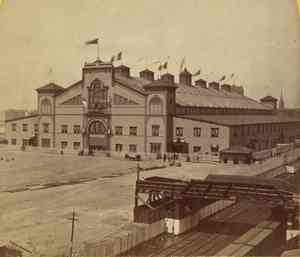
Peace Jubilee Coliseum 1872
Source: Good Old Boston
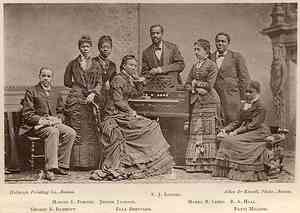
Fisk Jubilee Singers
Sometime in the seventies after formation in 1871
Source: Antiwar Songs
'Greeting to America' Waltz by Johann Strauss II
Premiere June 1872 at the Peace Jubilee Coliseum at Boston
Slovak Philharmonic Orchestra Michael Dittrich
'Manhattan Waltzes' Waltz by Johann Strauss II
Premiere 12 July 1872 at the Academy of Music in NYC
Final performance in America
Slovak Radio Symphony Orchestra Jerome Cohen 1996
As for Strauss, while yet in the United States he is thought to have compiled 'Farewell to America' before returning to Europe with truly international fame, "international" now meaning not but German versus Italian composers competing in London or Paris, but including Russia and the United States across an ocean as well. Thematically similar to his 'Manhattan Waltzes' is his 'Bouquet No.1' which premiered in Vienna on 1 January 1873.
'Farewell to America' Waltz by Johann Strauss II
Premiere 12 July 1872 at the Academy of Music in NYC
Final performance in America
Slovak Radio Symphony Orchestra Jerome Cohen 1996
'Bouquet No.1' Op 135 Waltz by Johann Strauss II
Premiere 1 Jan 1873 in Vienna
Slovak State Philharmonic Orchestra Christian Pollack 1995
Johann staged his second complete operetta, 'Der Karneval in Rom', at the Theater an der Wien on 1 March 1873 with libretto by Josef Braun and Richard Genée Victorien Sardou's 1861 'Piccolino'. On 22 April 1873 Strauss premiered his waltz, 'Wiener Blut' Op 354. 'Wiener Blut' was composed to celebrate the wedding of Prince Leopold of Bavaria with Archduchess Gisela Louise Maria (daughter of Austrian Emperor Franz Joseph I above). This was also Johann's debut conducting the Vienna Philharmonic Orchestra founded in 1842, heretofore refraining to be employed in the production of "light" or "pops" music.
Overture to 'Der Karneval in Rom' Operetta by Johann Strauss II
Premiere 1 March 1873 at the Theater an der Wien
Libretto: Joseph Braun / Richard Genée
K&K Ballet & Philharmoniker Matthias Georg Kendlinger 2011 in Kopenhagen
'Wiener Blut' ('Viennese Blood') Op 354 Waltz by Johann Strauss II
Premiere 22 April 1873 in Vienna
CSR Symphony Orchestra Ondrej Lenard Bratislava
Guide to Light Opera et Operetta John Palmer Wikipedia
Strauss's 'Die Fledermaus' ('The Bat') was performed at the Theater an der Wien on 5 April of 1874 with libretto by Richard Genée and Carl Haffner. His waltz, 'Du und du' ('You and You'), was wrought out of 'The Bat' when it arrived in 1874.
Overture to 'Die Fledermaus' ('The Bat') Operetta by Johann Strauss II
Premiere 5 April 1874 at the Theater an der Wien
Libretto: Karl Haffner / Richard Genée
Wiener Philharmoniker Herbert von Karajan New Year's Concert 1987
Guide to Light Opera et Operetta IMSLP Patsy Morita Wikipedia
'Du und du' ('You and You') Op 357 Waltz by Johann Strauss II
1874
Wiener Philharmoniker Mariss Jansons
'Myrthenblüthen Walzer' Op 395 Waltz by Johann Strauss II
'Myrtle Blossoms Waltz'
Premiere 7 May 1881 at the Hofburg Palace Ballroom
Otto Schulz-Biedermeier Orchestra Piano: Dr. Taka S. Otagawa
Strauss premiered five more operettas in Vienna before a Berlin performance of the famous comedy, 'Eine Nacht in Venedig' ('A Night in Venice'), at the Friederich-Wilhelmstädtisches Theater on 3 October of 1883 with text by Camillo Walzel and Richard Genée. That would have gone down well but for a faulty libretto which, upon quick reworking, was performed again in Vienna on 9 October 1883 toward 44 consecutive performances.
Selections from 'Eine Nacht in Venedig' Operetta by Johann Strauss II
'A Night in Venice'
Premiere 3 Oct 1883 in Berlin
Libretto: F. Zell / Richard Genée
Orchestra: various
Guide to Light Opera et Operetta Josef Weinberger Ltd. Wikipedia
He followed that back at the Theater an der Wien on 24 October 1885 with 'Der Zigeunerbaron' ('The Gypsy Baron') with libretto by Sydney Rosenfeld. That found its way to New York for staging at the Casino Theatre in 1886. In the meantime Strauss pulled melody from 'The Gypsy Baron' for 'Schatz-Walzer' ('Treasure Waltz'). In the meantime Strauss traveled to Russia again where he premiered his 'Marche des Gardes à Cheval' ('March of the Horse Guards') on 29 April 1886 (Russian calander 17 April) in St. Petersburg. That was a tribute to the Tsar's bodyguard at whose riding school Strauss conducted concerts there. Strauss had also written two waltzes and a polka for that trip, invited by the Russian Society of the Red Cross to give charity concerts. It had been seventeen years since Johann's last visit to Russia and this would be his last.
Overture to 'Der Zigeunerbaron' Operetta by Johann Strauss II
'The Gypsy Baron'
Premiere 24 Oct 1885 at the Theater an der Wien
Libretto: Ignaz Schnitzer
Ulm Philharmonic James Allen Gähres
Guide to Light Opera et Operetta Guide to Musical Theatre
'Schatz Walzer' Op 418 Waltz by Johann Strauss II
'Treasure Waltz'
Premiere 24 Oct 1885 at the Theater an der Wien
Wiener Johann Strauss-Orchester Willi Boskovsky
'Russischer Marsch' Op 426 March by Johann Strauss II
'Russian March'
Aka 'Marche des Gardes à Cheval' ('March of the Horse Guards')
Premiere 29 April 1886 (17 April Russian) in St. Petersburg
Admiralty Navy Band of the Leningrad Naval Base
Captain-lieutenant Nikita Ignatov
Concert Hall of the St.Petersburg State Academic Capella
28 Dec 2023
Johann left his 'Der Schelm von Bergen' written circa 1886 unfinished, but premiered 'Simplicius' at the Theater an der Wien on 17 December 1887. Libretto was by Victor Léon borrowed from Grimmelshausen's 1668 'Adventurous Simplicissimus'. This operetta concerns the adventures of the son, Simplicius, of the hermit, Wendelin, who joins the army, falls in love, becomes a hero and rises to lieutenant in the latter part of Thirty Years' War (1618–1648).
Overture to 'Simplicius' Operetta by Johann Strauss II
Premiere 17 Dec 1887 at the Theater an der Wien
Libretto: Victor Léon from Grimmelshausen's 1668 'Adventurous Simplicissimus'
Slovak State Philharmonic Orchestra Alfred Walter 1996
Bruce Eder Guide to Musical Theatre
In addition to Johann's Egyptian and Russian marches (above) he had earlier composed a 'Persian March' Op 289 in 1864 and a recent 'Reitermarsch' ('Cavalry March') Op 428 in latter 1887. Now he dedicated his 'Spanish March' to María Cristina, regent of Spain, that instead of traveling there. Instrumentation included castanets and was conducted by Johann's brother, Edward Strauss, in Vienna on 21 October 1888.
'Spanischer Marsch' March by Johann Strauss II
1888
Wiener Philharmoniker Mariss Jansons
Johann's 'Kaiser Waltzer' (Emperor Waltz') was originally titled 'Hand in Hand' as a gesture of friendship from Austria-Hungary's Franz Joseph I (above) to Germany's Wilhelm II. It was performed in Berlin on 21 October 1889. Come Johann's 'Gross-Wien' ('Great Vienna') for performance at Fasching ('Carnival') in November or December of 1889. This is a choral waltz authored for the Vienna Men's Choral Association with text by Franz von Gernerth. It was first performed by orchestra only on 10 May 1891, though an orchestra of 500 musicians from multiple military bands conducted by Strauss. Its choral version wasn't performed until 4 October 1891 with the chorus led by Eduard Kremser. 'Gross-Wien' marked the occasion of having incorporated 44 suburbs into the city of Vienna, giving it a population of 1,342,000 with 22,600 military. It took up nearly three times as much space as Berlin and was more than twice the size of Paris, though only half that of London.
'Kaiser Walzer' ('Emperor Waltz') Op 437 Waltz by Johann Strauss II
Premiere 21 Oct 1889
Wiener Philharmoniker Mariss Jansons
Jonathan Fenwick IMSLP Wikipedia
'Gross Wien' ('Great Vienna') Op 440 Waltz by Johann Strauss II
Premiere 10 May 1891 w orchestra of 500 conducted by Strauss
4 Oct 1891 w chorus led by Eduard Kremser
Slovak Philharmonic Orchestra Alfred Walter
On New Year's Day of 1892 Strauss' only opera, his three-hour comic 'Ritter Pázmán' Op 441, premiered at the Hofoper (Vienna State Opera) with libretto by Ludwig Dóczi based on the Hungarian poem, 'Pázmán Lovag', by János Arany. Pázmán is a fourteenth century Hungarian knight with a kissable wife. The czardas [Wikipedia] below is from the ballet in the third act. The czardas is a traditional Hungarian folk dance, so-called from "csárda" which was a roadside inn. It was originally a military dance celebrating the death of an enemy.
Czardas from ballet of Act 3 of 'Ritter Pázmán' Op 441
'Knight Pázmán'
Opera by Johann Strauss II
Premiere 1 Jan 1892 at the Hofoper in Vienna
Lajos Dóczi from a poem by János Arany
Wiener Philharmoniker Willi Boskovsky
Kevin Clarke IMSLP Score Wikipedia
Johann's 'Fürstin Ninetta' appeared at the Theater an der Wien on 10 January 1893 prior to staging 'Jabuka' ('The Apple Festival') on 10 October 1894 with libretto by Max Kalbeck and Gustav Davis.
Prelude to Act 1 of 'Fürstin Ninetta' ('Princess Ninetta')
Operetta by Johann Strauss II
Premiere 10 Jan 1893 at the Theater an der Wien
Libretto: Julius Bauer / Hugo Wittmann
Stockholm Strauss Orchestra Valéria Csányi
Kevin Clarke IMSLP Libretto Berth Vestergård
Prelude to Act 1 of 'Jabuka' Operetta by Johann Strauss II
Premiere 12 Oct 1894 at the Theater an der Wien
Libretto: Max Kalbeck / Gustav Davis
Gaudeamus Choir Brno European Johann Strauss Orchestra
Christian Pollack
Guide to Musical Theatre IMSLP Uncle Dave Lewis Wikipedia
Strauss staged his next to last operetta, 'Waldmeister' ('Woodruff' - the flowering plant), at the Theater an der Wien on 4 December 1895 with a libretto by Gustav Davis. The woodruff in this story is both a dubitable new species of the plant and a potion.
Overture to 'Waldmeister' ('Woodruff') Operetta by Johann Strauss II
Premiere 4 Dec 1895 at the Theater an der Wien
Libretto: Gustav Davis
Orchestra of the Berlin Municipal Opera Artur Rother
That was followed by Strauss's final operetta, 'Die Göttin der Vernunft', on 13 March 1897. This is the solitary premiere of a work by Strauss which he didn't either conduct or attend. He waited at home with a bronchial condition for news by telephone of the work's reception. Johannes Brahms, however, was in the audience, making a last appearance in public before dying in April. Set in Châlons in 1794 during the Reign of Terror of the French Revolution, the Goddess of Reason in this story refers to the Cult of the Supreme Being with which Robespierre had proposed to replace Christianity, there public displays of the "Goddess" organized by activists throughout France, including someone to assume that role (as concerns this operetta). One example of such was a procession of the Supreme Goddess to Notre Dame Cathedral. Napoleon put an end to both that and the atheist Cult of Reason in 1802.
Overture to 'Die Göttin der Vernunft' ('The Goddess of Reason')
Final operetta by Johann Strauss II
Premiere 13 March 1897 at the Theater an der Wien
Libretto: A. M. Willner / Bernhard Buchbinder
Swedish Radio Symphony Orchestra Okko Kamu
Wikipedia English Wikipedia German
Strauss' last work to receive an opus number (numerous unassigned) is his musical prelude, 'Klänge aus der Raimundzeit' ('Sounds from the Raimund Era') Op 479 which was performed on 31 May 1898 at the unveiling of a monument to the actor and dramatist, Ferdinand Raimund (1790–1836).
'Klänge aus der Raimundzeit' ('Sounds from the Raimund Era')
Musical prelude by Johann Strauss II Final opus as Op 479
Premiere 31 May 1898 at the Deutsches Volkstheater in Vienna
Berliner Symphoniker Robert Stolz 1971
Strauss left his only ballet, 'Aschenbrödel' ('Cinderella') unfinished upon his death of pneumonia on 3 June 1899 in Vienna. Though entirely sketched, orchestration needed filling which was accomplished by Josef Bayer in 1900.
Act 2 of 'Aschenbrödel' ('Cinderella')
Ballet by Johann Strauss II
Sketch by Strauss 1899 Orchestration by Josef Bayer 1900
Premiere 2 May 1901 in Berlin
National Philharmonic Orchestra Richard Bonynge
Kevin Clarke Bruce Eder Wikipedia
Strauss' 1873 'Wiener Blut' had been staged again several months after his death at the Carltheater in Vienna on 26 October 1899.
Sources & References for Johann Strauss II:
VF History (notes)
Audio of Johann Strauss II:
Idagio (Mephistos Höllenrufe / 1851 / Wiener Philharmoniker / Willi Boskovsky / 1997)
Idagio (Eva Walzer from Ritter Pázmán / 1892 / Wiener Philharmoniker / 1993 / 2019)
Compositions:
By genre:
By Op (479):
Johann Strauss Society of Great Britain
Johann Strauss Society of New York
Operettas (15 complete / 3 incomplete)
Usage of Strauss II in Film: IMDb
Recordings of Strauss II: Catalogs:
DAHR (shellac 1898-1950)
Recordings of Strauss II: Select:
Der Carneval in Rom (2nd operetta / 1873 / C & O of the Staatsoperette Dresden / Ernst Theis / 2008):
Classical Archives MusicWeb International Presto
The Gypsy Baron (C & O of the Vienna Volksoper / Anton Paulik / 1956)
Johann Strauss: Aschenbrödel (1899/1900 / ORF Radio-Symphonieorchester Wien / Ernst Theis / 2014)
J. Strauss, Jr. Edition · Vol. 43 (Slovak State Philharmonic / Christian Pollack / Marco Polo 8.223243 / 1995):
About by Christian Pollack
J. Strauss, Jr. Edition · Vol. 46 (Slovak Radio Symphony Orchestra / Michael Dittrich / Marco Polo 8.223246 / 1996):
About by Michael Dittrich
J. Strauss, Jr. Edition · Vol. 47 (Bratislava City Chorus / Slovak Radio Symphony Orchestra / Johannes Wildner / Marco Polo 8.223247 / 1996):
About by Johannes Wildner
J. Strauss, Jr. Edition · Vol. 51 (Slovak Radio Symphony Orchestra / Jerome Cohen / Marco Polo 8.223279 / 1996)
Strauss II: Die Göttin der Vernunft (final operetta / 1897 / Students of the Vienna Private University Conservatory / Slovak Sinfonietta Žilina / Christian Pollack / 1993-99):
jpc MusicWeb International Naxos Presto
About by Peter Kemp / Tomas Jelinowicz
Strauss II: The Gypsy Baron (C & O of the Berlin State Opera / Otto Anderson / Naxos 8.111329-30 / 1954)
About by Malcolm Walker / Keith Anderson
Strauss II: Eine Nacht in Venedig (Philharmonia C & O / Otto Ackermann / 1955 / Naxos 8.111254 / 2007):
About by Malcolm Walker
Strauss II: Eine Nacht in Venedig (Philharmonia C & O / Otto Ackermann / 1955 / Naxos 8.111254 / 2007):
About by Berth Vestergård
Scores / Sheet Music:
Abe Books (vendor)
M&K Kreusch
Musicalics
(vendor)
Strauss Musical Dynasty:
Classic FM
Johann Strauss Society
Kara McLeland
Georg Predota
Viennese Waltz:
Jake Fuller Mark Ginsburg WikipediaWorld's Peace Jubilee and International Musical Festival (Boston 1872):
Patrick GilmoreFurther Reading:
Classical Music Guide Forums (Strauss in the United States 1872)
Bill Morelock (The Waltz King and the Land of Giants / Minnesota Public Radio / 2005)
Georg Predota (Show Me the Money / 2022)
The Theatre Magazine Company (The Theatre / Vol 25 / 1917)
Bibliography:
James M. Keller (Strauss waltzes to America / 2017)
Authority Search: BMLO
Other Profiles of Strauss II:
Vienna Institute for Strauss Research
Classical Main Menu Modern Recording
|
|