
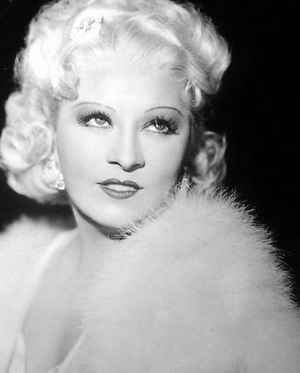
Mae West
Source: OTR Cat
Born in Brooklyn on 17 August 1893, actress, Mae West, is another bridge figure from early to modern popular music, beginning with censorship in the thirties concerning public sexuality. She began her career at age fourteen doing vaudeville, a style of variety show popular for about forty years consisting of a sequence of largely unrelated acts. Mae's work in theatre would help hasten the disappearance of vaudeville. Her work in early film help to seal its extinction as the movie palace became even more the place to go with the introduction of sound. By the time Paramount was ordered to sell its monopoly of theaters in 1948 television was already on its way toward keeping people at home.
West's first Broadway performance was in 1911 at age eighteen ('A La Broadway'). She early got into trouble with the law when she was charged with corrupting the morals of youth upon the 1926-27 staging of her first play, 'Sex', which she wrote, produced and directed. The play ran through 375 performances on Broadway before New York City police shut it down. West was sentenced to ten days in the workhouse on Roosevelt Island and fined $500. That was no small sum in those days, which West turned into an investment in notoriety, attracting the attention of Paramount Pictures. Her film debut, 'Night After Night', released in 1932. She starred in the release of 'She Done Him Wrong' in 1933, that based on her play, 'Diamond Lil'. She both helped write and starred in 'I'm No Angel' in 1933.
Excerpt from 'Night After Night' Mae West
Mae West's first film released 14 Oct 1932
Directed by Archie Mayo Screenplay by Vincent Lawrence
'A Guy What Takes His Time' Mae West Recording
Matrix B 13.037 Brunswick 6495 1933
From the film 'She Done Him Wrong'' Released 27 Jan 1933
Directed by Archie Mayo
Written by Harvey F. Thew and John Bright after West's 'Diamond Lil'
Composition: Ralph Rainger
'They Call Me Sister Honky Tonk' Mae West Recording
Matrix LA.61 Brunswick 6766 1933
From the film 'I'm No Angel' released 6 Oct 1933
Directed by Wesley Ruggles
Written by Mae West and Lowell Brentano
Composition: Harvey Brooks / Ben Ellison
'I'm No Angel' Mae West Film
Matrix LA33-A Brunswick 9529 1933
From the film 'I'm No Angel' released 6 Oct 1933
Directed by Wesley Ruggles
Written by Mae West and Lowell Brentano
Composition: Harvey Brooks / Ben Ellison
'My Old Flame' Mae West backed by the Duke Ellington Orchestra Recording
23 April 1934 Matrix PBS-79181 Biltmore 1014 / Cosmopolitan 7501
Composition: Arthur Johnston / Sam Coslow
Theatre and film were largely self-policed until 1934 when Hollywood became subject to the Hays Production Code, the release of motion pictures requiring approval from the PCA (Production Code Administration). Free speech was subject to the Code until that was declared unconstitutional in 1952. In the meantime, with sexuality finding expression in rebuttal to official moral authority, it seemed appropriate that her next film be censored from the start, the title of 'It Ain't No Sin' changed to 'Belle of the Nineties' in 1934.
Trailer to 'Belle of the Nineties' Mae West Film
Released 21 Sep 1934
Directed by Leo McCarey
Written by Mae West and Jack Wagner
Though 'Goin' to Town' in 1935 drew no fire, later films were not so polite and saw some censorship: 'Klondike Annie' (1936), 'My Little Chickadee' (1940) and 'The Heat's On' (1943). The last would be West's last film for another 27 years. In 1937 she managed to get banned from NBC radio for what the FCC considered "vulgar and indecent" speech [Murray]. She wouldn't be heard on radio again until the early fifties. In the meantime she worked in theatre in New York City. In 1966 Mae issued her rock album titled 'Way Out West'. In 1970 she played the role of Leticia Van Allen in the film, 'Myra Breckenridge', that from the book by Gore Vidal concerning a transsexual which part was played by Raquell Welch. In 1972 May issued another rock LP, 'Great Balls of Fire'. She appeared in her last film, 'Sextette', in 1978, that based on her play of the same title.
'Now I'm a Lady' Mae West Film
From the film 'Goin' to Town' released 25 April 1935
Directed by Alexander Hall
Written by Mae West / Marion Morgan / George B. Dowell
Music: Sammy Fain Lyrics: Sam Coslow / Irving Kahal
'Come Up and See Me Some Time' Mae West Film
From the film 'My Little Chickadee' released 9 Feb 1940
Directed by Edward F. Cline
Written by Mae West and W.C. Fields
Composition: Louis Alter / Arthur Swanstrom
'I'm In the Mood for Love' Mae West Recording
23 Nov 1954 in NYC Matrix 87086 Decca 91537
See the album 'The Fabulous Mae West' on Decca DL-9016 / MCA-2053
Music: Jimmy McHugh Lyrics: Dorothy Fields
'Baby It's Cold Outside' Mae West w Rock Hudson Television 1957
Composition: Frank Loesser 1944
'The Mae West Cut' Mae West Film
From the film 'Myra Breckinridge' released 24 June 1970
Directed by Michael Sarne
Written by Michael Sarne and David Giler from Gore Vidal's 'Myra Breckinridge'
'Great Balls of Fire' Mae West Recording 1972
See the album 'Sextette' on Decca DL-9016 / MCA-2053
Composition: Jack Hammer / Otis Blackwell
Trailer to 'Sextette' Mae West Film
Released 2 March 1978
Directed by Ken Hughes
Written by Mae West and Herbert Baker
Commercial for Poland Spring water Mae West Recording
Mae West's last-known recording 1979
Mae West died of stroke in Los Angeles some 2 1/2 years after the release of her last film on 22 November 1980 [obit].
Sources & References for Mae West:
Linda Seida (All Music)
VF History (notes)
Audio: Internet Archive YouTube
Chronology: PBS
Collections: Library of Congress
Documentaries:
Dirty Blonde (excerpt / PBS American Masters / 2020)
Mae West and the Men Who Knew Her (directed by Gene Feldman / Suzette Winter / 1994)
Mae West's Shocking Life Story (Remember This / 2023)
Interviews: 1976 (Dick Cavett Show)
Obituaries: YouTube
Recordings: Catalogs:
Recordings: Compilations:
Come Up and See Me Sometime (1933-54 / Living Era / 2006)
Sixteen Sultry Songs Sung By Mae West 'Queen Of Sex' (Rosetta / 1987)
Recordings: Sessionographies: DAHR (1934/54/70)
Further Reading:
Stefan Andrews (Bombshell Mae West / 2017)
Susannah McCorkle (The Immortality of Mae West / 2001)
Censorship in film: Hays Production Code (1934-68):
David P. Hayes (The Production Code of the Motion Picture Industry (1930-1967) / 2009)
Kristin Hunt (The End of American Film Censorship / 2018)
Censorship of Mae West:
Miss Cellania (The Lifelong Censorship of Mae West / 2016)
Paul Phaneuf (Censor Will vs. Diamond Lil / 2011)
Charlotte N. Toledo (She Would Not Be Silenced / The Downtown Review / Vol 3 No.2 / Cleveland State University / 2016)
Vaudeville: Library of Congress University of Virginia
Bibliography:
Thomas Doherty (Pre-Code Hollywood / Columbia University Press / 1999)
Emily Wortis Leider (Becoming Mae West / Farrar Straus Giroux / 1997)
Anthony Slide (The Encyclopedia of Vaudeville / University Press of Mississippi / 2012)
Jill Watts (An Icon in Black and White / Oxford University Press / 2003)
Authority Search: BNF Data VIAF
Classical Main Menu Modern Recording
|
|