
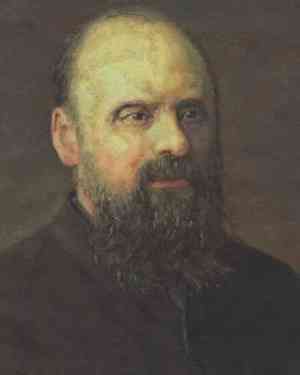
Mily Balakirev
Source: American Pink
Born on 2 January 1836 in Nizhny Novgorod about 260 miles east of Moscow, Mily Balakirev was a Russian Chopin who's goal might seemingly have been to write the most difficult music that a pianist could play. He was also leader of The Five, aka the Mighty Handful, which group concerned itself with weaning composition away from western European conservatory-grown standards to give it a nationalist Russian character of its own. The other members of that group were Alexander Borodin, César Cui, Modest Mussorgsky and Rimsky-Korsakov. Though a champion of Mikhail Glinka, Balakirev was largely an autodidact in composition, nor had any use for academic routine. Emphasizing individual direction from brick one would find Balakirev in conflict with Anton Rubinstein's St. Petersburg Conservatory founded in 1862. Another of Balakirev's important professional associations was Tchaikovsky [Tchaikovsky Research].
Though Balakirev's father, Alexey, who would die in 1869 was of a line of Russian nobility a few centuries old he occupied only the status of a titular councilor, the civilian equivalent of a military captain in Peter the Great's Table of Ranks created in 1722. Such the rank meant that Mily's father couldn't exceed his station in appointment to a government position, nor be passed up by someone of lower rank. His noble status, however, was no guarantee of a noble lifestyle, David Wright at Wright Music describing him as a poor clerk, Mily himself to struggle with poverty. Mily's mother, Elizaveta, of a more recent line of "nobility" than her husband, began to instruct Mily in piano when he was age four. He first saw Moscow for piano instruction at age ten, and was boarded at the Alexandrovsky Institute upon his mother's death of smallpox in 1847.
Balakirev led his first performance, Mozart's 'Requiem Mass in D minor', at age fourteen. His earliest surviving pieces were composed at age fourteen in 1852, an incomplete septet and 'Grande Fantasie on Russian Folksongs' Op 4. The latter didn't get published until 1954.
'Grande Fantasie on Russian Folksongs' Op 4 Mily Balakirev
Composed 1852
Russian Philharmonic Orchestra / Konstantin Krimetz
Piano: Joseph Banowetz
Mily matriculated into the University of Kazan, about 450 miles east of Moscow, in 1853. Studying mathematics, he also began to teach piano. In 1854 he left his Op 2, a string quartet, unfinished. In 1855 he met Glinka on a trip to St. Petersburg, thereat encouraged to exchange math for music. The next year saw the unfinished writing of his Op 1, 'Piano Concerto No.1' in F-sharp minor. Its one completed movement saw performing at the University of Kazan in February of 1856. IMSLP has it waiting until 1908 to be published. It was further reworked in 1910. Balakirev also composed his 'Octet' Op 3 and his first of three scherzos in 1856. His may have completed his 'Octet' Op 3 before his 'Concerto' Op 1, but I've sequenced them by opus number below. It had also been 1856 when The Five (above) came together with blessings from Alexander Serov and Dargomyzhsky.
'Piano Concerto No.1' Op 1 F-sharp minor 1 movement Mily Balakirev
Composed 1856
Russian Philharmonic Orchestra / Dmitry Yablonsky
Piano: Anastasia Seifetdinova
'Octet' C minor Mily Balakirev
Composed 1856
Piano / violin / viola / cello / bass / flute / oboe / horn
London Conchord Ensemble
'Scherzos 1-3' Mily Balakirev
'Scherzo No.1' B minor 1856 IMSLP
'Scherzo No.2' B-flat minor 1900 IMSLP
'Scherzo No.2' F-sharp major 1901 IMSLP
Piano: Alexander Paley
IMSLP has Balakirev composing 'Polka' in F sharp minor in 1857 toward publishing in 1859. It isn't determined whether that preceded or followed 'Overture on a Spanish March Theme' Op 6 of the same year. Balakirev composed his 'Overture on 3 Russian Folk Themes No.1' ('Увертюра на трёх русских народных песен') in 1858, not published until 1882. His second overture on Russian themes followed in 1864 (below). Relevantly, Rimsky-Korsakov also composed an 'Overture on 3 Russian Themes', his Op 28 of 1866 [Beggerow].
'Polka' F-sharp minor Mily Balakirev
Composed 1857
Piano: Paolo Giacometti
'Overture on a Spanish March Theme' Op 6 D minor / D Mily Balakirev
Composed 1857
State Academic Symphony Orchestra / Evgeny Svetlanov
'Overture on Three Russian Themes No.1' Mily Balakirev
Composed 1858 Revised 1882
State Academic Symphony Orchestra / Evgeny Svetlanov
Balakirev composed 'Hebrew Melody' in 1859, that set to Lord George Byron's 'My Soul Is Dark' from the latter's collection of 30 poems in 'Hebrew Melodies' published in 1815. With Byron's text translated by Mikhail Lermontov, 'Hebrew Melody' ('My Soul Is Dark') was published in 1861 as No.13 of '20 Songs'. According to Richard Stokes Balakirev set music to only one of Byron's 'Hebrew Melodies'.
'My Soul Is Dark' Mily Balakirev
Composed 1859 Text: Lord George Byron
Piano: Alexander Tcherepnin Vocal: Boris Christoff
Balakirev formed the Free School of Music in 1861 with Garial Lomakin, such become needful to establish legitimacy amidst the greater prestige of musical institutions in general. Balakirev directed the orchestral part of things, Lomakin the choral. Anton Rubinstein's Russian Musical Society (RMS) was also in the operation of education and giving concerts, the difference that Balakirev's school emphasized singing and was, as implied in its name, both less conservative and tuition-free. As well, though Balakirev was a kind man to the point of becoming a vegetarian, he was anti-Semitic, accepting no Jews at the Free School. In 1862 Balakireve left his 'Piano Concerto No. 2' in F-sharp major unfinished. That was eventually completed in 1910 by his student (as of 1885) Sergei Lyapunov, toward performance on 2 January 1911 in Berlin.
'Piano Concerto No.2' Mily Balakirev
Left incomplete 1862 Finished by Sergei Lyapunov toward premiere on 2 Jan 1911 in Berlin
Westphalian Symphony Orchestra / Siegfried Landau
Piano: Michael Ponti
Balakirev published his first of seven mazurkas in 1864. That was preceded if not followed the same year by 'Overture on 3 Russian Themes No.2'. Wikipedia has that revised in 1884. Be as may, IMSLP identifies that as the "musical picture" (rather than symphonic poem) called '1000 лет' ('1000 Years') published in 1869. That was retitled 'Россия' or 'Русь' ('Russia' or 'Rus' as Russia was once called) upon its revision in 1890, then revised again in 1907. Also notable in 1864 was Balakirev's eloquent transcription of 'The Lark' which was Song 10 of 12 in Glinka's 1840 'A Farewell to Saint Petersburg'.
'Mazurkas 1-7' Mily Balakirev
'Mazurka No.1' A-flat major 1861 IMSLP
'Mazurka No.2' C-sharp minor 1861 IMSLP
'Mazurka No.3' B minor 1886 IMSLP
'Mazurka No.4' G-flat major 1886 IMSLP
'Mazurka No.5' D major 1900 IMSLP
'Mazurka No.6' A-flat major 1902 IMSLP
'Mazurka No.7' E-flat minor 1906 IMSLP
Piano: Joseph Banowetz
'Overture on Three Russian Themes No.2' Symphonic poem by Mily Balakirev
Completed 1864 Revised 1884 [Wikipedia]
USSR Radio Grand Symphony Orchestra / Alexander Gauk
'The Lark' 1864 B-flat minor Arrangement by Mily Balakirev
Arrangement of Glinka's 1840 'A Farewell to Saint Petersburg'
Piano: Ethan David Loch
'The Lark' 1864 B-flat minor Arrangement by Mily Balakirev
Arrangement of Glinka's 1840 'A Farewell to Saint Petersburg'
Piano: Tony Scholl
Balakirev's 'Collection of Russian Folksongs' saw print in 1866, the year he made an adversary of Smetana with a criticism of the latter's production of Glinka's 1836 'A Life for the Tsar' [Wisconsin Public Radio]. Come his 'Ouverture on Czech Themes', also titled 'In Bohemia', in 1867, revised in 1905. From 1867 to 1869 Balakirev shared directorship of Rubinstein's Russian Musical Society (RMS) with Nikolai Zaremba, even as his Free School was an emphatic rival, he assuming full directorship in 1867 upon Lomakin's resignation. Balakirev's piano work, 'Islamey' Op 18, saw performance by Nikolay Rubinstein at his Free School in Moscow on 12 December 1869, including passages that Balakirev, a piano virtuoso himself, couldn't play.
'Overture on Czech Themes' aka 'In Bohemia' 1864 B-flat minor Mily Balakirev
Completed 1867
State Academic Symphony Orchestra / Evgeny Svetlanov
'Islamey' Op 18 B-flat minor / D-flat major Fantasie for piano by Mily Balakirev
Completed 1869 Revised 1902
Piano: Sandro Russo
Chetham's International Piano Festival in Manchester 27 Aug 2010
Circassian World Norbert Gertsch IMSLP George Predota Wikipedia
In 1871 Balakirev collapsed from an exhausting drive. Removing himself from the music profession, he took a job as a railroad clerk in Warsaw the next year. His mother died and he joined the Russian Orthodox Church that year as well. Rimsky-Korsakov assumed his vacant spot as director of the Free School in 1874. Mily slowly waded back into the music profession as a private teacher of theory in 1876. Resuming his place at the Free School in 1881, he finished the Oriental symphonic poem on which he'd been working since 1867, 'Tamara', in 1882.
'Tamara' B minor Symphonic Poem by Mily Balakirev
Completed 1882 Performed March 1883 in Moscow
Russian State Symphony Orchestra / Igor Golovschin
Maureen Buja IMSLP Thomas Oram George Predota Theodore Thomas Wikipedia
Balakirev became director of the Imperial Chapel Choir in 1883, also conducting for the Imperial Music Society. Per above, he received Lyapunov as a student in 1885. Retiring from the Imperial Chapel in 1895, he finished his 'Symphony No.1' in C major begun in 1864 in 1898, its first performance held in St. Petersburg on 23 April. Later on 18 October 1898 Balakirev completed 'Nocturne No.1' in B-flat minor.
'Symphony No.1' C major Mily Balakirev
Premiere 23 April 1898 in St. Petersburg
Russian State Symphony Orchestra / Igor Golovschin
Alan Beggerow IMSLP Christoph Schlüren Joseph Stevenson Wikipedia
'Nocturnes 1-3' Mily Balakirev
'Nocturne No.1' B-flat minor 1898 IMSLP
'Nocturne No.2' B minor 1901 IMSLP
'Nocturne No.3' D minor 1902 IMSLP
Piano: Alexander Paley
Balakirev entered the 20th century composing two of seven waltzes beginning with 'Waltz No.1' in G major as of 1900:
'Waltzes 1-7' Mily Balakirev
'Waltz No.1' G major 1900 IMSLP
'Waltz No.2' F minor 1900 IMSLP
'Waltz No.3' D major 1901 IMSLP
'Waltz No.4' B-flat major 1902 IMSLP
'Waltz No.5' D-flat major 1903 IMSLP
'Waltz No.6' F-sharp minor 1904 IMSLP
'Waltz No.7' G-sharp minor 1906 IMSLP
Piano: Alexander Paley
Balakirev finished his 'Humoresque' in B major in 1903. A humoresque is a short fanciful free form similar to a capriccio (caprice) which conveys a happy mood. Pianist, Nicholas Walker, has Balakirev writing three sonatas, the first a 'Grande Sonata' Op 3 in B-flat minor as of 1855. (Balakirev's 'Octet' of 1856 was also assigned Op 3.) Come 'Sonata No.1' Op 5 in B-flat minor in 1857 [IMSLP]. His third, 'Sonata No.2' Op 102 in B-flat minor didn't arrive for nearly another half century in 1905 [see Naxos].
'Humoresque' B major Mily Balakirev
Completed 1903
Piano: Alexander Paley
'Piano Sonata No.2' B-flat minor Mily Balakirev
Completed 1905
Piano: Vadym Kholodenko
Balakirev had begun his 'Symphony No.2' in D minor in 1900 toward its completion in 1908, its first performance in 1909 in St. Petersburg conducted by his student, Lyapunov. His final works of 1909 were, disregarding sequence, his symphonic 'Chopin Suite' in four movements, 'Sonatina' also called 'Esquisses' ('Sketches'), and a couple of romantic songs called 'Dawn' and 'The Rock'.
'Symphony No.2' D minor Mily Balakirev
Completed 1908
USSR Symphony Orchestra / Yevgeny Svetlanov Moscow 1987
'Sonatina' aka 'Esquisses' ('Sketches') G major Mily Balakirev
Completed 1909
Piano: Mikhail Kollontay
Balakirev died on 29 May 1910 and was buried in St. Petersburg.
Sources & References for Mily Balakirev:
Uncle Dave Lewis (All Music) VF History (notes) Wikipedia English
Audio of Balakirev: Corpora:
Audio of Balakirev: Individual:
Islamey (fantasie / 1869 / revised 1902 / Boris W. Berezovsky)
Islamey (fantasie / 1869 / revised 1902 / PianoCzarX)
Nocturne No.3 (1902 / Ryan Layne Whitney)
Symphony No.1 (1898 / Russian State Symphony Orchestra / Igorr Golovschin)
Symphony No.2 (Op 102 / 1905 / Russian State Symphony Orchestra / Igorr Golovschin)
Tamara (symphonic poem / 1882 / State Academic Symphony Orchestra / Evgenyy Svetlanov)
Waltz No.1 (1900 / Julian Jacobson)
Compositions: Corpora:
Discussion: Talk Classical
Documents: Gallica
The Five (The Mighty Handful: Balakirev / Cui / Mussorgsky / Rimsky-Korsakov / Borodin / 1856-70):
Austin M. Doub (Cedarville University / 2019)
Ella Urenn (Northern Michigan University / 2020)
Lyrics: Lieder Net
Recordings of Balakirev: Catalogs:
Arkiv Discogs Musicc BrainzRecordings of Balakirev: Select:
Symphony No.2 / Russia (Russian State Symphony Orchestra / Igorr Golovschin / Naxos 8.550793 / 1994):
Keith Anderson (review)
Saint Petersburg Conservatory (founded 1862):
St. Petersburg State Conservatory Wikipedia English
Scores / Sheet Music:
IMSLP
Musicalics (vendor)
Table of Ranks (1722-1917):
Further Reading:
Other Profiles:
English:
Bobb Edwards (Find a Grave)
French: Wikipedia
Russian:
Brockhauss and Efron Encyclopedic Dictionary
Classical Main Menu Modern Recording
|
|