
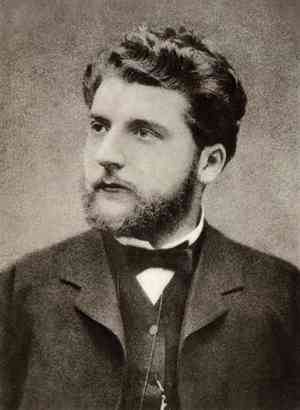
Georges Bizet
Source: Britannica
Born in Paris on 25 October 1838, Georges Bizet is a composer who wasn't so appreciated during his time as he now, particularly as to his opera, 'Carmen'. The only other opera that gets staged more is Verdi's 'La Traviata' ('The Wayward One') of 1853 with several hundred performances around the globe each year. Bizet had a singing teacher for a father. Showing sufficient ability in piano and singing to enter the Paris Conservatoire at age nine (the minimum age of ten waived), he there excelled in composing and piano. As he continued through his youth at the Conservatoire his major instructor and influence would become Charles Gounod. Before advancing too far we should note that "WD" numbering in Bizet is per 'Werkverzeichnis nach Winton Dean' published in 1948 by Dean. Dean's directory is thematic divided into six sections per dramatic works, orchestral works, piano works, works for various instruments, songs and other vocal works.
Bizet's earliest surviving compositions are a couple of wordless songs for soprano circa 1850 which Klassika identifies as 'Vokalise für Tenor' WD 109 and a barcarolle titled 'Vokalise für Zwei Soprane' in F Dur WD 110 ('Vokalise for Two Sopranos' in F major). Such are the first encounter with vocalise in these histories. Vocalise had developed only recently as a tool of instruction in the 18th century. Generally sung to one or so vowels, vocalise isn't to be confused with its jazzier modern counterpart arriving a century later than Bizet as vocalese, which is lyrics added to preexisting wordless music exemplified by such as Eddie Jefferson's 1968 rendition of Coleman Hawkins' 1939 solo during his orchestra's 11 October 1939 recording of 'Body and Soul' (Johnny Green 1930). Another sort of wordless singing to arrive a century later via jazz is the scat of such as Ella Fitzgerald consisting of nonsensical syllables on such as her 1947 bop rendition of 'How High the Moon' (Morgan Lewis-Nancy Hamilton 1940).
Bizet had been with the Conservatoire 6 of 9 years when he published a couple songs in 1854 titled 'Petite Marguerite' WD 69 and 'La Rose et l'Abeille' WD 70 with texts by Olivier Rolland. Also composed that year included a waltz (WD 48), a nocturne (WD 49) and a fugue (WD 62). Along with works written in 1855 including a fugue (WD 63), a waltz (WD 112), a cantata (WD 117) and perhaps an overture (WD 32), Bizet spent a month at age seventeen on the student task of 'Symphonie C-Dur' WD 33. That symphony authored as a student at the Conservatoire was neither performed nor published in Bizet's lifetime.
'La Rose et l'Abeille' WD 70 Melody by Georges Bizet
'The Rose and the Bee'
Text: Olivier Rolland
Tenor: Reinoud Van Mechelen 2025
'Symphony No.1' C major WD 33 Georges Bizet
C Dec 1855
Premiere 70 years later on 26 Feb 1925 in Basel, Switzerland w Felix Weingartner conducting
Netherlands Chamber Orchestra / Gordan Nikolić conducting at violin
Concertgebouw, Amsterdam / 12 Oct 2020
IMSLP Larousse MacDonald Wikipedia English Wikipedia French
Bizet's first opera to be performed was 'Le Docteur Miracle' composed in 1856, premiering in Paris at the Théâtre des Bouffes Parisiens on 9 April of 1857. Doctor Miracle is a quack who wins the hand of one Laurette by preparing a horrid poisoned omelet for her father, Magistrrate of Padua. Also in 1857 Bizet won the Prix de Rome for solfège (music theory), his particular scholarship to study 2 years in Rome, 1 year in Germany and two more in Paris. He was accommodated the next year in Rome at the Villa Medici [Wikipedia], the French Academie's quarters there, then obtained permission to study in Italy another year instead going to Germany. Upon completing his Prix de Rome Bizet became a teacher and accompanist. He also arranged, transcribed and didn't get very far as a music critic.
'Le Docteur Miracle' Operette in 1 act by Georges Bizet
1856 toward premiere 1857
Premiere 70 years later on 26 Feb 1925 in Basel, Switzerland w Felix Weingartner conducting
Libretto: Léon Battu & Ludovic Halévy after Sheridan's 1775 'Saint Patrick's Day'
Orchestre de Radio-Canada / Jacques Beaudry
Laurette by soprano Céline Dussault
MacDonald Opera Scotland Wikipedia English
'Symphony No.2' aka 'Souvenirs de Rome' C major WD 37 Georges Bizet
Premiere 12 Oct 1861 in Paris
University of Chicago Orchestra
IMSLP MacDonald Wikipedia English
Bizet had begun the opera, 'Ivan IV', in 1856 toward completion in 1857 or 1858. Thought to have never been performed, it is now lost. He began a second version in 1862, abandoned in 1863 to work on another project, then resumed in 1864 toward completion in late 1865. That work disappeared as well until discovered in 1929 toward a possible first performance in 1940, another in 1943. This tale concerns the first Russian Tsar, Ivan IV (1530-84), as he weds his Circassian princess, Marie, while the Kremlin is in under attack.
'Ivan IV' WD 12 Opera by Georges Bizet
Late 1865 Premiere possibly 75 years later in 1940
Libretto: Francois-Hippolyte Leroy & Henri Trianon
BBC Northern Orchestra & Chorus / Bryden Thomson 3 Oct 1975
Erik Eriksson MacDonald Wikipedia English
Bizet's opera, 'La jolie fille de Perth' ('Fair Maid of the Sea') arrived in 1866 to premiere the next year. Set in Perth, Scotland, sometime in the 14th century, this work tells of the love between a blacksmith named Henri Smith and Catherine Glover. Unfortunately, Henri is led to suspect Catherine of infidelity with the Duke of Rothsay.
'La Jolie Fille de Perth' WD 15 Opera by Georges Bizet
1866 toward premiere 26 Dec 1867 in Paris
Libretto: Henri Saint-Georges & Jules Adenis after Scott's 1828 'The Fair Maid of Perth'
Performance above directed by Pierre Jourdan
Orchestre d'État Hongrois Failoni / Jérôme Pillement
Cori spezzati (split choirs) / Olivier Opdebeeck
IMSLP MacDonald Wikipedia English
Among Bizet's works for piano was his 'Variations Chromatiques de Concert' WD 54 composed in 1868. Like Saint-Saëns, Fauré and Messager, Bizet was a defender of the infant Third Republic (1870-1940) and joined the National Guard. He also fled Paris during the subsequent Commune of March to May 1871, returning a month later. It was 1871 that he authored the twelve miniature pieces of 'Jeux d'Enfants' ('Children's Games') WD 56 Op 22 for piano 4 hands.
'Variations Chromatiques de Concert' WD 54 Op 3 Piano piece by Georges Bizet
1868 in dedication to French pianist Stefan Geller
Piano: Julia Severus
IMSLP MacDonald Score Score Wikipedia Russian
'L'Escarpolette' of 'Jeux d'Enfants' ('Children's Games') No.1 of 12 WD 56 Op 22
Miniature piano 4 hands by Georges Bizet 1871
Piano: Sun-Young Yu / Minna Han
Seoul Arts Center 22 Feb 2015
IMSLP MacDonald Wikipedia English
From 1873 to 1874 Bizet composed one of the more memorable in the history of opera, that his final titled 'Carmen' WD 31 which included his famous aria, 'Habanera' and 'Toreador Song'. Bizet wasn't so highly regarded as a composer at his time, and what has since become a major operatic work was a failure to him. Less than well received at the time, 'Carmen' was about a woman who rolled cigarettes at a tobacco factory in Seville. Tagged as "vice" at the time, Carmen was a rough stage character who not only smoked in public in the story, but smoked on stage via the first woman to play Carmen's role, Célestine Galli-Marié, at the Opéra-Comique in Paris on 3 March 1875. It was a shameless faux pas for a female to light up in public in the latter 19th century and Bizet paid the price for the theme [see also 'Carmen' and cigarettes at Limelight]. Tobacco (along with cacao and sugar for chocolate) had been crossing the Atlantic from the New World to Europe since the 16th century and Bizet himself was a smoker, presumably cigarettes. Other early smoking composers had been Bach, Handel and Beethoven who all used pipes. Mozart didn't smoke but was partial to snuff. Both Berlioz and Chopin fired up opium while Brahms preferred cigars [see also smoking composers at Google Groups / Talk Classical].
'Carmen' No.1 of 12 WD 31 Opera by Georges Bizet
Premiere 3 March 1875 at the Opéra-Comique in Paris
Libretto: Henri Meilhac & Ludovic Halévy after Prosper Merimee's 1845 'Carmen'
Performance above directed by Romain Gilbert
Orchestre de l'Opéra de Rouen Normandie / Ben Glassberg
Opéra de Rouen Normandie Choeur Accentus / Chœur d'enfants de la Maîtrise du Conservatoire de Rouen
Carmen: Deepa Johnny (mezzo-soprano)
Sets: Antoine Fontaine Costumes: Christian Lacroix
Lights: Hervé Gary Choreography: Vincent Chaillet
BBC Classic FM Columbia University IMSLP LiveAbout MacDonald
Music With Ease Opera Folio Utah Opera David Salazar Wikipedia English
'L'amour est un oiseau rebelle' ('Love is a rebellious bird') Aria by Georges Bizet
Aka 'Habanera" ('Music of Havana')
From Scene 5 of Act 1 of 'Carmen'
Premiere 3 March 1875 at the Opéra-Comique in Paris
Lyrics: Bizet
Performance above on 20 June 2022:
Orchestre National de Montpellier Occitanie / Luciano Acocella
Choeur de l'Opéra de Monte Carlo
Mezzo-soprano: Héloïse Mas
LiveAbout Ximena Sepulveda Song Facts Wikipedia English
'March of the Toreadors' aka 'Toreador Song' ('Bullfighter Song') March by Georges Bizet
From opening of Scene 1 Act 2 of 'Carmen'
Premiere 3 March 1875 at the Opéra-Comique in Paris
Libretto: Henri Meilhac & Ludovic Halévy
Performance above on 6 June 2015:
Folsom Symphony / Peter Jaffe
Harris Center for the Arts in Folsom CA
Four of Bizet's songs received no WD designation. Otherwise, the final title in Dean's 'Werkverzeichnis' of Bizet is a dramatic legend called 'Geneviève de Paris' WD 136 as of 1875. Bizet also described that as a mystery and oratorio. Georges died of heart attack three months to the day after 'Carmen' premiered, that on 3 June 1875, he only 36 years of age.
Sources & References for Georges Bizet:
Aryeh Oron (Bach Cantatas)
VF History (notes)
Audio of Bizet:
(cylinder recordings 1890-1934)Bizet on Broadway: IBDB
Compositions: Corpora:
All Music (alphabetical)
IMSLP (by date / genre / WD)
Klassika (by genre / WD)
Hugh MacDonald (alphabetical)
Wikipedia English (by genre / template)
Wikipedia English (by genre / WD)
Wikipedia Dutch (by genre / WD)
Wikipedia French (by genre / WD)
Wikipedia German (by genre / WD)
Wikipedia Russian (by genre / WD)
Operas: Operone Stanford University Wikipedia Dutch
Correspondence / Letters: Gutenberg
Usage of Bizet in Film: IMDb
Iconography: Gallica Wikimedia Commons
Lyrics:
Petite Marguerite (WD 69 / 1854 / Olivier Rolland)
La Rose et l'Abeille WD 70 / 1854/ Olivier Rolland)
Recordings of Bizet: Catalogs:
DAHR (shellac 1929)
Wikipedia (Carmen)
Recordings of Bizet: Select:
Georges Bizet and Charles Lecocq: Le docteur Miracle (Royal Philharmonic Orchestra / Cameo Classics CC9113 / 2019)
Songs by Bizet (Dame Ann Murray [mezzo-soprano] / Graham Johnson [piano] 1998)
Scores / Sheet Music:
Abe Books (vendor)
CPDL (choral works)
Musicalics (vendor)
Tobacco Trade: New World to Europe:
Jason YoungFurther Reading: Classic FM Freedom From Religion (Bizet's religion)
Bibliography:
Owen Jander (Vocalise / 2001)
Susan McClary (Georges Bizet: Carmen / Cambridge University Press / 1992)
Authority Search: BNF Data Deutsche Digitale Bibliothek
Other Profiles:
Encyclopedic
Store Norske Leksikon (Norwegian)
Musical:
Opera Philadelphia San Francisco Classical Voice
Symphozik (French) WMHT Radio
Wikipedia:
Asturian Catalan Dutch French German Japanese Russian Spanish
Classical Main Menu Modern Recording
|
|