
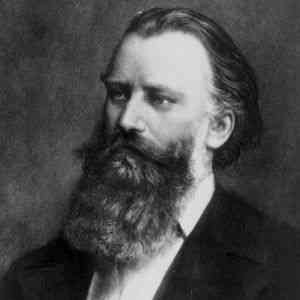
Johannes Brahms
Source: Biography
Born on 7 May 1833 in Hamburg, Johannes Brahms composed for orchestra, chamber, piano and voice. Though raised a Lutheran he is thought to have later become agnostic or atheist. One well-documented aspect of Brahms which the above image doesn't convey is the tease that he was, fond, for example, of telling people to expect the worst, only for the best to happen which they would like a lot. Brahms had a professional multi-instrumentalist for a father who played largely horn and double bass. Johannes himself began to play piano at age seven. He first began touring in 1853, soon to meet Franz Liszt in Weimar. He began living with Robert Schumann in Düsseldorf in 1853, working with him until the latter's confinement to a sanatorium the next year. During that time Brahms' Op 1, 'Piano Sonata No.1' in C major, was performed on 17 December 1853 in Leipzig at the Gewandhaus. Brahms had actually written his 'Piano Sonata No.2' prior to 'No.1' which he published as Op 1 because he felt it was the stronger work. Published in February of 1854 in dedication to Clara Schumann, 'Piano Sonata No.2' premiered in Frankfurt a couple years after 'No.1' in December 1855. Upon Schumann's death in 1856 Brahms fell in love with Clara. A professional pianist like her deceased husband, she loved Johannes as well, but as a mother to her son. So he formed and conducted a ladies choir in Hamburg that year, working as well as a court conductor and teacher in the Principality of Lippe. Some of Brahms' works stretch along a lengthy period between the inception of a composition and its eventual premiere. To simplify, sequence on this page proceeds per Opus numbers which don't perfectly align chronologically.
'Piano Sonata No.1' OP 1 C major Johannes Brahms
Premiere 17 Dec 1853 at the Gewandhaus in Leipzig
Piano: Vladislava Trepachka
Kelly Dean Hansen IMSLP Score Wikipedia
'Piano Sonata No.2' OP 2 F-sharp minor Johannes Brahms
Premiere Dec 1855 in Frankfurt
Piano: Pete Rosel 1974
Kelly Dean Hansen IMSLP Wikipedia
Ten works followed Brahms' piano sonatas before presenting his 'Ave Maria' Op 12 to Hanover on 2 December 1859. This was Brahms' initial choral piece, first written for four female voices and organ, then expanded to orchestra. This Op 12 didn't premiere until nigh a year after Op 15 further below.
'Ave Maria' OP 12 Johannes Brahms
Premiere 2 Dec 1859 in Hanover
Teal Voices Wellington Girls' College 2015
Kelly Dean Hansen IMSLP John Palmer Score Text
'Ave Maria' OP 12 Johannes Brahms
Premiere 2 Dec 1859 in Hanover
Voorhees Choir Candlelight Concert Dec 2015
Kelly Dean Hansen IMSLP John Palmer Score Text
It was during the fifties and sixties that what came to be called the War of the Romantics occurred. Conservatives largely wished to preserve Schumann's direction, who was Brahms' main man, thereat putting some distance between himself and heroic Richard Wagner as well as the remarkable Liszt. The movement's 'Manifesto', probably written by Brahms, saw publishing in 1860. It was in that climate that Brahms' highly applauded 'Piano Concerto No.1' in D minor Op 15 saw its first performance in Hanover on 22 January 1859 (a year earlier than his 'Ave Maria' Op 12 above). Brahms also arranged this for a pair of pianos and piano four hands.
'Piano Concerto No.1' OP 15 D minor Johannes Brahms
Premiere 22 Jan 1859 in Hanover
Orchestra della Svizzera Italiana Piano: Nelson Freire
Calvin Dotsey Kelly Dean Hansen IMSLP Blair Johnston Wikipedia
Brahms arrived to Vienna in 1862, there to become conductor at the Wiener Singakademie (an institute of vocal training). By that time he was a rich man, largely from publishing his works. He kept a housemaid but lived in a modest apartment. His mother died in February of 1865, likely inspiring 'A German Requiem' Op 45 first performed in Leipzig at the Gewandhaus on 18 February 1868. Later that year he published one of his most famous works in November 1868, his 'Wiegenlied' ('Lullaby' or 'Cradle Song'). This was No.4 of five pieces in his 'Lieder und Gesange' Op 49 for piano and voice first performed on 22 December 1869 in vienna by Clara Schumann (piano) and Luise Dustmann (voice). Johannes' name had long since become firmly established throughout Europe by the time he became concert director for the Gesellschaft der Musikfreunde in 1872, there remaining to 1875.
'Ein Deutsches Requiem' OP 45 D minor Johannes Brahms
Premiere of first 3 movements 1 Dec 1867 in Vienna
Premiere of all 7 movements 18 Feb 1869 in Laipzig
Text from the Bible as translated by Martin Luther
NEC Concert Choir and Philarmonia Erica Washburn / David Loebel
Jordan Hall New England Conservatory Boston 2 Dec 2014
Kelly Dean Hansen IMSLP Text Wikipedia Wikisource
'Wiegenlied' ('Lullaby' or 'Cradle Song') OP 49 Johannes Brahms
Published Nov 1868 No.4 of 5 of 'Lieder und Gesange'
Verse 1 from traditional published in:
'Des Knaben Wunderhorn: Alte Deutsche Lieder' 1806/08
('The Boy's Magic Horn: Old German Songs')
Verse 2 by Georg Scherer 1849
Piano: Byron Schenkman Voice: Hailey McAvoy
Classic FM Kelly Dean Hansen IMSLP Wikipedia
Johannes had long since conceived first drafts to his 'Symphony No.1' Op 68 in 1854. He spent the next twenty-two years writing it toward its premiere on 4 November 1876 in Karlsruhe with Felix Otto Dessoff conducting. Though certain works for piano might be more famous, they may be his symphonies for which Brahms is altogether most highly regarded. If he was only famous throughout Europe before, his symphonic works brought his name to preeminence.
'Symphony No.1' OP 68 C minor Johannes Brahms
Premiere 4 Nov 1876 in Karlsruhe conducted by Felix Otto Dessoff
Orchestre de Paris Paavo Järvi
Roger Dettmer Kelly Dean Hansen IMSLP Wikipedia
Brahms composed his happy 'Symphony No.2' in F-sharp minor Op 73 in the summer of 1877, first performed on 30 December that year in Vienna with Hans Richter conducting the Weiner Philharmonic.
'Symphony No.2' OP 73 D major Johannes Brahms
Premiere 4 Nov 1876 in Karlsruhe conducted by Felix Otto Dessoff
Orchestre de Paris Paavo Järvi
AEIOU Kelly Dean Hansen IMSLP Allen Schrott Score Wikipedia
In 1877 Brahms declined an honorary doctorate from the University of Cambridge, but accepted the same from the University of Breslau in 1879. He composed his 'Academic Festival Overture' Op 80 in appreciation in 1880 toward its performance by the Breslauer Orchesterverein on 4 January 1881. This work is "academic" in a couple of ways. The first is that it is inspired by student drinking songs, yet presents a mastery of orchestration revealing how seriously he regarded such the award. That was one of a pair of overtures written in the summer of 1880, the next being 'Tragic Overture' Op 81 which saw its initial performance on 26 December 1880 in Vienna with Hans Richter conducting.
'Academic Festival Overture' OP 80 C minor 1 movement in allegro Johannes Brahms
Premiere 4 Jan 1880 in Breslau conducted by Brahms
University of Washington Symphony Orchestra Daren Weissfisch
Roger Dettmer Kelly Dean Hansen IMSLP Wikipedia
'Tragic Overture' OP 81 D minor Johannes Brahms
Premiere 26 Dec 1880 in Vienna conducted by Hans Richter
University of North Carolina Symphony Orchestra Tonu Kalam
Roger Dettmer Kelly Dean Hansen IMSLP Wikipedia
Come the first performance of 'Piano Concerto 2' in B-flat major Op 83 in Budapest on 9 November 1881. Brahms dedicated that to his teacher, Eduard Marxsen. Two years later he premiered his 'Symphony No.3' in F major Op 90 premiered in Vienna on 2 December of 1883. 'Symphony No.4' in E minor Op 98 followed a couple years afterward on 25 October 1885.
'Concerto No.2' OP 83 B-flat major Johannes Brahms
Premiere 9 Nov 1881 in Budapest conducted by Alexander Erkel w Brahms at piano
Berliner Philharmoniker Kirill Petrenko Piano: Daniil Trifonov 31 Dec 2024
Roger Dettmer Herbert Glass Kelly Dean Hansen
IMSLP Steven Ledbetter Music Brainz Wikipedia
'Symphony No.3' OP 90 F major Johannes Brahms
Premiere 2 Dec 1883 in Vienna
Orchestra of the University of Music Franz Liszt Weimar Nicolás Pasquet
Kelly Dean Hansen Blair Johnston IMSLP
Steven Ledbetter Alondra de la Parra Wikipedia
'Symphony No.4' OP 98 E minor Johannes Brahms
Premiere 25 Oct 1885 in Meiningen
Chamber Orchestra of Europe Bernard Haitink
Kelly Dean Hansen IMSLP Michael Rodman Wikipedia
Brahms is the first composer in these histories of classical to record music on cylinder, that for Thomas Edison on 2 December of 1889, recording his 'Hungarian Dance No.1' at the home of one Dr. Fellinger in Vienna with Edison necessarily in attendance. Brahms included a wee bit of Josef Strauss's 'Die Libelle' ('The Dragonfly') Op 204 as well. Brahms is not, however, the first to record music on cylinder. Edison came up with the cylinder phonograph on 18 July of 1877 [Wikipedia], which invention altered the course of music the way Gutenberg's printing press put major changes to literature back in the 15th century. The oldest playable cylinder recording is Handel's 'Israel in Egypt' (1739) documented at the Crystal Palace in London by a chorus of 4000 with conducting by August Manns on 29 June of 1888 [audio]. Arthur Sullivan's 'The Lost Chord' may have been recorded in August of 1888 [audio], his 'Dinner Toast' to Edison on 5 October of 1888 [audio]. Brahms' 'Sapphische Ode' saw recording in Vienna by mezzo-soprano, Rosa Papier, on 2 November 1889. Pianist, Alfred Grünfeld, documentted dances by Brahms on 14 November 1889 in Vienna. See other early cylinder recordings preceding Brahms as well as the UCSB Cylinder Audio Archive. Due the unintelligibleness of Brahms' 'Hungarian Dance No.1' below, it is followed with a performance by Evgeny Kissin to lend a better idea of what he recorded. Brahms' 'Hungarian Dances' ('Ungarische Tänze') are his WoO 1. He published ten of them without Opus in two volumes in 1869. Eleven followed in two volumes in 1880, again without Opus. They had come about due to a dual attraction, one being traditional gypsy music, the other the Hungarian themes authored by his rival in the War of the Romantics, Franz Liszt. All pieces were arrangemants of gypsy dances excepting Nos. 11, 14 and 16 which are original Brahms. Brahms orchestrated three of the twenty-one pieces, Nos. 1, 3 and 10.
'Hungarian Dance No.1' No.1 of 21 of 'Hungarian Dances' WoO 1 Johannes Brahms
Published 1869
2 Dec 1889 at the home of Dr. Fellinger in Vienna
Voice /piano: Brahms
'Hungarian Dance No.1' No.1 of 21 of 'Hungarian Dances' WoO 1 Johannes Brahms
Published 1869
Piano: Evgeny Kissin Tokyo 1998
Brahms' last work to receive an opus number was 'Eleven Choral Preludes' for organ Op 122 composed in 1896 shortly after the death of his close friend for the last forty years, Clara Schumann, on 20 May 1896. They were performed and published posthumously in 1902 in Vienna, as Brahms himself had followed Clara the next year on 3 April 1897 of cancer.
'Mein Jesu, der du mich' No.1 of 'Eleven Choral Preludes' Op 122 Johannes Brahms
Composed 1896 Premiere posthumous on 24 April 1902 in Vienna
Organ: Kumiko Matsunami Miyazaki Lutheran Church in Japan Nov 2022
Kelly Dean Hansen IMSLP Stephen Westrop Wikipedia
Sources & References for Johannes Brahms:
Classical Net Aryeh Oron (Bach Cantatas)
VF History (notes) Wikipedia English
Analyses:
Classical Nerd (Thomas Little)
London Symphony Orchestra (2008)
Nahre Sol (There's More to Brahms Than You Think / 2022)
Audio of Brahms / Specific:
Academic Festival Overture (Nuremberg Symphonic Orchestra / Urs Schneider)
Eleven Choral Preludes (Ken Bowyer at organ)
Piano Concerto No.1 (Gewandhausorchester / Riccardo Chailly w Nelson Freire at piano)
Piano Concerto No.1 (Staatskapelle Dresden / Christian Thielemann w Maurizio Pollini at piano)
Piano Sonata No.2 (Hélène Grimaud at piano)
Audio of Brahms / Various:
Classical Archives Classical Connect
Presto UCSB (cylinder recordings 1903-1913)
Chronologies:
AEIOU Brahms Museum Murzzuschlag
Johannes Brahms Websource Universalis
Collections:
Archive of the Society of Friends of Music in Vienna
Compositions:
Alphabetical: All Music MusicNeo Wikipedia Spanish
By Genre All:
By Genre Specific:
By Opus / WoO:
Classic Cat IMSLP Johannes Brahms Websource
Wikipedia French Wikipedia Russian Wikipedia Spanish
Documentaries:
But For Women (János Darvas / 1996)
The Great Composers: Brahms (directed Graham Holloway / written by Vanessa Tovell / 2020)
Great Composers: Johannes Brahms / Christopher Nupin / 1983:
Johannes Brahms: Die Pranke des Löwen / directed by Annette Baumeister / written by Stefan Wilke / 2022:
Usage of Brahms in Film: IMDb
Iconography: AEIOU Gallica Wikimedia Commons Wikimedia Commons
Gravesite: Find a Grave Gravsted Wikipedia French
Recordings by Brahms: Hungarian Dance No.1 of 21 of Hungarian Dances WoO 1 / 2 Dec 1889:
Jonathan Berger (Stanford University / 1999 / archived)
Jonathan Berger (Stanford University)
Jonathan Berger / Charles Nichols (signal analysis)
Recordings of Brahms: Catalogs:
45 Cat Arkiv DAHR (shellac 1901-1951)
Recordings of Brahms: Select:
Brahms: Complete Organ Works (Robert Parkins / Naxos 8.550824 / 1994):
About by Robert Parkins
Scores / Sheet Music:
Abe Books (vendor) ClassicaLand
Musicalics (vendor) MusOpen
Editions: Brahms Complete Edition
Societies:
Brahms Gesellschaft Baden-Baden (Germany)
Brahms Gesellschaft Hamburg (Germany)
Brahms Gesellschaft Schleswig-Holstein (Germany)
Brahms Museum Murzzuschlag (Austria)
Gesellschaft der Musikfreunde Wien (Austria):
Schenker Documents Online The Society of Friends of Music Vienna Wikipedia
War of the Romantics: Art and Popular Culture BBC Classical Music
Further Reading:
Classic FM (15 Facts)
Classic FM (Brahms Symphonies)
Wilhelm Furtwängler (Brahms and the Crisis of Our Time / 1934)
rulit (Brahms and Tchaikovsky / Russian)
Bibliography:
The Music of Brahms by Michael Musgrave / Routledge / 1985
The Songs of Johannes Brahms / by Eric Sams / Yale University Press / 2000
Authority Search: BNF Data
Other Profiles:
Audio: Top Classical Music
English Encyclopedic:
Encyclopedia of World Biography
English Musical: Galaxy Notes
Alfred Maczewski Sebastian MitchellFrench: Larousse Musicologie
German
Russian: Aquarium Belcanto Иоганнес Брамс Krugosvet Wikisource
Classical Main Menu Modern Recording
|
|