
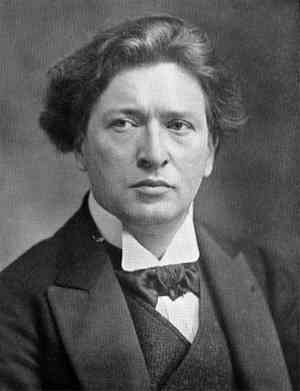
Ferruccio Busoni
Source: Wikipedia
Ferruccio Busoni was born in Empoli, Italy, on 1 April 1866 to professional musicians, his father a clarinetist, his mother a pianist. Raised largely in Trieste, he would come to compose for piano, voice, chamber and orchestra along with operas.
Busoni's earliest compositions listed in the "BV" directory were written at age seven. By the time he had finished assigning opus numbers to his works they had become confusing enough to later inspire Jürgen Kindermann's BV numbering scheme in 'Thematisch-chronologisches Verzeichnis der musikalischen Werke von Ferruccio B. Busoni' published in 1980 (Regensburg). Where KiV, Kind or K numbering are seen they refer to the same BV catalogue by Kindermann with which they are congruous because they're the same thing. Where BV B numbering is seen it refers to adaptations of other composers such as transcriptional arrangements of their, not his, original works. Busoni's BV 1, then, is 'Canzone' in C major also listed as Op 1, an unpublished work thought composed in June of 1873.
'Canzone' BV 1 Op 1 in C major Ferruccio Busoni
Comp June 1873 Not published
Piano: Ferruciao Aleghieri
Busoni was a virtuosic prodigy who made his first public appearance at piano at age seven with his parents on 24 November of 1873 at the Schiller-Verein in Trieste. He was playing his own compositions at age nine, entering the Vienna Conservatory that year. It was in Vienna that he composed his first published work, 'Cinq Pieces' for piano BV 71 Op 3 of 1877 [Rodoni].
'Cinq Pieces' BV 71 Op 3 Ferruccio Busoni
Comp 1877 First published work 1878 in Vienna by Spina
Piano: Frederic Copén
Busoni further studied beneath Wilhelm Mayer in Graz at age 11 and was conducting by age 12. Lending example of his early composing is his '24 Preludes' BV 181 Op 37 written when he was barely age 16 toward publishing the next year (1881).
'24 Preludes' BV 181 Op 37 No.1 Ferruccio Busoni
Comp 1879-80 Published 1881
Piano: Lucas Krupinski
In 1886 Busoni received instruction from Carl Reinecke in Leipzig. Taking his first teaching post in 1888 in Helsinki, Busoni then taught in Moscow in 1890 and 1891 before touring the United States between 1891 and 1894 [Roberge] where he taught at Boston's New England Conservatory [Wikipedia] in 1891 and 1892. The NEC had been founded in 1867 by Eben Tourjée. The Boston Symphony Orchestra [Wikipedia] had been founded in 1881 only ten years prior to Busoni's arrival (1891). It was given a home in 1900 with the erection of Boston Symphony Hall. Tchaikovsky had also first arrived to the States in August of 1891 for the official opening of Carnegie Hall [Wikipedia]. Paderewski would visit the States in November.
Returning to Berlin in 1994, Busoni then taught in Weimar, Vienna and Basel. It was 10 November 1904 when he first performed one of his best-known compositions, his 'Piano Concerto' in C Major BV 247 Opus 39 with Karl Muck conducting the Berlin Philharmonic.
'Piano Concerto' BV 247 Op 39 Ferruccio Busoni
Comp 1903-04 Premiere 10 Nov 1904 at the Beethoven-Saal in Berlin Pub 1906
Royal Philharmonic Orchestra / Daniell Revenaugh
John Alldis Choir Piano: John Ogdon
Colin Clarke IMSLP Thomas May Sofia Phlharmonic Wikipedia
Busoni's BV 248 Op 41 was his romantic 'Turandot Suite' for orchestra premiering in October 1905. That was incidental music to Carlo Gozzi's fairytale play of 1762. Revisions were made in 1911 (BV 248a) and 1917 (BV 248b).
'Turandot Suite' BV 248 Op 41 Ferruccio Busoni
Comp 1904 Premiere 21 Oct 1905 in Berlin Pub 1906
Hong Kong Philharmonic Orchestra / Samuel Wong
Dave Billinge Pierre Flinois IMSLP Wikipedia
On an unidentified date in 1905 Busoni had begun making piano rolls [Kogan] for Welte-Mignon to as late as 1907, highly criticized as little representing his virtuosic pianism. Recording was stuck between a rock and hard place in the early 20th century. Piano rolls offered clarity but virtuosity on stilts; acoustic recording could track virtuosity if you could hear it through noise. The major leap in recording arrived with the invention of the electronic microphone and electrical recording in 1925. In the meantime two of the rolls Busoni made for Welte-Mignon in 1905 are believed to be Chopin's 'Nocturne' in F sharp Op 15 No.2 and Franz Liszt’s 'Rigoletto Paraphrase'. Busoni would also make piano rolls for Hupfeld, later transferred to Ampico, as well as Duo-Art [Wikipedia].
Chopin's 'Nocturne' Op 15 No.2 in F sharp Piano roll by Ferruccio Busoni
1905
Franz Liszt's 'Rigoletto Paraphrase' Piano roll by Ferruccio Busoni
1905
Busoni enters the annals of early modernism at its avant-garde via his discussion of absolute music in his manifesto on modernity in music, 'Sketch of a New Aesthetic of Music' published in 1907, reissued in 1911. With that book his composing began to change as witnessed in 'Elegies' for piano BV 249 for piano of which six were written in 1907 with his 'Berceuse' lullaby composed on 5 June 1909 added to a total of seven pieces.
'Elegien' BV 249 Op 41 Ferruccio Busoni
Comp 1907/09 Pub 1908/09
Piano: Igor Levit
Busoni's 'Berceuse Elégiaque' for orchestra BV 252a Op 42 bears a composing date of 27 Oct 1909 to see conducting for the first time at Carnegie Hall in the United States by Gustav Mahler on 21 Feb 1911. This was dedicated to his mother, Anna, who had died on 3 October 1909.
'Berceuse Elégiaque' BV 252a Op 42 Ferruccio Busoni
Comp completed 27 Oct 1909 Premiere 21 Feb 1911 at Carnegie Hall in NYC Pub 1910
Dedicated to his mother Anna who had died 3 Oct 1909
Royal Concertgebouw Orchestra / Ed Spanjaard
10 Dec 2010 at the Concertgebouw in Amsterdam
Busoni's first of three versions of 'Fantasia Contrappuntistica' for solo piano BV 256 saw composing in June 1910. Revisions of 'Fantasia Contrappuntistica' followed on 20 July 1912 (256a) and 3 July 1921 (256b).
'Fantasia Contrappuntistica' BV 256 Ferruccio Busoni
Comp 1910 Revised 1912/21 Pub 1912
Piano: Wolf Harden
Busoni's No.1 of several versions of 'Sonatina' is dated 4 August 1910 numbered BV 257. Busoni wrote six of these: No.2 BV 259 in 1912, No.3 BV 268 in 1915, No.4 BV 274 in 1917, No.5 BV 280 in 1919 and No.6 BV 284 in 1920.
'Sonatina No.1' BV 257 Ferruccio Busoni
Comp completed 4 Aug 1910 Pub 1910
Piano: Marc-André Hamelin
Busoni wrote the librettos to all four of his operas, three completed of which the first, 'Die Brautwahl' ('The Bridal Choice') BV 258, premiered on 12 April 1912 at the Stadttheater in Hamburg [IMSLP]. This is a comedy in which suitors vie for the hand of one Albertine. Its 'Suite' BV 261 Op 45 premiered in Berlin on 3 January 1913.
'Die Brautwahl Suite' BV 261 Op 45 Ferruccio Busoni
Comp 1912 Premiere 3 Jan 1913 in Berlin Pub 1917
BBC Philharmonic Orchestra / Neeme Järvi
Busoni served as director of the Musical Lyceum of Bologna in 1913 until the start of WW I in July 1914. He had premiered his 'Indian Fantasy' BV 264 Op 44 for piano and orchestra only briefly before that conflict in May. That had been based on research in the music of the American Indian by Natalie Curtis in 1910, to whom he also dedicated the work.
'Indianische Fantasie' BV 264 Op 44 Ferruccio Busoni
Comp April 1913-22 Feb 1914 Pub in Leipzig by Breitkopf und Härtel 1915
London Symphony Orchestra / Jascha Horenstein Piano: John Ogden
15 Sep 1966 at Royal Albert Hall in London
Adrian Corleonis IMSLP Wikipedia
Busoni toured to the United States again in January 1915. By the time he returned to Europe, Italy had declared war on Austria-Hungary (May 23 1915). Not wishing to work in any country participating in the War, he headed for Zurich. While in Switzerland he published his first edition of 'Bach-Busoni' in 1916, a work that would come to seven volumes in 1920 encompassing thirty years' worth of Bach transcriptions [Bach Cantatas / Wikipedia].
It was yet World War I, America entering the contest on 6 April 1917, when Busoni presented a double billing of operas on 11 May 1917 at the Zurich Opera House, one being 'Arlecchino' ('Harlequin') BV 270, the other 'Turandot' BV 273. Turandot is the daughter of Emperor Altoum who riddles her suitors. Who lose with wrong answers are to be executed.
'Arlecchino' ('Harlequin') BV 270 Op 50 Opera by Ferruccio Busoni
Comp 1914 Revised 1915/16 Premiere 11 May 1917 at the Zurich Opera House
Pub in Leipzig by Breitkopf und Härtel 1917
Libretto: Busoni
Aldo Bottion Orchestra of the RTSI of Lugano / Francis Travis
Stage direction: Filippo Crivelli Harlequin: Piero Baldini
1984 in Lugano, Switzerland
Paul Corfield Godfrey IMSLP Rodoni Wikipedia
'Turandot' BV 270 Op 50 Opera by Ferruccio Busoni
Comp 1916-17 Premiere 11 May 1917 at the Zurich Opera House
Libretto: Busoni
Radio Telefis Eireann Symphony Orchestra / Simon Joly
Turandot: Kristine Ciesinski (soprano)
1988 at the Wexford Festival Opera in Ireland
IMSLP Rodoni Steve Schwartz Wikipedia
Busoni's 'Klavierübung' ('Piano Exercises') BV A 3 began to see publishing in parts in 1918 by Breitkopf & Härtel in Leipzig, the Great War ceasing that year on 11 November 1918. Breitkopf & Härtel was Europe's oldest music publishing house established in 1719 [Wikipedia].
It was 18–19 November 1919 that Busoni recorded thirteen tracks at Columbia Studios in London, compositions by Franz Liszt hogging the show with six of them, including a couple of abbreviations of 'Hungarian Rhapsody No.13'. Those were unfit for distribution and likely lost. Busoni would return to future sessions for Columbia on 27 February 1922 to document thirteen more tracks including Bach's chorale prelude for organ, 'Rejoice, Beloved Christians' BWV 734 issued on Columbia L 1470 [Mahler Foundation / Wikipedia]. In the meantime Busoni labeled his version of modernism "Young Classicism" in a 1920 letter to German critic, Paul Bekker. Busoni's new classicism isn't to be confused with Neo-classicism.
Acoustic disc recording by Ferruccio Busoni
Recorded 27 Feb 1922 Matrix 76702 Columbia L 1470
Sequenced by Mark Ainley (Piano Files curator) w Side B first:
1: Busoni's Bach-Busoni transcription BWV 734 'Prelude to Choral' aka 'Prelude to Glory' aka 'Rejoice, Beloved Christians'
2: Beethoven's 'Scotch Step'
3: Chopin's 'Prelude In A Major'
4: Chopin's 'Etude In G Flat'
Busoni published another work on music theory in 1922 called 'Von der Einheit der Musik' ('The Unity of Music') before his death of kidney disease on 27 July 1924 [Berlin gravesite]. He'd left his fourth and final opera, 'Doktor Faust' BV 303, unfinished, its libretto begun just after the outbreak of WW I. 'Doktor Faust' was completed by his student, Philipp Jarnach, toward its posthumous premiere on 21 May 1925 at the Sächsisches Staatstheater in Dresden.
'Doktor Faust' BV 303 Opera by Ferruccio Busoni
Unfinished upon Busoni's death on 27 July 1924 Completed by student Philipp Jarnach
Posthumous premiere 21 May 1925 at the Sächsisches Staatstheater in Dresden
Pub 1926 in Leipzig by Breitkopf und Härtel
Chorus and Orchestra del Maggio Musicale Fiorentino / Cornelius Meister
Doktor Faust: Dietrich Henschel (baritone)
Mephistopheles: Daniel Brenna (tenor)
Robert Cummings IMSLP Libretto English Libretto Italian Rodoni Wikipedia
Sources & References for Ferruccio Busoni:
Busomi International Competition
Uncle Dave Lewis (All Music)
VF History (notes)
Audio of Busoni: Corpora:
Classical Archives Hyperion Kunstderfuge (MIDIs) MuziekWeb Naxos Presto
RodoniAudio of Busoni: Individual: Chronoligical:
24 Preludi (BV 181 Op 37 / 1880 / piano: Karl-Heinz Schlüter)
Piano Concerto (BV 247 Op 39 / 1904 / Royal Philharmonic Orchestra / Daniell Revenaugh /John Alldis Choir / piano: John Ogdon)
Berceuse Elégiaque (BV 252a Op 42 / 1909 / Hong Kong Philharmonic Orchestra / Samuel Wong)
Chopin's Ballade Op 23 No.1 (Hupfeld piano roll c 1910 / transferred to Ampico 50047 issued 1916)
Fantasia Contrappuntistica (BV 256 / 1910 / piano: Geoffrey Douglas Madge)
Sonatina No.1 (BV 257 / 1910 / piano: Geoffrey Douglas Madge)
Arlecchino (BV 270 Op 50 / 1917 / Orchestra del Teatro Communale di Bologna / David Agler / Arlecchino: Marco Alemanno / 2007)
Arlecchino (BV 270 Op 50 / 1917 / New York Philharmonic / Dimitri Mitropoulos / Arlecchino: John Brownlee / 1951 / audio only)
Authorship / Correspondence:
Arlecchino (BV 270 Op 50 / 1917 / libretto)
Die Brautwahl (BV 258 / 1912 / libretto)
Sketch of a New Aesthetic of Music (1907): AA Conversations Adam Harper Project Gutenberg (full text)
Turandot (BV 273 / 1917 / libretto)
Chronology: Classical Pianists
Compositions:
Classic Cat (by K [BV])
IMSLP (alphabetical)
IMSLP (by BV / date / genre / key / Op / title)
QWE Wiki (by BV / date / Op / title)
Rate Your Music (by genre / date)
Rodoni (by KIV [BV])
Wikipedia (adaptations / transcriptions / editions of other composers)
Wikipedia (by BV / date / Op / title)
Wikipedia (by genre)
Documentaries:
Ferruccio Busoni Radio Documentary (Joseph Tushinsky / 1969 / radio)
The Music of Ferruccio Busoni (Ronald Stevenson / 1974 / film)
Lyrics / Texts: Emily Ezust (LiederNet)
Manuscripts: Gallica
Piano Rolls:
Ampico: Peter's MIDI
Duo-Art:
IAMMP (International Association of Mechanical Music Preservationists)
Hupfeld: Piano World Forum (transferred to Ampico) Michael Swanson (transferred to Ampico)
Welte-Mignon: Grigoriĭ Kogan Pianola
Recordings of Busoni: Catalogs:
Bach Cantatas (Bach-Busoni piano transcriptions)
(1919-1940) (acoustic recordings for Columbia 1919 / 1922)Recordings of Busoni: Select:
Bach | Busoni (including Fantasia Contrappuntistica / piano: Lukasz Kwiatkowski / 2014)
Busoni: Turandot Suite (Hong Kong Philharmonic Orchestra / Samuel Wong / Naxos 8.555373 / 2001)
Scores / Sheet Music:
Abe Books (vendor)
Bach Cantatas (Bach-Busoni Editions)
Klavierübung (Piano Exercises / BV A 3 / 1917-1922)
Musicalics (vendor)
Notenlager (vendor / Europe)
Wikipedia (Bach-Busoni Editions)
Further Reading:
Absolute Music:
Encyclopedia Study WikipediaBösendorfer (Bösendorfer Imperial piano of 1909)
Joe Horowitz (Ferruccio Busoni: “A Fresh Gust of Air”)
IMDb (Usage of Busoni in modern media)
Michele Napolitano (The great Busoni's clarinet returns)
Neoclassicism (not Busoni):
The Art Story Britannica English 11 Honors Elliott Jones Met Museum Wikipedia
Aryeh Oron (Bach Cantatas)
Rebecca Schmid (How Ferruccio Busoni Shaped 20th-Century Music / 2018)
K. Robert Schwarz (Busoni: The Contradictions Persist / New York Times / 1985)
Bibliography:
Della Couling (Ferruccio Busoni: A Musical Ishmael / Bloomsbury Academic / 2005)
Colin Davis (“The New Harmony” of Ferruccio Busoni’s Fantasia Contrappuntistica / 2018)
Erinn E. Knyt:
Approaching the Essence of Music (Journal of Musicological Research / 2026)
Ferruccio Busoni and His Legacy (Indiana University Press / 2017)
Ferruccio Busoni and the New England Conservatory (American Music / Vol 31 No.3 / 2013) (alt)
How I Compose: Ferruccio Busoni's Views (Journal of Musicology / 2010)
Grigory Kogan (Busoni as Pianist / Eastman Studies in Music / 2010)
Marc-André Roberge:
Busoni: Fantasia Contrappuntistica (Musical Quarterly / Vol 80 No.2 / 1996)
Ferruccio Busoni in the United States (American Music / Vol 13 No.3 / 1995)
Larry Sitsky:
Busoni and the Piano (Greenwood Press / 1986)
The esoteric musical tradition of Ferruccio Busoni
Ferdia J. Stone-Davis (Music and Transcendence / Taylor & Francis / 2016)
Authority Search: BNF Data
Other Profiles:
Dizionario Biografico degli Italiani
(Vol 15 / 1972)Enciclopedia Italiana (1930)
Georg Predota (Interlude)
Wikipedia: Español Français Italian
Classical Main Menu Modern Recording
|
|