
Pyotr Ilyich Tchaikovsky
Source: Wikipedia
Born on 7 May 1840 deep in Russia (780 miles east of Moscow in Votkinsk in present-day Udmurt Republic), Pyotr Ilyich Tchaikovsky is written Пётр Ильич Чайковский in his native language. Tchaikovsky completed eighty opuses including three ballets, eleven operas, seven symphonies, various chamber, orchestral and choral works, as well as a strong number of arrangements of other composers. Before roaming too far, however, we should address Tchaikovsky catalogues and major sources. Tchaikovsky Research (TR) needs to be cited in addition to IMSLP and Wikipedia. References to "ČW" numbering are from 'The Thematic and Bibliographical Catalogue of P. I. Čajkovskij's Works' by Vaidmanx, Korabelnikova & Rubtsova in 2003 / 2006. "TH" numbering is per 'The Tchaikovsky Handbook' by Poznansky & Langston (Indiana University Press 2002).
Tchaikovsky had an engineer and lieutenant colonel serving in the Department of Mines for a father. Groomed for life as a civil servant, Tchaikovsky was ten when he was sent away from Votkinsk to complete studies needful to enter the Imperial School of Jurisprudence in St. Petersburg. His first composition is commonly cited to be an unidentified waltz at age fourteen in honor of his mother upon her death of cholera in 1854. That isn't to be confused w the 'Anastasie-valse' in F major ČW 95 TH 119 that he dedicated to his governess, Anastasiya Petrova, in August of 1854 a couple months after his mother's death. Another of Tchaikovsky's early works while at the School of Jurisprudence was his lost one-act opera, 'Hyperbola' ČW 446 TH 201, written in autumn of 1854.
'Anastasie-valse' ČW 95 TH 119 F major Piano piece by Pyotr Tchaikovsky
Aug 1854 at Oranienbaum Age 14
Dedicated to his governess Anastasiya Petrovna Petrova
Piano: Aleksandar Kačurov
Tchaikovsky Research
In 1859 Tchaikovsky was employed at the Ministry of Justice for the next three years, having been taught piano sporadically by a couple teachers by then, but not to much actual intent. He began to get serious in 1861, studying music theory at classes arranged by the Russian Musical Society (RMS) in St. Petersburg, that founded in 1859 by Grand Duchess Elena Pavlovna and Anton Rubinstein. Tchaikovsky's 'Mezze Notte' ČW 209 TH 91 of 1860 or 1861 was his first composition to be published, that by Yury Leibrock in Saint Petersburg in an edition of 'Musée Musical', lost thereafter until discovery in 1903 [1, 2; audio: 1, 2; score; text]. See other early works by Tchaikovsky.
'Mezze Notte' ('Midnight') ČW 209 TH 91 G major Song by Pyotr Tchaikovsky
C 1860
Piano: Vladimir Viktorov Soprano: Tamara Milashkina
Tchaikovsky Research Text
In 1862 Tchaikovsky enrolled in Rubinstein's Saint Petersburg Conservatory. Among his first explorations during that period was 'Characteristic Dances' ČW 428 TH 37 also serving as the first public performance of one of his works, that conducted by Johann Strauss II at Pavlovsk Park on 11 September 1865. Pyotr wrote 'Piano Sonata' in C sharp minor ČW 97 TH 123 Op posth 80 during his last year of study at the Conservatory, that not published until 1900.
'Piano Sonata' ČW 97 TH 123 Op posth. 80 C-sharp minor Pyotr Tchaikovsky
1865 4 movements
Piano: Emil Gilels Moscow 1962
Tchaikovsky was appointed Professor of Music Theory at the Moscow Conservatory by Nikolai Rubinstein [Wikipedia] in 1865. I will refer to him throughout this page as Nikolai to distinguish him from his older brother, Anton (above). Nikolai conducted most of Tchaikovsky's orchestrated works until his death in 1881. Tchaikovsky was just beginning his professorship at the Moscow Conservatory when he began 'Symphony 1 in G minor' ('Winter Daydreams') ČW 21 TH 24 Op 13 in 1866, that getting conducted at an RMS concert in Moscow by Nikolai on 15 Feb of 1868. That was also dedicated to Nikolai as a good number of works to follow would be. Tchaikovsky's initial Opus (published work), however, is assigned to "Two Pieces for Piano' consisting of 'Scherzo à la Russe' in B-flat minor ČW 98 TH 124 Op 1 No.1 performed by Nikolai in Moscow on 31 March of 1867, and 'Impromptu' in E-flat minor ČW 99 TH 122 Op 1 No.2 which had actually been composed as a student in 1863 or 1864.
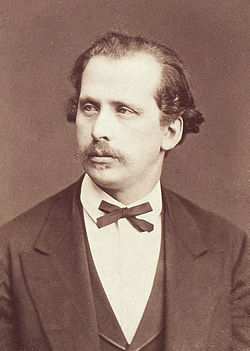
Nikolai Rubenstein 1872
Composer / conductor / pianist
(1835-1881)
Brother to Anton Rubinstein
Source: Wikipedia
'Scherzo à la Russe' No.1 of 'Two Pieces for Piano' Pyotr Tchaikovsky
ČW 98 TH 124 Op 1 No.1 B-flat minor
Comp 1867
Premiere 31 March 1867 by Nikolai Rubinstein for the Russian Musical Society in Moscow
Piano: Earl Wild
'Impromptu' No.2 of 'Two Pieces for Piano' Pyotr Tchaikovsky
ČW 99 TH 122 Op 1 No.2 E-flat minor
Comp C 1863-64 as a student at the Saint Petersburg Conservatory
Dedicated to Nikolai Rubinstein
Piano: Franco Trabucco 2011
'Symphony No.1' ČW 21 TH 24 Op 13 G minor Pyotr Tchaikovsky
Premiere 15 Feb 1868 by Nikolai Rubinstein for the Russian Musical Society in Moscow
Sinfonia Rotterdam / Conrad van Alphen De Doelen in Rotterdam 22 Sep 2022
Wikipedia
Tchaikovsky's first of eleven operas listed at TR was 'The Voyevoda' ('The Governor') ČW 1 TH 1 Op 3, premiering at the Bolshoi Theatre in Moscow on 11 February 1869. That isn't to be confused with his later incidental music of 1886 for the play of the same name (TH 22 in G minor) nor his unrelated symphonic ballad of 1890-91, 'The Voyevoda' Op 78 (further below). This opera concerns one Nechay Shalygin, the governor, of no specific place along the River Volga who gets himself into trouble with the Tsar by kidnapping a couple of women, namely Marya who already has a lover, and Olyona who is married.
Overture to 'The Voyevoda' ('The Governor') ČW 1 TH 1 Op 3
First opera by Pyotr Tchaikovsky
Premiere 11 Feb 1869 at the Bolshoi Theatre in Moscow
Libretto by Alexander Ostrovsk
Bamberg Symphony / Janos Fürst
Graham's Music IMSLPPhil's Opera World Score Tchaikovsky Research Wikipedia
Tchaikovsky premiered his symphonic poem, 'Fatum' ČW 38 TH 41 Op 77, four days later on 15 Feb 1869 at the eighth concert held in Moscow by the RMS, again conducted by Nikolai.
'Fatum' ČW 38 TH 41 Op 77 Symphonic poem by Pyotr Tchaikovsky
Premiere conducted by Nikolai 15 Feb 1869 in Moscow
National Symphony Orchestra / Christoph Eschenbach
Kennedy Center for the Performing Arts in Washington DC 29 Jan 2015
Tchaikovsky Research Wikipedia
By that time the last fourteen years had witnessed the rift between Anton Rubinstein, a musical conservative who emphasized the importance of western European composition, and Balakirev, whose Free School distanced itself from European influence, emphasizing individuality in the creation of a nationalistic music that Russia could call its own. Tchaikovsky was caught in between, sympathizing with both, neither absolutely, and distancing himself from both, neither absolutely. Tchaikovsky and Rubinstein had their disagreements on the direction Russian music ought go but worked together closely off and on until Rubinstein's death in 1881. Balakirev nevertheless contributed in a consultative manner to Tchaikovsky's symphonic poem, 'Romeo and Juliet' ČW 39 TH 42, that premiered on 16 March of 1870 based on the 1591-95 eponymous play by Shakespeare. This is, of course, the tempestuous tale of two lovers from feuding families.
'Romeo and Juliet' ČW 39 TH 42 Op 77 Fantasy overture by Pyotr Tchaikovsky
1869 Revised 1870 / 1880
Premiere 16 March 1870
Netherlands Radio Philharmonic Orchestra / Dima Slobodeniouk
TivoliVredenburg in Utrecht 16 Nov 2018
Boston Symphony Orchestra IMSLP Hollywood Bowl Steven Ledbetter
Joseph Stevenson Tchaikovsky Research Wikipedia
Come Tchaikovsky's second opera, 'Undina' ČW 2 TH 2, to the Bolshoi on 28 March 1870. 'Undina' is the story of the knight, Huldbrandt, who can't make up his mind between Undina, the daughter of a fisherman, and Berthalda, the daughter of a Duke, which makes for turmoil that ends up killing him. This drama was never fully performed. Tchaikovsky applied parts to other works, then destroyed it, though fragments remain. Tchaikovsky wrote his 'Guide to the Practical Study of Harmony' ('Руководство к практическому изучению гармоний') ČW 513 TH 255 in July and August of 1871 toward publishing in 1872. He received Balakirev's blessing on his 'Symphony No.2' in C minor ('Little Russian') Op 17, composed in 1872, after which he and the Free School would remain on generally friendly terms. The Finale of 'Little Russian' was privately performed at the residence of Rimsky-Korsakov, youngest member of Balakirev's Five, on 7 January 1873 in St. Petersburg. Its entirety with Nikolai Rubinstein again conducting premiered in Moscow on 7 February. His second version premiered several years later on 12 Feb 1881 in St. Petersburg for the RMS.
'Symphony No.2' ('Little Russian') ČW 22 TH 25 Op 17 C minor Pyotr Tchaikovsky
Full premiere 7 Feb 1873 in Moscow w Nikolai conducting
Oslo Philharmonic / Mariss Jansons
Wikipedia
Pyotr Jurgenson published Tchaikovsky's 'A Short Manual of Harmony' ČW 514 TH 256 in 1875. Tchaikovsky's 'Piano Concerto No.1' Op 23 in B flat minor was first performed in Boston on 25 October 1875 by Hans von Bülow because his favored pianist, Nikolai, didn't at first like the work.
'Piano Concerto No.1' ČW 53 TH 55 Op 23 B-flat minor Pyotr Tchaikovsky
Premiere 25 Oct 1875 by Hans von Bülow in Boston
Nordwestdeutsche Philharmonie / Yves Abel
Piano: Anna Fedorova
Tchaikovsky Research Wikipedia
It was 1876 when Pyotr began corresponding for the next fourteen years with a patroness he would never meet, Nadezhda von Meck, the widow of a wealthy railroad magnate who had died that year. Meck, also a capable amateur pianist, paid Tchaikovsky 6,000 rubles a year, equivalent to about $160,000 today. Among others she supported were Nikolai and Claude Debussy. Come Tchaikovsky's ballet, 'Swan Lake' ČW 12 TH 12 Op 20, at the Bolshoi Theatre on 4 March 1877 performed by the Bolshoi Ballet. In magical 'Swan Lake' Princess Odette gets metamorphosed into a swan by evil Baron Von Rothbart. But because the spell can be broken by true love, come Prince Siegfried ahunting.
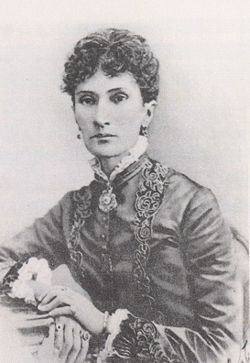
Nadezhda von Meck 1872
Business woman / patroness / recluse
(1831-1894)
Source: Wikipedia
Finale of 'Swan Lake' ČW 12 TH 12 Op 20 Ballet by Pyotr Tchaikovsky
Premiere 4 March 1877 by the Bolshoi Ballet at the Bolshoi Theatre in Moscow
Royal Liverpool Philharmonic Orchestra / Jamie Phillips
Royal Albert Hall 16 Oct 2023
Classic FM College Sidekick Aaron Green IMSLP
Jeremy Nicholas Tchaikovsky Research Wikipedia
It was 1880 when Tchaikovsky spent six weeks composing his '1812 Overture' ČW 46 TH 49 Op 49 toward its premiere in Moscow on 20 August of 1882 with Ippolit Al'tani conducting. Despite this overture's popularity, Tchaikovsky himself had small confidence in the work.
'1812 Overture' ČW 46 TH 49 Op 49 E-flat major Overture by Pyotr Tchaikovsky
Premiere conducted by Ippolit Altani 20 Aug 1882 at the Art & Industry Exhibition in Moscow
Royal Liverpool Philharmonic Orchestra / Jamie Phillips
Royal Concertgebouw Orchestra / Bernard Haitink
Aaron Green Fran Hoepfner IMSLP
Tchaikovsky Research Wikipedia
In 1884 Tchaikovsky was awarded the Order of St. Vladimir by Tsar Alexander III. Already a tycoon, in 1885 he was awarded an annual pension of 3,000 rubles, worth about $80,000 today. Tchaikovsky visited St. Petersburg in November 1887, initiating his relationship with the Belyayev circle, a group of nationalistic composers including Rimsky-Korsakov who gravitated about the publisher, Mitrofan Belyayev [Wikipedia]. Tchaikovsky's 'Symphony No. 5' in E minor premiered at the Mariinsky Theatre in St. Petersburg on 17 November 1888.
'Symphony No.5' ČW 26 TH 29 Op 64 E minor Pyotr Tchaikovsky
Premiere conducted by Tchaikovsky 17 Nov 1888
For the Philharmonic Society at the Mariinsky Theatre in St. Petersburg
Leningrad Philharmonic Orchestra / Evgeny Mravinsky Vienna Nov 1960
Roger Dettmer IMSLP Tchaikovsky Research Wikipedia
Tchaikovsky conducted his overture-fantasia, 'Hamlet' ČW 50TH 53 Op 67, one week after 'Symphony No.5' on 24 November 1888 for the RMS in St. Petersburg, again borrowing from Shakespeare. This is not his later 'Hamlet' Op 67a of incidental music for the play's performance at the Mikhailovsky Theatre in St. Petersburg on 21 February 1891. Come Tchaikovsky's highly popular ballet, 'The Sleeping Beauty' ČW 13 TH 13 Op 66, to the Mariinsky Theatre in St. Petersburg on 15 January 1890. In this version of the tale, Princess Aurora falls to sleep after pricking her finger on a needle, to be awakened one hundred years later by the hunter, Prince Désiré. There is, of course, the evil fairy, Carabosse, who casts the spell because she wasn't chosen to be one of Aurors's six godmothers, opposite the good lilac fairy who ensures that Carabosse doesn't get her way absolutely.
'Hamlet' ČW 50 TH 53 Op 67 F minor Fantasy overture by Pyotr Tchaikovsky
Premiere 24 Nov 1888 for the RMS in St. Petersburg
SYO Philharmonic / Brian Buggy
Hollywood Bowl Herbert Glass Score Tchaikovsky Research Wikipedia
'Sleeping Beauty' ČW 13 TH 13 Op 66 Ballet by Pyotr Tchaikovsky
Premiere conducted by Riccardo Drigo 15 Jan 1890 at the Mariinsky Theatre in St. Petersburg
Libretto: Ivan Vsevolozhsky
Performance above directed by Alexander Neef
Orchestre de l'Opera National de Paris at the Opera Bastille / Vello Pahn
Choreography: Rudolf Noureev Sets: Ezio Frigerio
Costumes: Franca Squarciapino Lights: Vinicio Cheli
Hollywood Bowl Herbert Glass Score Tchaikovsky Research Wikipedia
The oratorio hall in the basement of Carnegie Hall officially opened with a performance by Franz Rummel on 1 April 1891. Its Music Hall officially opened on 5 May 1891 with Tchaikovsky, among others, performing his 'Coronation March' of 1883. Tchaikovsky is among the first composers in these histories to have visited the United States, arriving by steamboat to New York City in April 1891. He had been preceded to the States by Strauss II in the summer of 1872 followed by Anton Rubinstein later that year. Leopold Godowsky arrived to the States in 1884, Fritz Kreisler in 1888. Both Busoni and Paderewski also first visited the States in 1891. Back in Russia that year, Tchaikovsky conducted his symphonic ballad, 'The Voyevoda' in A minor ČW 51 TH 54 Op 78 on 18 November 1891 in St. Petersburg [1, 2, 3, 4; audio: All-Union Radio SO, Chicago SO, Zaporizhzhya Academic SO]. That isn't to be confused with his first opera, Op 3, of 1869 by the same title (above) nor his incidental music for the eponymous play of 1883.
'The Voyevoda' ('The Governor') ČW 51 TH 54 Op 78 A minor
Symphonic ballad by Pyotr Tchaikovsky
Premiere 18 Nov 1891 in St. Petersburg
All-Union Radio Symphony Orchestra / Vyacheslav Ovchinnikov / 1989
IMSLP Tchaikovsky Research Wikipedia
Tchaikovsky's string of ballets, 'Nutcracker Suite' ČW 32 TH 35 Op 71a, premiered for the RMS in St. Petersburg on 19 March 1892. Eight of those were borrowed from his ballet, 'The Nutcracker' ČW 14 TH 14 Op 71, that later premiered on 18 December 1892. With Antonietta Dell'Era in the role of the Sugar Plum Fairy, she received 5 encores. The 'Nutcracker Suite' was featured in the Walt Disney animation film, 'Fantasia', in 1940. Included in both the 'Nutcracker Suite' and 'The Nutcracker' is the 'Dance of the Sugar Plum Fairy', the ballet version, No.14 Var.2, being longer by 32 bars. In 'The Nutcracker' one Clara throws her slipper at the King of Mice which saves the life of a big living nutcracker in the shape of a soldier which is actually a Prince. She is then honored in the Kingdom of Sweets by the Sugar Plum fairy.
'Nutcracker Suite' ČW 32 TH 35 Op 71a Pyotr Tchaikovsky
Premiere 19 March 1892 for the RMS in St. Petersburg
Sinfonia Rotterdam / Conrad van Alphen 20 Sep 2014
IMSLP Score Tchaikovsky Research Wikipedia
'The Nutcracker' ČW 14 TH 14 Op 71 Ballet by Pyotr Tchaikovsky
Premiere 18 Dec 1892 at the Maryinsky Theatre in St. Petersburg
Riccardo Drigo conducting w choreography by Lev Ivanov
Libretto: Marius Petipa
Performance above directed by Oleg Vinogradov
Kirov Ballet / Viktor Fedotov
Mariinsky Theatre in St. Petersburg 1994
ESOL Courses Galaxy Music Notes Aaron Green IMSLP
Nutcracker! Score Tchaikovsky Research Wikipedia
'Dance of the Sugar Plum Fairy' from 'The Nutcracker' Ballet by Pyotr Tchaikovsky
Nina Kaptsova 2010
'Dance of the Sugar Plum Fairy' from 'The Nutcracker' Ballet by Pyotr Tchaikovsky
Lauren Cuthbertson 2017 ?
Tchaikovsky premiered his last opera, 'Iolanta' ČW 11 TH 11 Op 69, on the same date as 'The Nutcracker' as a double billing on 18 December 1992. He conducted his last concert on 28 Oct 1893 at the debut of 'Symphony No. 6' ('Pathétique') in B minor ČW 27 TH 30 Op 74 in Saint Petersburg.
'Iolanta' ČW 11 TH 11 Op 69 Last opera by Pyotr Tchaikovsky
Premiere 18 Dec 1892 at the Maryinsky Theatre in St. Petersburg
Libretto: Modest Tchaikovsky (brother)
Performance above directed by Rebecca Herman
Queen City Opera Orchestra / Isaac Selya
Iolanta: Raquel González Costumes: Joy Galbraith
IMSLP Logan Martell Tchaikovsky Research Chris Voss Wikipedia
'Symphony No.6' ('Pathétique') ČW 27 TH 30 Op 74 B minor Pyotr Tchaikovsky
Premiere conducted by Tchaikovsky 28 Oct 1893 at the Maryinsky Theatre in St. Petersburg
Portland Youth Philharmonic / David Hattner
Arlene Schnitzer Concert Hall 2 March 2013
IMSLP LA Phil Tchaikovsky Research Wikipedia
Tchaikovsky died on 6 November 1893 nine days after his final concert. It isn't known what killed him, cholera from drinking bad water the general consensus. Though he had twice married, neither successfully, he is known to have been homosexual.
Sources & References for Pyotr Ilyich Tchaikovsky:
Alexander Poznansky (Tchaikovsky Research)
Tchaikovsky Research (chronology)
VF History (notes)
Audio of Tchaikovsky: Corpora:
Authorship: Personal:
Rictor Norton (letters w Bob Davidov [nephew])
Tchaikovsky Research (diaries)
Tchaikovsky Research (letters)
Tchaikovsky Research (letters w Nadezhda von Meck)
Authorship: Professional:
Руководство к практическому изучению гармоний / A Guide to the Practical Study of Harmonies / ČW 513 TH 255 / pub 1871:
Краткий учебник гармоний / A Brief Textbook of Harmonies / ČW 514 TH 256 / pub 1875:
Bestmusicteacher Musikipedia Liliya Shamazov Tchaikovsky Research
Belyayev Circle: Fugue for Thought Wikipedia English Wikipedia Spanish
Compositions: Corpora:
All Music (by date / title)
Classic Cat (by date / op)
IMSLP (by date / genre / op / TH / title)
IMSLP (operas)
IMSLP (symphonies)
Klassika (by date / genre / op / title)
Musique et Musiciens (by genre)
Opera Folio (operas)
Rate Your Music (by date / genre) (chronological)
Tchaikovsky Research (by genre)
Tchaikovsky Research (by op)
Tchaikovsky Research (for piano)
University of Wisconsin (by op)
Wikipedia English (by genre)
Wikipedia English (by genre / op)
Wikipedia English (symphonies)
Wikipedia French (by op)
Tchaikovsky's Death: Straight Dope Wikipedia English Wikipedia Spanish
Tchaikovsky & the Five (The Mighty Handful: Balakirev / Borodin / Cui / Mussorgsky / Rimsky-Korsakov 1856-70):
Wikipedia English Wikipedia Spanish
Iconography: Find a Grave Tchaikovsky Research Wikimedia Commons
Lyrics / texts: Lieder Net
Nadezhda von Meck (Russian patroness / 1831-94):
Wikipedia EnglishRecordings of Tchaikovsky: Catalogs:
45 Cat Arkiv DAHR (shellac / 1900-50) Discogs Music Brainz VGMdb
Scores / Editions:
Academic Edition of the Complete Works (2013-2018)
(107 volumes / 1940-1990) (76 volumes / 1993-2001)Scores / Sheet Music:
Abe Books (vendor)
Musicalics (vendor)
Further Reading:
The Armchair Harmonist (Tchaikovsky and the Triad Parts 1-6 / Intervals According to Tchaikovsky Parts 1-3)
Jacy Burroughs (10 Facts You Should Know About Peter Ilyich Tchaikovsky)
Alexandra Guzeva (How a boy from the sticks became Russia's most famous composer / 2019)
(performances on Broadway)IMDb (usage in film)
(The Life & Letters of Peter Ilich Tchaikovsky / John Lane / 1911)Tchaikovsky Research (family / associates musical et all)
Tchaikovsky Research (travels)
Tchaikovsky's Homosexuality:
Hamilton Philharmonic Orchestra
Tchaikovsky Research (homosexuality myth)
Tchaikovsky Research (intimacies)
Bibliography:
Philip Ross Bullock (Pyotr Tchaikovsky / Reaktion Books / 2016)
Timothy Jackson (Aspects of Sexuality and Structure in the Later Symphonies of Tchaikovsky / Music Analysis / 1996)
Polina Vaidman (Tchaikovsky Papers: Unlocking the Family Archive / Yale U Press / 2018)
Authority Search: BMLO BNF Data Deutschen Nationalbibliothek
Other Profiles:
Kennedy CenterLarousse (Français) Magazzini Sonori (Italiano)
|
|
About Contact Privacy