
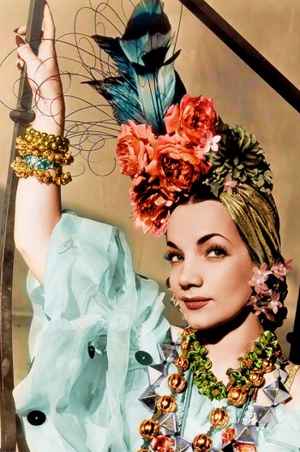
Carmen Miranda
Source: Versos de Fogo
Carmen Miranda was born Maria do Carmo Miranda da Cunha on 9 February 1909 in Marco de Canaveses, Portugal, to bring samba to the world largely via the United States. She was a close contemporary of Mexican film star, Dolores del Rio, who also did some dancing in film ('Bird of Paradise', 'In Caliente'), and whose career was built in the States. As for Miranda, she got transported to Brazil as a young child with her family, her father in the produce business, later to run a barbershop. Miranda herself learned to make hats at a boutique where she worked, and owned her own business selling hats while young, said to be successful.
Carmen's father was an opera fan emphatically against his daughter pursuing a career in show business. Miranda nevertheless sang at such as parties and festivals. She appeared in her first film before sound, 'A Esposa do Solteiro', in 1926, that since lost. It was when she came to the attention of composer and guitarist, Josué de Barros (1888-1959), that Miranda acquired her first record contract with the German label, Brunswick, in 1929. DAHR traces her earliest track to 'Triste Jandaia' ('Sad Jandaia') on 4 December 1929. De Barros had recorded the polka, 'Explorer', for Columbia in 1910, he well-seasoned in the early music industry by the time he met Miranda. Be as may, Brunswick, delayed issuing those recordings, Miranda meanwhile signing up with RCA, again with Barros' assistance. Her earliest recordings were therefore released by both labels, those by RCA first (January 1930), and getting the attention, those by Brunswick briefly afterward, going largely wayside. Miranda's most popular title overall, 'Pra Voce Gostar de Mim (Tahi)', had been issued in 1930.
'Triste Jandaia' ('Sad Janaia') Carmen Miranda
First-known recording to issue
4 Dec 1929 in Rio Matrix 50134 Victor 33249 (Brazil)
Composition: Josué de Barros
'Dona Balbina' Carmen Miranda
Second-known recording to issue
5 Dec 1929 in Rio Matrix 50135 Victor 33249 (Brazil)
Composition: Josué de Barros
'Pra Você Gostar de Mim' ('For You to Like Me') Carmen Miranda
22 Jan 1930 in Rio Matrix 50169 Victor 33263 (Brazil)
Composition: Joubert de Carvalho
'Yáyá, Yôyô' Carmen Miranda
23 Jan 1930 in Rio Victor 33259 (Brazil)
Composition: Josué de Barros
'Eu gosto da Minha Terra' ('I Like My Land') Carmen Miranda
6 Aug 1930 in Rio Matrix 50433 Victor 33374 (Brazil)
Composition: Randoval Montenegro
Singing for Rádio Mayrink Veiga in her home city of Rio de Janeiro, Miranda'a talking film debut arrived in 1933 with 'A Voz Do Carnaval', a documentary. Her first feature film, 'Alô, Alô Brasil', followed two years later. Miranda's love affair with hats was initially portrayed in the 1939 film, 'Banana-da-Terra', in which the Queen of Bananaland (Dircinha Batista) gets kidnapped and taken to Rio where she falls in love with a member of Miranda' band.
'Eu Dei' ('I Did It') Carmen Miranda
1937
Composition: Ary Barroso
'O que e que a Baiana tem' Carmen Miranda
('What does the Bahian woman have')
From the film 'Banana-da-Terra' ('Banana of the Land')
Directed by Ruy Costa Released 10 Feb 1939
Composition: Dorival Caymmi
Wikipedia
'Banana-de-Terra' was Carmen's last Brazilian film before visiting the United States in 1939 to perform in theatre, the Brazilian government (President Vargas at the time) paying the fares for Carmen's band. In addition to starring on Broadway ('The Streets of Paris'), she met President Franklin Roosevelt and sang for radio. Government was a big factor in Miranda's early success due much to President Roosevelt's Good Neighbor Policy concerning Latin American nations, Miranda received as a cultural ambassador.
Miranda's first Hollywood contract got signed in 1940 with 20th Century Fox, she to appear in 'Down Argentine Way'. Upon returning to Brazil that year Miranda was booed from the stage as an Americanized sellout. She left Brazil for fourteen years after that. As well, 'Down Argentine Way' was banned from Argentina for being everything but Argentine.
'Mamãe Eu Quero' Carmen Miranda w Garoto (guitar)
From the film 'Down Argentine Way'
Directed by Irving Cummings Released 11 Oct 1940
Composition: Vicente Paiva / Jararaca 1937
Carla Arton IMDb Michael Troyan Wikipedia
'That Night in Rio' arrived in 1941, in which Miranda plays the role of the girlfriend of an entertainer (Don Ameche) who does impersonations which raise complications when he mimics one Baron Duarte (also Ameche) who is attempting to start an airline. She was heavily criticized in Cuba upon release of the film, 'Weekend in Havana', later that year, the press finding little Cuban about the film. Altogether, Miranda was no purist, her music much embellished beyond samba and such. Mixing musical styles, she also more represented Latin in general than Brazil in particular. Atop her platform shoes with seven-inch heels, her flaring flamboyant energy at five feet two — salsa, if you like — was another item which the Latin press found distasteful about her, but which Americans loved, particularly the Chiquita banana brand who would place an outline of her on their label in 1944, as, to quote one of Miranda's songs, 'Bananas Is My Business'.
'Chica Chica Boom Chic' Carmen Miranda
From the film 'That Night in Rio'
Directed by Irving Cummings Released 11 April 1941
Music: Harry Warren Lyrics: Mack Gordon Portuguese: Aloysio de Oliveira
'Cai Cai' ('Fall Fall') Carmen Miranda
From the film 'That Night in Rio'
Directed by Irving Cummings Released 11 April 1941
Composition: Roberto Martins
'I, Yi, Yi, Yi, Yi (I Like You Very Much)' Carmen Miranda
From the film 'That Night in Rio'
Directed by Irving Cummings Released 11 April 1941
Music: Harry Warren Lyrics: Mack Gordon
'Rebola a Bola' 'When I Love I Love' Carmen Miranda
From the film 'Weekend in Havana'
Directed by Walter Lang Released 8 Oct 1941
Music: Harry Warren Lyrics: Mack Gordon
Come 'Springtime in the Rockies' which premiered in November 1942 in which Miranda appeared with Betty Grable and Harry James. as the secretary of a wealthy actor, one Dan Christy, who has fallen out with his business partner and love, Vicky (Grable). Christy romances Miranda in a scheme to make Vicky jealous of her and return to him.
'Chattanooga Choo Choo' Carmen Miranda
From the film 'Springtime in the Rockies' Aka 'Minha Secretária Brasileira'
Directed by Irving Cummings Released 6 Nov 1942
Music: Harry Warren Lyrics: Mack Gordon
'Tic-Tac Do Meu Coração' ('Tic-Tac From My Heart') Carmen Miranda
From the film 'Springtime in the Rockies' Aka 'Minha Secretária Brasileira'
Directed by Irving Cummings Released 6 Nov 1942
Composition: Alcyr Pires Red / Walfrido Silva
Come the film, 'The Gang's All Here', in 1943 with the Benny Goodman Orchestra. This romantic intrigue was banned from Brazil due to its many barely-clad dancers handling giant bananas. Nevertheless, by 1945 Miranda was both the highest paid entertainer and highest taxed female in America, earning over $200,000 that year.
'The Lady in the Tutti Frutti Hat' Carmen Miranda
From the film 'The Gang's All Here'
Directed by Busby Berkeley Released 24 Dec 1943
Music: Harry Warren Lyrics: Leo Robin
'Give Me a Band and a Bandana' Carmen Miranda
From the film 'Greenwich Village'
Directed by Walter Lang Released 27 Sep 1944
Music: Nacio Herb Brown Lyrics: Leo Robin
In 1947 Miranda herself produced the film, 'Copacabana', in which she starred with Groucho Marx. The brother of one of her investors, David Sebastian, married her in Beverly Hills on 17 March 1947. Their relationship was apparently a rough go until they eventually learned to settle with it. In 'Copacabana' Carmen assumes the roles of Carmen Navarro and Mademoiselle Fifi, both one person posing as two in a silly attempt by her agent to impress a film producer. The masquerade, of course, cannot continue indefinitely.
'Tico Tico' Carmen Miranda
From the film 'Copacabana'
Directed by Alfred E. Green Released 30 May 1947
Composition: Zequinha de Abreu 1917
During the latter forties Miranda continued to work in nightclubs and recorded tracks with the Andrews Sisters as well. But by 1953 during which she filmed 'A Date with Judy' she was exhausted to degree of collapse. She sought electroshock treatment due to depression. As that failed, she returned to Brazil in 1954 to recuperate. Back in the States in 1955, Carmen worked in Las Vegas, then toured in Cuba. Her final performance was in August that year with Jimmy Durante on 'The Jimmy Durante Show'. Ill to degree of needing to kneel to gather herself, she performed anyway, then died of heart attack the next day at her home in Beverly Hills on 5 August 1955. Carmen was apparently pregnant and suffering from preeclampsia. Another beautiful thing gone in an instant, just like that.
'Cooking with Gas' Carmen Miranda w Xavier Cugat and His Orchestra
From the film 'A Date With Judy'
Directed by Richard Thorpe Released 29 July 1948
Music: Gabriel Ruiz Lyrics: Ray Gilbert
'Cuanto la Gusta' Carmen Miranda w Xavier Cugat and His Orchestra
From the film 'A Date With Judy'
Directed by Richard Thorpe Released 29 July 1948
Music: Gabriel Ruiz Lyrics: Ray Gilbert
'The Jimmy Durante Show' Carmen Miranda
Television 4 Aug 1955
About 60,000 people attended Carmen's funeral in Rio de Janeiro. She had been a Catholic.
Sources & References for Carmen Miranda:
Jason Ankeny (All Music)
Gary Morris (Arquivo)
VF History (notes)
Audio of Miranda: Internet Archive YouTube
Miranda on Broadway: IBDB (1939/41)
Chronology: Timelines and Soundtracks
Collections Museo Carmen Miranda
Covers: Music Brainz Second Hand Songs
Documentaries:
Bananas Is My Business directed by Helena Solberg / 1996:
Review by Gary Morris
How American Propaganda Changed Carmen Miranda's Career (Be Kind Rewind / 2022)
Miranda in Film: IMDb Wikipedia
Select (chronological):
That Night in Rio (directed by Irving Cummings / 1941):
Springtime in the Rockies (directed by Irving Cummings / 1942):
The Blonde at the Film IMDb Wikipedia
Copacabana (directed by Alfred E. Green / 1947):
Cesar Balbi (w costumes in the Museo Carmen Miranda)
A Date With Judy (directed by Richard Thorpe / 1948):
Rebecca Deniston (Taking Up Room)
Iconography: Getty Images Wikimedia Commons
Interviews:
April 1948 (London / film)
1950 (At Home from Hollywood Reel by Erskine Johnson w Coy Watson)
July 1952 (George Fisher)
Obituaries:
Miranda on Radio: Old Time Radio (1942-56)
Recordings by Miranda: Catalogs:
Discogs IMMuB RYMRecordings by Miranda: Sessions: DAHR (1929-50)
Further Reading:
Archives:
Edmonton Journal
(26 Aug 1984 / Stephen Bloom / After 30 years Carmen Miranda Still a
Bombshell)
Life Magazine
(17 July 1939)
Pittsburgh Post-Gazette
(30 May 1988 / Woodine Merriman / On Trail of Miranda Museum)
Dame Town (Have You Been Properly Carmen Miranda-ized?)
Irenebrination (The Lady in the Tutti-Frutti Hat / 2021)
Lulu Garcia-Navarro (Of Fruit Hats and 'Happy Tropics' / NPR radio / 2015)
Lisa Shaw (Carmen Miranda's fashion / 2015)
Silver Screenings (The Fashion Influence of Carmen Miranda)
Andrew Vargas (Stereotype or Samba Pioneer? / 2016)
Caetano Veloso (Miranda and Dada)
Caetano Veloso (Miranda and Tropicalismo)
Wikipedia (Carmen Miranda Museum)
Bibliography:
Kathryn Bishop-Sanchez (Creating Carmen Miranda / Vanderbilt U Press / 2016)
Roy Castro (Carmen – Uma biografia / Companhia das Letras / 2005):
Martha Gil-Montero (Brazilian Bombshell / Donald I. Fine / 1989)
Reviews of Helena Solberg's 1996 Bananas Is My Business:
Darién J. Davis Regina R. Félix
Authority Search: BNF Data
Other Profiles: Connect Brazil