
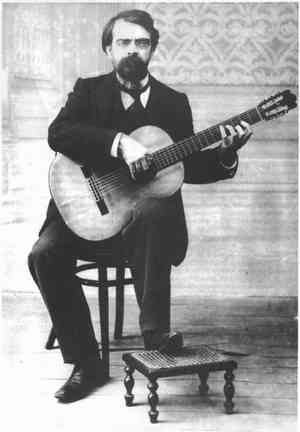
Francisco Tárrega
Source: Find a Grave
Born in Villarreal in the province of Castellón on 21 November 1852, Francisco de Asís Tárrega y Eixea had a flamenco guitarist for a father when not working as a watchman. Considered by many to be the "father" of classical guitar, Tárrega began to study both guitar and piano for a brief time in Barcelona in 1862. A few sources have him writing 'Gran Jota' as early 1872. I tend to doubt that but can't discover any other date so we'll tentatively roll with it here:
'Gran Jota' Francisco Tárrega 1872
Guitar: Lilit Mardiyan
Tárrega enrolled into the Madrid Royal Conservatory in 1874 due to the patronage of one Antonio Canesa. He there studied composition beneath Emilio Arrieta. By the latter seventies he was giving guitar concerts and teaching. He played houses in Lyon, Paris and London in 1881 before settling in Madrid. Tárrega moved to Barcelona only four years later in 1885 where he would reside for the remainder of his life. He there soon found another patron, one Conxa Martinez, who lent him one of her homes in which to live with his family.
Tárrega's 'Capricho Arabe' arrived in 1892. He possibly conceived one of his more favored pieces, 'Lagrima' ('Teardrop') in E major, as early as 1881 while in London. It wasn't composed, though, until 1892 per Wikipedia and IMSLP. Blitz Guitar has 1900. Wild dates or no dates aren't the only thing that a study of Tárrega will get you: As with other of Tárrega's preludes for guitar, the Prelude number for 'Lagrima' differs depending on the catalogue being cited. The most commonly used of several are the Gangi-Carfagna of 1971 which lists 'Lagrima' as Prelude 36, and the Chiesa of 1984 which lists it as Prelude 5. Prelude numbers with Tárrega can be disorienting, as other catalogues with differing numbers are used as well.
'Capricho Arabe' ('Arabic Whim') Francisco Tárrega 1892
Guitar: Alexandra Whittingham
'Lagrima' ('Teardrop') Francisco Tárrega 1892
Guitar: Jesús Amaya
IMSLP Savarese Score Wikipedia
'Lagrima' ('Teardrop') Francisco Tárrega 1892
Guitar: Michael Chapdelaine
IMSLP Savarese Score Wikipedia
Tárrega's favored 'Recuerdos de la Alhambra' ('Memories of de la Alhambra') was composed in 1899 per Wikipedia and IMSLP. Tárrega visited Algiers in 1900, Italy in 1903. In the meantime, one of his mazurkas, 'Adelita', is thought to have been published in 1902 by Antich y Tena.
'Recuerdos de la Alhambra' Francisco Tárrega 1899
Guitar: Radmila Besic
'Recuerdos de la Alhambra' Francisco Tárrega 1899
Guitar: Stephanie Jones
'Recuerdos de la Alhambra' Francisco Tárrega 1899
Guitar: Kyuhee Park
'Recuerdos de la Alhambra' Francisco Tárrega 1899
Guitar: Ana Vidovic
'Recuerdos de la Alhambra' Francisco Tárrega 1899
Guitar: Xuefei Yang
'Danza Mora' Francisco Tárrega 1900
Guitar: Thu Le
'Danza Mora' Francisco Tárrega 1900
Guitar: Jose Ramirez 1964
'Danza Mora' Francisco Tárrega 1900
Guitar: David Russell
'Adelita' Francisco Tárrega 1902
Guitar: Taso Comanescu
Classical Guitar Magazine EMusicMaestro IMSLP Savarese Score
Tárrega's last composition was 'Oremus' with a date of 2 December 1909. 'Oremus' (Latin for "Let us pray") is so often performed with 'Endecha' (Spanish for "dirge" or 'lament", and which date of composition is unidentified) that IMSLP lists them both together as 'Endecha y Oremus'. They are also listed together as 'Dos Preludios' per a posthumous Madrid copyright of 4 November 1929 [LOC]. Like other of Tárrega's preludes, the Prelude numbers for 'Endecha' and 'Oremus' differ depending on which of several catalogues. In Gangi-Carfagna 'Endecha' in D minor is Prelude No.37 and 'Oremus' in D minor is Prelude No.38. In Chiesa 'Endecha' is Prelude No.11 and 'Oremus' is Prelude No.10. An array of other numbers are also used. Be as may, 'Oremus' is actually Tárrega's transcription of Robert Schumann's 'Phantasietanz' Op 124 No.5 of 1854.
'Endeche' w 'Oremus' 'Oremus' at 1:55 D minor Francisco Tárrega 1909
Guitar: Joseph Lau
Score to 'Endeche' Score to 'Oremus'
'Oremus' D minor Francisco Tárrega 1909
Guitar: Matteo Staffini
'Oremus' D minor Francisco Tárrega 1909
Guitar: Giulio Tampalini March 2020
Tárrega died on December 15, 1909, a couple weeks after transposing 'Oremus'. He had written a minimum of 78 pieces, likely considerably more, and fairly set the foundation for which Spain has come to be so well-known, that being classical guitar in addition to flamenco. Tárrega played the Torres guitar made by Antonio Torres Jurado, one of which is valued at $157,000 by Christie's.
Sources & References for Francisco Tárrega:
Robert Cummings (All Music)
VF History (notes)
Audio of Tárrega: Corpora:
Audio of Tárrega: Individual:
Lagrima (Teardrop / 1892): Bradford Werner
Recuerdos de la Alhambra (1899): Bradford Werner
Compositions: Corpora:
Classic Cat
Preludes
Wikipedia English
Wikipedia Spanish
Compositions: Individual (not referenced above):
Recuerdos de la Alhambra (1899):
IMSLP
Savarese
Score
Wikipedia
Iconography:
Wikimedia Commons
Antonio Torres Jurado
(1817-92 / guitarist / luther of the Torres guitar):
José L. Romanillos
(Antonio de Torres, Guitar Maker - His Life and
Work / Bold Strummer / 1990)
Recordings of Tárrega: Catalogs:
DAHR
(shellac / 1928-42)
Recordings of Tárrega: Select:
Tárrega: Integral de Guitarra
(David Russell / Opera Tres CDS 1003/4 / 1991)
Scores / Sheet Music:
Abe Books
(vendor)
IMSLP
The Torres Guitar:
La Invencible
(1884)
Further Reading:
David J. Buch
(On the Need for a Scholarly Edition of Tárrega’s Complete Works /
Guitar Foundation of America / 2021)
The Guitar Blog
(Tárrega’s Transcriptions of Chopin for Guitar / 2011)
IMDb
(usage of Tárrega in film)
Authority Search:
BMLO
BNF Data
Other Profiles:
Wikipedia International:
French
German
Italiano
Spanish
Classical
Main Menu
Modern Recording