
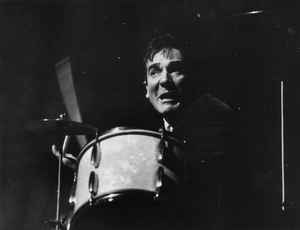
Gene Krupa
Source: Quotation Of
Born on 15 January 1909 in Chicago, drummer, Gene Krupa, expanded the drums ensemble beyond the usual bass, cymbals and snare [Drummer Man]. Famous for his work with Benny Goodman, he is thought to have first recorded with Red McKenzie and Eddie Condon's Chicagoans on December 8, 1927, for Okeh: 'Sugar' and 'China Boy'. The Chicagoans consisted of Bud Freeman at tenor sax along with Condon at banjo, Jimmy McPartland (cornet), Frank Teschmacher (clarinet), Joe Sullivan (piano) and Jim Lannigan. These were the first recordings for all performers involved excepting McPartland who had begun his recording career three years earlier when he replaced Bix Beiderbecke in the Wolverine Orchestra. If McKenzie participated on these tracks in any way they wouldn't have been his first either, he also first recording in 1924. Of all the big jazz names belonging to the Chicagoans it is probably Krupa who became the most famous of all to this day, making a beloved figure of himself as a percussionist beyond only his elite status in the genre of jazz. Krupa could keep a steady beat and made a big bang of which most have heard by now. Which seems a little spooky to me since the year he began recording noise in 1927 was the same that Georges Lemaître formulated the cosmological theory which alternative was Fred Hoyle's Steady State model.
'China Boy' McKenzie and Condon's Chicagoans
Recorded 8 December 1927 in Chicago Matrix 82030-B Okeh 41011
Cornet: Jimmy McPartland Tenor sax: Bud Freeman
Clarinet: Frank Teschmacher Piano: Joe Sullivan Banjo: Eddie Condon
Tuba / bass: Jim Lannigan Drums: Gene Krupa
Composition: Phil Boutelje / Dick Winfree
'Nobody's Sweetheart' McKenzie and Condon's Chicagoans
Recorded 16 December 1927 in Chicago Matrix 82082-B Okeh 40971
Cornet: Jimmy McPartland Tenor sax: Bud Freeman
Clarinet: Frank Teschmacher Piano: Joe Sullivan Banjo: Eddie Condon
Tuba / bass: Jim Lannigan Drums: Gene Krupa Cymbals: Mezz Mezzroe
Composition: Gus Kahn / Ernie Erdman / Elmer Schoebel / Billy Meyers
Several more unissued tracks with Condon followed in 1928 until Thelma Terry and her Playboys recorded 'Lady of Havana', among others, on March 29. From spring to summer that year Krupa found himself recording with Condon in various groups from the Chicago Rhythm Kings, the Jungle Kings, Frank Teschemacher's Chicagoans and a band run by Miff Mole to the Eddie Condon Quartet before recording with Wingy Manone's Club Royal Orchestra in September: 'Downright Disgusted' and ''Fare Thee Well'. Tracks also went down in September with the Wabash Dance Orchestra, partnering with Red Nichols and, again, Wingy Manone. Krupa finished 1928 with Red McKenzie in December, recording 'Crazeology' and 'Can't Help Lovin' That Man' with the Bud Freeman Orchestra.
'Starlight and Tulips' Thelma Terry and her Playboys
Recorded 29 March 1928 in Chicago Matrix 145855-4 Columbia 1532-D
Trumpet: Carl Rinker Clarinet: Bud Jacobson
Clarinet / alto or tenor sax: Mike Platt / Phil Shuken
Banjo: Roy Campbell Bass: Thelma Terry Drums: Gene Krupa
Composition: Alfred Bryan / Pete Wendling
'Crazeology' Bud Freeman & His Orchestra
Recorded 3 December 1928 in Chicago Matrix 402151-C Okeh 41168
Trumpet: Johnny Mendell Trombone: Floyd O'Brien
Clarinet / sax: Bud Jacobson Tenor sax: Bud Freeman Piano: Dave North
Banjo: Herman Foster Bass: Johnny Mueller Drums: Gene Krupa
Composition: Bud Freeman
In 1929 Krupa supported Red Nichols' Five Pennies before more tracks with Condon and McKenzie, now with the Mound City Blue Blowers. He also performed with Emmett Miller, Red Nichols' Midnight Airedales and Fats Waller in 1929. He began 1930 with Irving Mills and further configurations run by Nichols such as the Louisiana Rhythm Kings. He supported Hoagy Carmichael on May 21, 1930 in NYC toward 'Rockin' Chair' and 'Barnacle Bill the Sailor'. Participants in that session something illustrate the heady talent with which Krupa daily bumped shoulders: Bix Beiderbecke (cornet), Bubber Miley (trumpet), Tommy Dorsey (trombone), Benny Goodman (clarinet), Arnold Brilhart (alto sax), Joe Venuti (violin), Irving Brodsky (piano), Eddie Lang (guitar), Harry Goodman (tuba) and Carson Robison with Carmichael on vocals.
'Barnacle Bill the Sailor' Hoagy Carmichael & His Orchestra
Recorded 21 May 1930 in NYC Matrix 62301-1 Victor V38139
Cornet: Bix Beiderbecke Trumpet: Bubber Miley Trombone: Tommy Dorsey
Clarinet: Benny Goodman Alto sax: Arnold Brilhart Tenor sax: Bud Freeman
Piano: Irving Brodsky Violin: Joe Venuti Guitar: Eddie Lang
Tuba: Harry Goodman Drums: Gene Krupa
Vocals: Hoagy Carmichael / Carson Robison
Composition: Carson Robison / Frank Luther
A load of recordings with Nichols, among others, followed into 1931. In latter 1934 Krupa joined the Benny Goodman operation, having first worked with Goodman on recordings with Nichols' Five Pennies in April of 1929. Krupa remained with Goodman into 1938. Krupa had begun recording with his own orchestras in 1935, a session with his configuration of the Chicagoans on November 19 that year yielding 'The Last Round-Up', 'Jazz Me Blues', 'Three Little Words' and 'Blues of Israel'. Goodman was also a member of Krupa's Swing Band in 1936. Krupa and Goodman would record numerously together in various configurations throughout their careers. Krupa's last recordings were with the Benny Goodman Quartet at Carnegie Hall in NYC on June 29, 1973. Also in that ensemble were Lionel Hampton on vibes, Teddy Wilson on piano and Slam Stewart on bass. Krupa had first worked with Hampton with Benny Goodman in 1936 and would record with Hampton often, both with Goodman and in Hampton's orchestras. Teddy Wilson would drift in and out of his path on various occasions, including Krupa's bands.
'Three Little Words' Gene Krupa and His Chicagoans
Recorded 19 Nov 1935 in Chicago Matrix 90462-A Parlophone R2224
Trumpet: Nate Kazebier Trombone: Joe Harris
Clarinet: Benny Goodman Tenor sax: Dick Clark
Piano: Jess Stacy Guitar: Allan Reuss
Bass: Israel Crosby Drums: Gene Krupa
Composition: Bert Kalmar / Harry Ruby
'Blues of Israel' Gene Krupa and His Chicagoans
Recorded 19 Nov 1935 in Chicago Matrix 90463-B Parlophone R2224
Trumpet: Nate Kazebier Trombone: Joe Harris
Clarinet: Benny Goodman Tenor sax: Dick Clark
Piano: Jess Stacy Guitar: Allan Reuss
Bass: Israel Crosby Drums: Gene Krupa
Composition: Gene Krupa
'Sing, Sing, Sing' Gene Krupa w the Benny Goodman Orchestra
Movie: 'Hollywood Hotel' filmed in Hollywood in July-August 1937
Trumpet: Harry James Composition: Louis Prima
In 1939 Krupa featured in the Hollywood film, 'Some Like It Hot'. He was such a skilled drummer that it was inevitable that the drum solo be introduced to jazz by him, drum battles to ensue (such as the example further below for 1952).
'Wire Brush Stomp' Gene Krupa
Movie: 'Some Like It Hot' released 19 May 1939
Composition: Gene Krupa
Krupa and His Orchestra had begun placing titles on Billboard's Top 20 per 'Fare Thee Well' in 1938 sung by Annie Laurie. Eight of his recordings rose to the Top 20 while 7 of them reached the Top 10 beginning 'High on a Windy Hill' in February of 1941. Top 10 titles by Krupa and His Orchestra of which TsorT indicates 'Bonaparte's Retreat' of 1950 to be his best-selling title overall:
High on a Windy Hill
#2 2/1941 Krupa Orchestra
It All
Comes Back to Me Now #2 2/1941 Krupa
Orchestra w Howard Dulany
Just a Little Bit South of
North Carolina #9 8/1941 Krupa
Orchestra w Anita O'Day
Let Me Off Uptown
#10 9/1941 Krupa Orchestra w Anita O'Day & Roy
Eldridge
Along the Navajo Trail #7
10/1945 Krupa Orchestra w Buddy Stewart
Chickery Chick
#10 12/1945 Krupa Orchestra w Anita O'Day
Boogie Blues #9 7/1946 Krupa
Orchestra w Anita O'Day
Bonaparte's Retreat #9 6/1950
Krupa Orchestra w Bobby Soots
'High on a Windy Hill' Gene Krupa and His Orchestra backing Howard Du Lany
Recorded 17 Sep 1940 in NYC Matrix 28643-1 Okeh 5883 Charts: #2 Feb 1941
Composition: Alex Kramer / Joan Whitney
'After You've Gone' Gene Krupa and His Orchestra
Recorded 5 June 1941 in NYC Matrix 30605-1 Okeh 6278
Trumpet: Roy Eldridge Composition: Henry Creamer / Turner Layton
'Drum Boogie' Gene Krupa Orchestra
Movie: 'Ball of Fire' released 2 Dec 1941
Actress: Barbara Stanwyck voice dubbing Martha Tilton
Composition: Gene Krupa / Roy Eldridge
In 1943 Krupa was arrested for possession of two joints of cannabis and contributing to the delinquency of a minor. He'd spent nearly three months in jail when it was decided that he'd been framed and was cleared of charges ['New York Times']. Continuing to record extensively both with other musicians and his own ensembles, often quartets, highlights of his career include several occasions with Norman Granz' Jazz at the Philharmonic, the first on February 12, 1945 in Los Angeles. (The initial Jazz at the Philharmonic was held on July 2, 1944, in Los Angeles.) Gigs for Granz were reserved to the cream of jazz performers as Krupa broadened his fame among the greater general audience in the forties via film appearances. As mentioned, his composition with Remo Biondi, 'Boogie Blues', reached Billboard's #9 spot in July of 1946, sung by Anita O'Day.
'Boogie Blues' Gene Krupa and His Orchestra backing Anita O'Day
Recorded 21 Aug 1945 in NYC Matrix CO35113-1 Columbia 36986 Charts: #9 July 1946
Composition: Gene Krupa Arrangement: Remo Biondi
'Bop Boogie' Gene Krupa and His Orchestra backing Dolores Hawkins
Film: 'Thrills of Music' 1948
Composition: George Williams
'Drum Battle' Gene Krupa w Buddy Rich
Jazz At The Philharmonic at Carnegie Hall in NYC on 13 Sep 1952 Album
Trumpet: Roy Eldridge / Charlie Shavers
Alto sax: Benny Carter Tenor sax: Flip Phillips / Lester Young
Piano: Hank Jones / Oscar Peterson Guitar: Barney Kessel Bass: Ray Brown
Composition: Krupa / Rich
(Producer Norman Granz sometimes credited jam sessions to an imaginary "Norman Shrudlu")
'Flying Home' Gene Krupa w Buddy Rich
Jazz At The Philharmonic at Carnegie Hall in NYC on 13 Sep 1952 Album
Trumpet: Roy Eldridge / Charlie Shavers
Alto sax: Benny Carter Tenor sax: Flip Phillips / Lester Young
Piano: Hank Jones / Oscar Peterson Guitar: Barney Kessel Bass: Ray Brown
Composition: Benny Goodman / Lionel Hampton
'Sing, Sing, Sing' Gene Krupa Trio
1 Feb 1954 in NYC Matrix 1505-2 MGM GAS132
Trumpet / clarinet / saxophone: Eddie Shu Piano: Teddy Napoleon
Composition: Louis Prima
Krupa performed in the 'Timex All Star Jazz Show' for NBC from 1957 into 1959. More than thirty years into his profession, Krupa was hardly history, but a happy drummer long acquainted with people making a fuss of him, when a movie was made about his career in 1959 called 'The Gene Krupa Story' with screenplay by Orin Jannings, direction by Don Weis and Sal Mineo as Krupa. Krupa worked with Condon again in 1961 per 'Chicago and All That Jazz' for NBC. His last performance as a leader listed in Tom Lord's sessionography was a quartet with Eddie Shu on tenor sax, John Bunch at piano and Nobil Totah on bass in April, 1973, at the New School in New York. His last known recordings were held on 29 June 1973 with the Benny Goodman Quartet at Carnegie Hall.
'Sing, Sing, Sing' Gene Krupa Television
26 June 1960 'The Ed Sullivan Show'
Clarinet / tenor sax: Eddie Wasserman Piano: Ronnie Ball Bass: Jimmy Gannon
Composition: Louis Prima
'Chicago' Gene Krupa w the Benny Goodman Quartet
Television21 Aug 1967 in NYC 'I Remember Illinois' Giants of Jazz GoJ1005
Clarinet: Benny Goodman Piano: Teddy Wilson Bass: George Duvivier
Composition: Fred Fisher
'Boogie Woogie' Gene Krupa w the Benny Goodman Quartet
29 Sep 1973 at Carnegie Hall in NYC From Krupa's last known session Album
Clarinet: Benny Goodman Piano: Teddy Wilson
Vibes: Lionel Hampton Bass: Slam Stewart
Krupa died of leukemia and heart failure in Yonkers, New York, on 16 October 1973.
Sources & References for Gene Krupa:
John Cohassey (Gene Krupa Reference Page)
Shawn C. Martin (Drummer Man)
Modern Drummer Magazine (Drummer Man)
VF History (notes)
Scott Yanow (All Music)
Audio of Krupa: Internet Archive
Billboard (popularity charts): MusicVF TsorT
Filmographies: Drummer Man IMDb
Films:
Ball of Fire (1941)
Hollywood Hotel (1937)
Some Like It Hot (1939)
Iconography: Drummer Man Wikimedia Commons
Interviews:
1956 (w Buddy Rich by Willis Conover for Voice of America Radio)
Recordings: Catalogs:
Shawn C. Martin (Drummer Man)
Recordings: Compilations:
Chronological Classics:
1938 1947-1949 1949-1951 1952-1953 1953-1954
Drummin' Man (Columbia C2L 29 / 1963)
Recordings: Sessions:
DAHR (Krupa / 1927-1962)
DAHR (Krupa & His Chicagoans / 1935)
Tom Lord: leading 263 of 626 sessions 1927-1973
Brian Rust (Jazz and Ragtime Records, 1897-1942 / Mainspring Press / 2001):
Internet Archive (searchable text)
Brian Rust (Jazz Records, 1917–1934)
Reputation: Drummer Man
Bibliography: Bruce Klaube (World of Gene Krupa / Pathfinder / 1990)
Authority Search: VIAF
Other Profiles:
Bernhard Castiglioni (Drummer World)
Donald Clarke (Music Box)
Owen Edwards (Smithsonian)
Donald Greyfield (Find a Grave)
Classical Main Menu Modern Recording