
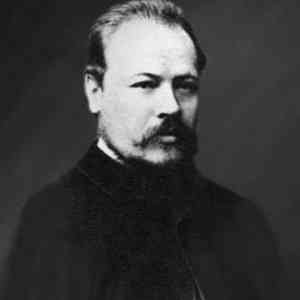
Anatoly Lyadov
Source: Alchetron
Born on 12 May 1855 in Saint Petersburg, Anatoly Konstantinovich Lyadov's mother was a pianist, his father the conductor of the Imperial Opera Company. Lyadov was a composer of miniatures, never producing a large-scale composition. He entered the St. Petersburg Conservatory in 1870, initially to study piano and violin, later counterpoint and fugue. Lyadov's Opus 1 is assigned to '4 Songs' as of 1873/74.
Though said to be an indolent student, Lyadov played piano like a master and graduated in 1878 to become a teacher at the Conservatory, about the time he came to the attention of Alexander Borodin and his group of independent composers known as The Five. Lyadov contributed five pieces (Nos.1, 4, 6, 7 and 16) to the first edition of Borodin's project, 'Paraphrases', published in 1879, among the more notable being No.1 which is '24 Variations et Finale' ('24 Вариации и Финал') in C major to which César Cui and Rimsky-Korsakov also contributed. Those were variations on Borodin's 'Cutlet Polka' which was itself a variation of Arthur de Lulli's (Euphemia Allen) famous exercise for children, her 'Chop Waltz' (usually called 'Chopsticks' though having nothing to do with Eastern Asian eating utensils). Allen wrote the 'Chop Waltz' at age sixteen, and though she died a music publisher in 1948 she is known for nothing else. Mussorgsky had also contributed a piece, rejected for straying too far off topic, which he didn't revise as he thought the project wanted substance. Nor did Balakirev, leader of the Five, take the project seriously. Franz Liszt, however, a strong supporter of Russian composition up against German dominance, thought the project more ingenious than ingenuous and contributed 'Prelude' in B flat major to the second edition of 'Paraphrases' in 1880.
''Gique' ('Жига') C major Anatoly Lyadov 1879
No.7 of Borodin's 'Paraphrases'
Four hands arrangement performed by Lyadov Marco Rapetti w Daniela De Santis 2008
'Scherzo for Orchestra' ('Скерцо для оркестра') Op 16 D major Anatoly Lyadov 1879
Premiere 1886 at Kononov Hall in St. Petersburg
USSR Symphony Orchestra / Yevgeny Svetlanov
As a second generation member of the Five, in 1884 Lyadov began to serve on the musical committee of publisher, Mitrofan Belyayev [Wikipedia], as an integral contributor to the Belyayev circle. It was 1884 when Belyayev established a publishing house in Leipzig, also instituting the Glinka Prize with Lyadov [see also Mikhail Glinka]. Lyadov had also married in 1884, thereat acquiring a country estate at Polynovka, now in north-eastern Belarus near its border with Russia, where he resided the rest of his life. Belyayev had been teaching at the St. Petersburg Conservatory for seven or eight years when he began his own publishing enterprise in Leipzig in 1885 [Wikipedia], more to publish the work of other composers than his own, such as Borodin, Glazunov and Rimsky-Korsakov alike Belyayev.
Lyadov's most popular works were written during the latter part of his life, so we leap forward to Op 49 which is his first 'Polonaise for Orchestra' ('Полонез для оркестра') in C major. Though this was composed in 1889 it didn't see publishing until 1900 in Leipzig. Lyadov's Op 55 of 1902 is also a polonaise for orchestra.
'Polonaise for Orchestra' ('Полонез для оркестра') Op 49 in C major Anatoly Lyadov
Comp 1889 Pub 1900 In memory of Pushkin
Birmingham Symphony Orchestra / Neeme Järvi
Lyadov is best known for his tone poems based in Russian folklore, 'Baba Yaga' ('Польский') Op 56 appearing in 1904 toward publishing in Leipzig in 1905. Baba Yaga is an evil old witch who lives in the forest with a fence of human bones made from eating children. You know she is coming when the wind starts whipping up. The first-known mention of Baba Yaga is in Mikhail Vasilievich Lomonosov's 'Russian Grammar' of 1755.
'Baba Yaga' Op 56 Tone poem by Anatoly Lyadov 1904
Orquesta Sinfónica de Galicia / Dima Slobodeniouk
Palacio de la Ópera de A Coruña, Spain 2 Nov 2012
IMSLP Marianne Williams Tobias Score
Come Lyadov's fairy tale, 'The Enchanted Lake' ('Заколдованное озеро') in D flat major Op 62 in 1908, published the next year.
'The Enchanted Lake' ('Заколдованное озеро') Op 62 D-flat major
Symphonic poem by Anatoly Lyadov 1909
BBC Philarmonic / Vassily Sinaisky
Robert Cummings IMSLP Gumersindo Díaz Lara
Musical Musings Georg Predota Wikipedia English Wikipedia Français
'Kikimora' ('Кикимора') in E minor Op 63 also appeared in 1909 toward publishing in 1910. Kikimora is an evil demon in Slavic folklore with a head the size of a thimble atop a body lighter than a straw. She spends her days spinning flax while hating the world. She had grown up in the care of a magician and his cat so fast that she reached maturity by age seven.
'Kikimora' ('Кикимора') Op 63 E minor
Symphony by Anatoly Lyadov 1909 Pub 1910
St Petersburg Philharmonic Orchestra / Yuri Temirkanov Aug 2013
Eduardo García Walker Homes IMSLP James Leonard Wikipedia Français
Lydov's 'Nénie' also called 'Mournful Song' ('Skorbnaya Pesn') ('Скорбная песнь') Op 67 premiered on 13 March of 1910 in St. Petersburg with Nikolay Tcherepnin conducting. Nénie or Nenia Dea is the Roman goddess of the funeral lament and rite.
'Nénie' aka 'Mournful Song' ('Skorbnaya Pesn') ('Скорбная песнь') Op 67
Symphonic dirge by Anatoly Lyadov
Premiere 13 March 1910 in St. Petersburg w Nikolay Tcherepnin conducting
Slovak Philharmonic Orchestra / Stephan Gunzenhause
IMSLP Merritts Hill Music Laura Stanfield Prichard
Though Op 67 was Lyadov's last assigned Opus he wrote later works left WoO (Without Opus) including the latest documented at IMSLP thought published in 1914, '12 Canons on a Cantus Firmus'. (A cantus firmus is a preexistent melody).
'12 Canons on a Cantus Firmus' WoO Canons by Anatoly Lyadov Pub 1914
Piano: Olga Solovieva
Lyadov died on 28 August 1914 exactly one month after the beginning of World War I on 28 July.
Sources & References for Anatoly Lyadov:
VF History (notes) Wikipedia English Xiaoyu Zhang
Audio of Lyadov:
Baba Yaga (Op 56 / 1904 / USSR State Academy Orchestra / Evgeny Svetlanov)
Kikimora (Кикимора / Op 63 / 1910 / USSR State Academy Orchestra / Evgeny Svetlanov)
Classical Archives Hyperion MuziekWeb International Naxos Presto
Belyayev Circle: Wikipedia English Wikipedia Español
Compositions: Corpora:
Klassika (by genre / opus / title)
IMSLP (by date / opus)
IMSLP (by title)
Liadow (Pусский)
Wikipedia English (by date)
ウィキペディア日本語版 (Wikipedia Japanese)
Russiches Musikarchiv (Deutschsprachige)
Discussion: Good Music Guide
Lyrics / Texts: LiederNet
Recordings of Lyadov: Catalogs:
45 Worlds Arkiv DAHR (shellac 1911-1950) Discogs Liadow (Pусский) Music Brainz RYM
Recordings of Lyadov: Select:
Orchestral Works (BBC Philharmonic Orchestra / Vassily Sinaisky / Chandos CHAN9911 / 2001)
Orchestral Works (Slovak Philharmonic Orchestra / Stephen Gunzenhauser / Marco Polo 8.220348 / 1990)
Review (Keith Anderson)
Scores / Sheet Music:
Abe Books (vendor)
iKliros (Pусский)
Musicalics (vendor)
Further Reading:
Baba Yaga (witch in Russian folklore):
Crazy Alchemist Frank Dugan Fandom Pagan Pages
Kris Spisak Kris Spisak Wikipedia World History
Alexander Borodin's Paraphrases on Euphemia Allen's Chopsticks:
Georg Predota Elinor Smith Wikipedia
Correspondence with Tchaikovsky 1885/1890: Tchaikovsky Research
Kikimora (Кикимора / demon in Slavic folklore):
Fandom Slavic Studies Wikipedia World History
Franz Liszt's Prelude to Borodin's Paraphrases:
Leslie Howard IMDB IMDB MuseScore Wikipedia
Lomonosov, Mikhail Vasilievich ( Ломоносов, Михаил Васильевич / 1711-1755 / author of Russian Grammar / 1755):
Russian Grammar / Российская грамматика / Lomonosov / 1755: Boris Karlov Text Text
Authority Search: Deutsche National Bibliothek
Other Profiles:
English: Stephen Coombs Kennedy Center James Manheim (All Music)
Pусский: Edusite Victor Kashirnikov Liadow
Wikipedia: Deutschsprachige Français 日本語 Pусский
Classical Main Menu Modern Recording
|
|