
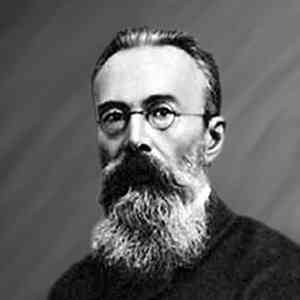
Nikolai Rimsky-Korsakov
Source: Bach Cantatas
Born on 8 March 1844 in Tikhvin (120 miles east of St. Petersburg), Nikolai Rimsky-Korsakov (Николай Андреевич Римский-Корсаков) had written largely orchestral works and operas, as well as choral works, songs, chamber works and pieces for piano. Of noble lineage, Nikolai's father who had been vice-governor of Novgorod, then civil governor of Volyn. His older brother, Warrior Andreyevich, would become a rear admiral in the Russian navy. Nikolai began piano at age six and was composing at age ten. Among earliest works is 'Бабочка' ('The Butterfly') for piano and voice in 1855. Yet Nikolai had little interest in music until meeting teacher, Feodor Kanille, in 1859. Kanille in turn introduced Korsakov to Mily Balakirev in 1861. Balakirev taught Korsakov some fundamentals, but "teach yourself" was the primary lesson that he gave to all his students. He would later get the same advice, in so many words, from Tchaikovsky.
Upon graduating from the School for Mathematical and Navigational Sciences in Saint Petersburg in 1862, Risky-Korsakov took to the sea as a midshipman the next year. He did some composing at sea, but notions of becoming a musician began to fade before returning to St. Petersburg in 1865. Had he not met Balakirev before his tour at sea he might never have composed a thing else. Now seeing him again, Balakirev encouraged him to finish the symphony that he had begun at sea in 1861. That resulted in the first public performance, directed by Balakirev at his Free School, of Nikolai's first Opus, 'Symphony 1' in E flat minor, in December of 1865. His much later 1884 version in E minor is the standard presented below:
'Symphony No.1' in E minor Op 1 Nikolai Rimsky-Korsakov
1861-65 Revised 1884
Bergen Philharmonic Orchestra Dmitri Kitajenko
IMSLP Andrew Lindemann Malone Wikipedia
From 1866 to 1898 Nikolai composed 17 'Romances' containing multiple songs for piano and voice. His first was Op 2 consisting of four. Balakirev is said to have written the piano for No.1:
'4 Romances' Op 2 Songs by Nikolai Rimsky-Korsakov
1865-66
1. Щекою к щеке ты моей приложись ('Lean Thy Cheek to Mine')
Text by Mikhail Mikhaylov
2. Восточный романс: «Пленившись розой, соловей
('Eastern Song: The Nightingale Enslaved by the Rose')
Text by Aleksey Koltsov
3. 'Колыбельная песня' ('Lullaby')
Text by Lev Mey
4. Из слез моих ('From My Tears')
Text ?
Piano: Xuefei Liu Soprano: Brianne Kollmorgen
Nikolai's 'Садко' ('Sadko') Op 5 was a symphonic poem (tone poem, musical picture, tableau musical) conducted by Balakirev at a concert of Anton Rubinstein's Russian Musical Society (RMS) in 1867:
'Sadko' Op 5 Symphonic poem by Nikolai Rimsky-Korsakov
1867 Revised 1869 / 1891–92
Libretto by Rimsky-Korsakov
Moscow Symphony Orchestra Igor Golovschin 1999
Hector Bellman IMSLP Wikipedia English Wikipedia Russian
Rimsky-Korsakov's 'Фантазия на сербские темы' ('Fantasy on Serbian Themes' or 'Serbian Fantasy') Op 6 was conducted by Balakirev on 24 May of 1867 in Moscow. Nikolai dedicated this work to Mighty Five comrade, Alexander Borodin. As Rimsky-Korsakov continued with assistance from Balakirev he became the youngest member of latter's The Five, a group led by Balakirev which interest was to fashion a Russian national identity in music distinguished from the prestige of what was taught in conservatories in western Europe. The Five was also called Moguchaya kuchka (Mighty Handful) by nationalist critic, Vladimir Stasov, who wrote a review for the 1867 performance of 'Serbian Fantasy' held on the occasion of the Second Slavonic Congress of 1867. Other members of The Five were César Cui and Modest Mussorgsky. Even so, Nikolai later recalled that he hadn't written 'Serbian Fantasy' for any reason nationalistic, but only for its beauty.
'Fantasy on Serbian Themes' Op 6 Nikolai Rimsky-Korsakov
Premiere 24 May 1867 for the Second Slavic Congress
Philharmonia Orchestra Yondani Butt
IMSLP Tchaikovsky Research Wikipedia English
Rimsky-Korsakov's Symphony No.2 ('Antar') Op 9 arrived in 1868 toward revisions in 1875 and 1891. It was first performed for Rubinstein's Russian Musical Society (RMS) in March of 1869:
'Symphony No.2' ('Antar') Op 9 Nikolai Rimsky-Korsakov
1868 Revised 1875 / 1891
USSR State Symphony Orchestra Yevgeny Svetlanov
IMSLP Andrew Lindemann Malone Wikipedia English
In 1871 Rimsky-Korsakov began teaching composition and orchestration at the Saint Petersburg Conservatory, the latter founded in 1862 by Rubinstein [Wikipedia]. Nikolai also married in July of 1871, one Nadezhda Purgold. 'The Maid of Pskov' ('Pskovityanka' or 'Псковитя́нка') with libretto by himself premiered on 13 January 1873 at Maryinsky Theatre [Wikipedia] in St. Petersburg. This Nikolai's first opera, it was set in the sixteenth century during the reign of Ivan IV as he attacks Novgorod and Pskov. It begins with a love triangle between Princess Olga of Pskov who is betrothed to a boyar named Nikita Matuta although she is in love with the warrior, Mikhail Tucha. Ivan agrees to save Olga from Matuta, but when Tucha attacks Ivan's camp Olga is killed, whereupon it is revealed that Olga was Ivan's daughter:
'The Maid of Pskov' Opera by Nikolai Rimsky-Korsakov
Premiere 13 Jan 1873
Libretto by Rimsky-Korsakov
Orchestre et Chœurs du Théâtre Mariinsky Valery Guerguiev
IMSLP Andrew Lindemann Malone Wikipedia English
Nikolai left 'Основы оркестровки' ('Principles of Orchestration') unfinished in 1873. It was completed by Maksimilian Steinberg in 1912 toward posthumous publishing in 1913. In the meantime Nikolai was yet active in the military and required to wear a uniform until resigning his commission in 1873, assuming a civil status as Russia's first naval band inspector. He became Russia's last naval band inspector in 1884 when that office was closed. Meanwhile, his 'Symphony No.3' Op 32 was first performed at the Club of the Nobility in St. Petersburg as a benefit for victims of famine, that on 18 February 1874:
'Symphony 3' in C major Op 32 Nikolai Rimsky-Korsakov
Premiere 18 Feb 1874 for the Club of the Nobility in St. Petersburg
St. Petersburg State Symphony Orchestra André Anichanov
IMSLP Talk Classical Wikipedia Italiano
In 1874 Nikolai began working with Balakirev at the Saint Petersburg Court Chapel, teaching there as well until 1894. This put him into something of a situation, teaching at Rubinstein's academic Saint Petersburg Conservatory while at once aligned with Balakirev's more progressive Five. In that atmosphere he gradually became more conservative, forming a close friendship with Tchaikovsky who could sympathize. Nikolai's second opera premiered at the Mariinsky on 21 January 1880, 'May Night' ('Майская ночь') with libretto again by himself. 'May Night' is set in Dikanka, Ukraine, during Pentecost at the beginning of the 19th century. It tells of the love between Hanna and Levko. Unfortunately, Hanna is also the desire of the Mayor, until it is discovered that Levko is the Mayor's son:
'May Night' Opera by Nikolai Rimsky-Korsakov
Premiere 21 Jan 1880 at the Mariinsky Theatre Conducted by Eduard Nápravník
Libretto: Rimsky-Korsakov after Nikolay Gogol
Moscow Radio Symphony Nikolai Golovanov 1946
IMSLP Matthew Rye Wikipedia English Wikipedia Russian
Nikolai's third opera, 'Снегурочка' ('Snegúrochka' or 'The Snow Maiden'), premiered at the Maryinsky on 29 January 1882 with libretto by himself after the 1873 eponymous play by Alexander Ostrovsky. Set in prehistoric times, Spring Beauty has a fifteen year-old daughter, the Snow Maiden, who falls in love with a merchant called Mizgir, that, however, unfortunately, for falling in love causes her to melt:
'The Snow Maiden' Opera by Nikolai Rimsky-Korsakov
Premiere 10 Feb 1882 at the Maryinsky Theatre in St. Petersburg
Libretto: Rimsky-Korsakov after Aleksandr Ostrovsky
Orchestre de l'Opéra Bastille (Orchestre de l'Opera national de Paris)
Musical direction: Mikhail Tatarnikov / Philippe Jordan
Mise en scene: Dmitri Tcherniakov Costumes: Elena Zaytseva
Lighting: Gleb Filshtinsky Video: Tieni Burkhalter
IMSLP Libretto MusicWeb International Wikipedia English Wikipedia Russian
Nikolai had spent 1879-84 engaged with ''Симфониетта на русские темы' ('Sinfonietta su temi russi' or 'Sinfonietta on Russian Themes'), but didn't publish it until 1887:
'Sinfonietta on Russian Themes' Op 31 Nikolai Rimsky-Korsakov
1884
USSR Symphony Orchestra Yevgeniy Svetlanov
Hector Bellman IMSLP Wikipedia Italiano
in 1886 Nikolai published 'Practical Manual of Harmony' ('Практический учебник гармонии') in which he examined harmony, modulation, figutation and dissonance. 'Испанское каприччио' ('Capriccio Espagnol' or 'Spanish Capriccio') Op 34 arrived the next year. Nikolai conducted its premiere in St. Petersburg on 31 October 1887. It was dedicated to the 67 members of the Imperial Russian Opera Orchestra:
'Capriccio Espagnol' Op 34 Nikolai Rimsky-Korsakov
1887
NDR Elbphilharmonie Orchestra Alan Gilbert Germany 18 June 2021
Rimsky-Korsakov composed his most famous work in 1888 for publishing in 1889, 'Шехеразада' ('Scheherezade') Op 35, a symphonic suite referring to the character by the same name in the Arabic collection of tales 'One Thousand and One Nights':
'Scheherazade' Op 35 Orchestral suite by Nikolai Rimsky-Korsakov
1888
1. 'Море и Синдбадов корабль' 'The Sea and Sinbad's Ship'
2. 'Рассказ царевича Календера' 'Legend of the Kalendar Prince'
3. 'Царевич и царевна' 'The Young Prince and Princess
4. 'Багдадский праздник' / 'Море' 'Festival at Baghdad' / 'The Sea'
Gimnazija Kranj Symphony Orchestra Nejc Bečan Violin: Matjaž Bogataj
Great Christmas Concert at Gallus Hall in Ljubljana, Slovenia 2010
Classic fM IMSLP Wikipedia English Wikipedia Russian
Nikolai's 'Светлый праздник: Воскресная увертюра' ('Bright Holiday: Sunday Overture' aka 'Russian Easter Festival' or 'Russian Easter Overture') saw performance in December 1888, publishing in 1890. In 1895 Nikolai derived and published 'Suite: The Snow Maiden' from his earlier opera (above).
'Russian Easter Overture' Op 36 Nikolai Rimsky-Korsakov
1890
USSR Symphony Orchestra Evgeny Svetlanov
Chris Boyes Alex Burns IMSLP Georg Predota Score Score Wikipedia English
'Suite: The Snow Maiden' Nikolai Rimsky-Korsakov
1895
1. 'Le beau printemps'
2. 'La danse des oiseaux'
3. 'Le cortège du roi'
4. 'Le danse des bouffons'
Scottish National Orchestra Neeme Järvi
Nikolai's opera, 'Sadko' ('Садко'), borrowed from his earlier symphonic poem of the same title (above). It premiered at the Solodovnikov Theatre in Moscow on 7 January of 1898 with libretto by himself and Vladimir Belsky. Set in 12th century Novgorod, 'Sadko' concerns the adventures of a traveler named Sadko who becomes wealthy upon meeting Volkhova, the Sea Princess, daughter of the Sea Tsar, whom he marries:
Overture to 'Sadko' Opera by Nikolai Rimsky-Korsakov
1898
Libretto: Rimsky-Korsakov w Vladimir Belsky
Bolshoi Theatre Orchestra Evgeny Svetlanov 2011
Nicholas Fuller IMSLP Rita Laurance Wikipedia English Wikipedia Russian
Come another libretto by himself in 'Царская невеста' ('The Tsar's Bride') which arrived to the Moscow Partnership of Private Russian Opera on 22 October 1899:
Overture to 'The Tsar's Bride' Opera by Nikolai Rimsky-Korsakov
Premiere 3 Nov 1899 at the Solodovnikov Theatre in Moscow
Libretto: Ilya Tyumenev after Lev Mey
Moscow Symphony Orchestra Igor Golovschin
IMSLP National Public Radio Score Wikipedia English Wikipedia Russian
As the calendar turned into the 20th century Nikolai premiered the opera, 'The Tale of Tsar Saltan' ('Сказка о царе Салтане'), at the Solodovnikov Theatre on 3 November 1900 with libretto by Belsky. In Act III of 'Tsar Saltan' is one of Rimsky-Korsakov's more famous pieces, 'The Flight of the Bumblebee'. The Suite for the 'A Tale of Tsar Saltan' Op 57 followed in 1901.
'The Tale of Tsar Saltan' Opera by Nikolai Rimsky-Korsakov
1901
Libretto: Vladimir Belsky after Aleksandr Pushkin's pseudonymous poem of 1831
C & O of the Bolshoi Theatre Vasily Nebolsin Tsar Saltan: Ivan Petrov 1959
Galaxy Music Notes IMSLP Wikipedia English Wikipedia Russian
'Flight of the Bumblebee' from 'The Tale of Tsar Saltan' Nikolai Rimsky-Korsakov
1901
Russian National Orchestra Mikhail Pletnev
Moscow State Conservatory 19 Sep 2008
Robert Cummings Galaxy Music Notes Wikipedia English
'The Three Wonders' from 'Suite: A Tale of Tsar Saltan' No.3 of Op 57
Nikolai Rimsky-Korsakov
1901
Berlin Radio Symphony Orchestra Michail Jurowski
Rimsky-Korsakov wrote one of his lesser known works, 'A Page from Homer' ('Из Гомера') for voice and orchestra, in 1901 toward performance in St. Petersburg on 28 November 1903:
'A Page from Homer' Op 60 Prelude by Nikolai Rimsky-Korsakov
Premiere 28 Nov 1903 in St. Petersburg
Yurlov Russian Choir / USSR State Symphony Orchestra / Evgeny Svetlanov
During the 1905 Russian Revolution Rimsky-Korsakov aligned himself with demonstrating students at the Saint Petersburg Conservatory who wanted a constitutional monarchy, and was dismissed, which led to a police ban on his works, which wrought more protesting, which saw him reinstated the next December before resigning the next year. He premiered his next to last opera at the Maryinsky Theatre on 20 February 1907 with libretto again by Vladimir Belsky, 'Сказание о невидимом граде Китеже и деве Февронии' ('The Legend of the Invisible City of Kitezh and the Maiden Fevroniya'). 'The Legend' is set in the city of Kitezh in the far ahead year of 6751. Fevroniya is a noble saint whose wedding to Prince Vsevolod Yuryevich is interrupted by invading Taters. The latter are joined by a traitor to Russia named Grishka Kuterma as Fevroniya is captured and Vsevolod is killed in battle. Upon a number of troubles Grishka goes delirious and Favroniya dies. But the next and last scene is in the invisible city of immortals from where Grishka receives a gracious message of hope from beautiful Favroniya who completes her wedding to Vsevolod.
'The Legend of the Invisible City of Kitezh and the Maiden Fevroniya'
Opera by Nikolai Rimsky-Korsakov
Premiere 20 Feb 1907 at the Maryinsky Theatre St. Petersburg
Libretto: Vladimir Belsky
Orchestra e Coro del Teatro Lirico di Cagliari Alexander Vedernikov 2/4 May 2008
IMSLP Rimsky-Korsakov Score Wikipedia English Wikipedia Russian
IMSLP has Rimsky-Korsakov's last assigned Opus going to 'Neapolitan Song' Op 63 which All Music has composed in 1907:
'Neapolitan Song' Op 63 Nikolai Rimsky-Korsakov
1907
Russian National Orchestra Carlo Ponti
Belsky wrote the libretto for Nikolai's last opera, 'Золотой петушок' ('The Golden Cockerel') composed in 1907, though Nikolai died before it's premiere on 7 October 1909. This tale concerns one Tsar Dodon who finds both assistance and doom in an astrologer and his magical golden cockerel as he invades Shemakha. Instead of marrying the Tsaritsa of Shemakha he ends up slain by the cockerel. Alexander Glazunov and Maximilian Steinberg compiled the opera's 'Suite: The Golden Cockerel' or 'Four Musical Pictures from 'The Golden Cockerel'' toward publishing in 1910.
'The Golden Cockerel' Opera by Nikolai Rimsky-Korsakov
Premiere 7 Oct 1909
Libretto: Vladimir Belsky after Aleksandr Pushkin
C & O of the Bolshoi Theatre Evgeny Svetlanov
Stage direction: Georgy Ansimov 12 July 1989
Eric A. Gordon IMSLP Libretto Georg Predota
David Salazar Wikipedia English Wikipedia Russian
Nikolai had been suffering with angina for perhaps the last twenty years, which finally killed him on 21 June 1908. His memoir, 'Летопись моей музыкальной жизни' ('Chronicle of My Musical Life'), was edited by his wife, Nadezhda, and published in 1909.
Sources & References for Nikolai Rimsky-Korsakov:
Aryeh Oron (Bach Cantatas)
VF History (notes)
Audio of Rimsky-Korsakov Corpora:
Audio of Rimsky-Korsakov: Individual:
Scheherazade (symphonic suite / Op 35 / 1888 / Orchestre de Philadelphie / Eugène Ormandy)
Authorship:
My Musical Life (1909): Gutenberg
Practical Manual of Harmony (1886): Contents in English Contents in Russian
Principles of Orchestration (unfinished 1873 / completed by Maksimilian Steinberg 1912 / published 1913):
Gutenberg National Electronic Library Northern Sounds
Chronology: Rimsky-Korsakov
Compositions: Corpora:
All Music (by title)
Classic Cat (by opus)
IMSLP (by date / force / genre / opus / title)
IMSLP (operas)
Klassika (by date / genre / opus / title)
Rimsky-Korsakov (by genre)
Rimsky-Korsakov (operas)
Russisches Musikarchiv (by genre)
RYM (by genre)
Stanford University (operas)
Staratel (by genre)
Wikipedia English (by genre)
Wikipedia English (by genre / template)
Discussion: Talk Classical
Documentaries: Rimsky-Korsakov (biographical film directed by Grigory Roshal and Gennady Kazansky / 1953)
The Five (The Mighty Handful: Balakirev / Borodin / Cui / Mussorgsky / Rimsky-Korsakov / 1856-70):
Austin M. Doub (Cedarville University / 2019)
Ella Urenn (Northern Michigan University / 2020)
Iconography: Wikimedia Commons
Lyrics: Lieder Net
Recordings of Rimsky-Korsakov: Catalogs:
DAHR (shellac 1902-50)
Operadis (operas)
Recordings of Rimsky-Korsakov: Select:
Rimsky-Korsakov: The Snow Maiden (Seattle Symphony Orchestra / Gerard Schwarz / Naxos 8.57287 / 2011)
Rimsky-Korsakov: Symphony No. 3 (St. Petersburg State Symphony Orchestra / André Anichanov / Naxos 8.550812 / 1994)
Russian Revolution of 1905:
Abraham Ascher Britannica Encyclopedia of Ukraine
Lemar Farhad Leah Jacob Wikipedia
Scores / Sheet Music:
Abe Books (vendor)
CPDL (choral works)
Musicalics (vendor)
Further Reading:
Academic Tree (Rimsky-Korsakov's musical lineage)
IMDb (usage in film)
O.B. Stepanov (Rimsky-Korsakov website)
Tchaikovsky Research (Rimsky-Korsakov and Tchaikovsky)
Wikipedia (Rimsky-Korsakov and Tchaikovsky)
I.B. Yakushev (Compass of the Composer / psychiatric pathography)
Bibliography: Classic Cat
Rimsky-Korsakov Authority Search: BNF DataOther Profiles:
English:
Bobb Edwards (Find a Grave)
Galaxy Music Notes
Norwegian: Store norske leksikon
Russian:
Научная музыкальная библиотека (Scientific Music Library)
Classical Main Menu Modern Recording
|
|