
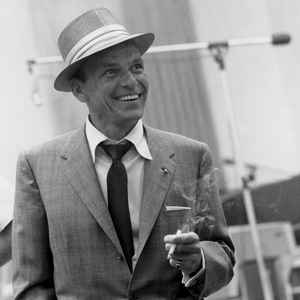
Frank Sinatra
Source: Jerry Jazz
Born on 12 December 1915, Frank Sinatra put his birthplace, Hoboken, New Jersey, on the map. Jersey City, New Jersey, could later boast his daughter, vocalist, Nancy Sinatra, and crooning son, Frank Sinatra Junior. Sinatra was raised a Catholic as the son of Italian immigrants. His mother stayed busy with the local Democratic Party. His father was an illiterate boxer employed as an Hoboken fireman who ran a speakeasy during the twenties where Frank sang as a child. He sang on other occasions as well, also playing a ukulele. Expelled from high school for behavioral causes, he worked delivering newspapers and as a riveter at the Todd shipyards. He sang for free at WAAT Radio in Jersey City. It wasn't his singing, but the advantage of owning a car, by which he joined his first group in 1935, the 3 Flashes, which then became the Hoboken Four. That group won a six-month touring contract at an audition on the Major Bowes Amateur Hour. During that time he made his first recording on March 18, 1939, a demo titled 'Our Love'. He was then noticed at the Paramount Theatre in New York City by bandleader, Harry James, who offered him a two-year contract in June of 1939. In July Sinatra and James performed titles like 'Wishing' and 'Star Dust' during a CBS radio broadcast from the Roseland Room in New York City. On the 13th 'From the Bottom of My Heart' became Frank's first commercially issued recording.
'Our Love' Frank Sinatra w Frank Manne and His Orchestra
Sinatra's first recording Unissued
18 March 1939 at the Harry Smith Studio in Manhattan
Composition: Larry Clinton / Buddy Bernier / Bob Emmerich
'From the Bottom of My Heart' Frank Sinatra w Harry James and His Orchestra
Sinatra's first recording issued
13 July 1939 in NYC Matrix B 25057-1 Brunswick 8443
Composition: Bill Hayes / Andy Gibson / Morty Beck / Harry James
Sinatra began working with Tommy Dorsey in 1940. His first recordings with Dorsey were also his first with the Pied Pipers [see Jo Stafford], those on February 1 in Chicago: 'After I Say I'm Sorry' and 'Sweet Potato Piper'. He also sang solos on 'The Sky Fell Down' and 'Too Romantic'. The Pied Pipers accompanied Dorsey consistently until 1943, on occasion afterward to as late as 1945. Also a major movie star, Sinatra's first film is thought to have been in 1940: 'Las Vegas Nights'.
'Star Dust' Frank Sinatra w the Tommy Dorsey Orchestra and the Pied Pipers
11 Nov 1940 in Hollywood Matrix 055158-1 Victor 27233
Composition: Hoagy Carmichael / Mitchell Parish
'I'll Never Smile Again' Frank Sinatra w the Tommy Dorsey Orchestra and the Pied Pipers
From the film 'Las Vegas Nights' recorded in Hollywod by Paramount Nov 1940
Directed by Ralph Murphy Released 28 March 1941
Composition: Ruth Lowe 1939
Sinatra saw backing by Louis Armstrong in May of 1945. That pair would later perform duets in 1952 and 1954. It was 1946 when Sinatra scored his first #1 issue on Billboard, that 'Oh! What It Seemed to Be' in February. Below is a list of only Frank's chart-topping #1 songs:
Oh! What It Seemed to Be
Feb 1946
Five Minutes More Aug 1946
Mam'selle May 1947
Learnin' the Blues May 1955
It Was a Very Good Year Dec 1965 AC
Strangers in the Night April 1966
Summer Wind Sep 1966 AC
That's Life Nov 1966
The World We
Knew Aug 1967 AC
'Blue Skies' Frank Sinatra w Louis Armstrong Radio
Aug 1945 in Los Angeles AFRS Jubilee #146 See Pumpkin 109
Directed by Ralph Murphy Released 28 March 1941
Composition: Irving Berlin 1926
'Five Minutes More' Frank Sinatra w the Axel Stordahl Orchestra
28 May 1946 in Hollywood Columbia 37048 #1 on Billboard
Music: Jule Styne Lyrics: Sammy Cahn
'Mam’selle' Frank Sinatra w the Axel Stordahl Orchestra
17 March 1947 in Hollywood Columbia 373443 #1 on Billboard
Music: Edmund Goulding Lyrics: Mack Gordon
Sinatra's major home base would become Las Vegas, he first performing there at the Desert Inn in 1951. Among the bigger names with whom Sinatra performed duets was Ella Fitzgerald in 1955. Those two paired up on multiple occasions to as late as 1976. Sinatra founded Reprise Records in 1960, the same year his 1959 album, 'Come Dance with Me!', won the second Album of the Year Grammy Award.
'Learnin’ the Blues' Frank Sinatra w the Nelson Riddle Orchestra
7 March 1955 in Los Angeles Capitol 13628 #1 on Billboard
Composition: Dolores Vicki Silvers
'All the Way' Frank Sinatra Television
1957 on 'The Frank Sinatra Show'
Music: Jimmy Van Heusen Lyrics: Sammy Cahn
'Come Dance With Me' Frank Sinatra w Billy May and His Orchestra
From the album 'Come Dance With Me' recorded 9/22/23 Dec 1958 in Los Angeles
Music: Jimmy Van Heusen Lyrics: Sammy Cahn
In addition to his relationship with the Pied Pipers, Sinatra was later a member of the famous Rat Pack along with Joey Bishop, Peter Lawford, Dean Martin and Sammy Davis Junior. The original Rat Pack was but a circle of friends (such as Errol Flynn, Nat King Cole, Mickey Rooney and Cesar Romero) who gravitated around Humphrey Bogart in the fifties, to which his wife, Lauren Bacall, oft played hostess. As "den mother" she had named the group. Bogart's death in January of 1957 initiated Bacall's second Rat Pack until it was leaked that Bacall and Sinatra were engaged to be married. Though it wasn't Bacall who made the leak it angered Sinatra enough to have nothing more to do with her and she fell out. Others of Sinatra's sixties gang included Corbett Monica and Norman Fell. Female associates were called Rat Pack "mascots" such as Marilyn Monroe, Angie Dickinson, Juliet Prowse and Shirley MacLaine. What that circle of friends had to do with entertainment was in that when one member was performing, largely in Las Vegas, others showed up to generate electricity, there countless examples of such between Sinatra and Martin. Variations of the Rat Pack also starred in films together.
Another major bandleader who backed Sinatra was Count Basie, they first recording together on 2 October 1962. Basie supported Sinatra on several occasions to as late as the 'Sinatra, the Man & His Music' television special in 1981.
'Pennies From Heaven' Frank Sinatra w Neal Hefti conducting the Count Basie Orchestra
From the album 'Sinatra-Basie: An Historic Musical First' recorded 2/3 Oct 1962 in Los Angeles
See Reprise Records R9-1008
Album personnel:
Trumpet: Albert Aarons / Al Porcino / F. P. Ricard / Sonny Cohn / Thad Jones
Trombone: Benny Powell / Henry Coker / Rufus Wagner
Sax: Charlie Fowlkes / Eric Dixon / Frank Foster / Frank Wess / Marshal Royal
Piano: Basie Guitar: Freddie Green
Bass: Buddy Catlett Drums: Sonny Payne
Composition: Arthur Johnston / Johnny Burke Arrangement: Heft
'Wives and Lovers' Frank Sinatra w Quincy Jones conducting the Count Basie Orchestra
From the album 'It Might as Well Be Swing' recorded 9-12 June 1964 in Hollywood
See Reprise Records FS-1012
Album personnel:
Trumpet: Albert Aarons / Al Porcino / Don Rader / Harry "Sweets" Edison / George Cohn / Wallace Davenport
Trombone: Bill Hughes / Grover Mitchell / Henderson Chambers / Henry Coker / Kenny Shroyer
Reeds: Charlie Fowlkes / Eric Dixon / Frank Foster / Frank Wess / Marshal Royal
Piano: Basie Vibes: Emil Richards Guitar: Freddie Green
Bass: Buddy Catlett Cello: Ann Goodman / Edgar Lustgarten Drums: Sonny Payne
Viola: Alvin Dinkin / Paul Robyn / Stan Harris / Virginia Majewski
Violin:
Bonnie Douglas / Erno Neufeld / Gerald Vinci / Israel Baker / Jacques Gasselin
James Getzoff / Lou Raderman / Marshall Sosson / Paul Shure / Thelma Beach
Music: Burt Bacharach Lyrics: Hal David Arrangement: Jones
'September of My Years' Frank Sinatra w conducting by Gordon Jenkins
From the album 'September of My Years' recorded 13-14 April / 22/27 May 1965 in Hollywood
Album personnel:
Trumpet: Cappy Lewis
Trombone: Dick Nash / Tommy Pederson / George Roberts (bass) / Tom Shepard
Oboe: Melinda Eckels / Bert Gassman / Arnold Koblentz Bassoon: Lloyd Hildebrand (flute)
Clarinet: Clyde Hylton (flute) / Harry Klee (flute / woodwind / sax) / Wayne Songer
Sax / woodwind: Buddy Collette / Chuck Gentry / Justin Gordon / Willie Schwartz
Piano: Bill Miller / Joe Parnello
Harp: Kathryn Julye / Kathryn Thompson Vail
Guitar: Bob Bain / Bill Pitman / Tony Mottola / Al Hendrickson / Vincent Terri
Viola:
Alvin Dinkin / Stanley Harris / Louis Kievman
Ray Menhennick / Paul Robyn / Sanford Schonbach / Barbara Simons
Cello: Armand Kaproff / Edgar Lustgarten / Kurt Reher / Eleanor Slatkin
Bass guitar: Max Bennett
Double bass: Joe Comfort / Mike Rubin Drums: Irving Cottler / Nick Fatool
Music: Jimmy Van Heusen Lyrics: Sammy Cahn Arrangement: Gordon Jenkins
'Fly Me to the Moon' Frank Sinatra w Quincy Jones conducting the Count Basie Orchestra
20 June 1965 at the Kiel Opera House in St. Louis
Charity concert for Dismas House of St. Louis
Composition: Bert Howard
'The Birth of the Blues' Frank Sinatra w Quincy Jones conducting the Count Basie Orchestra
20 June 1965 at the Kiel Opera House in St. Louis
Rat Pack: Sammy Davis Jr. / Dean Martin / Johnny Carson filling for Joey Bishop
(Bishop out with a bad back)
Charity concert for Dismas House of St. Louis
Music: Ray Henderson Lyrics: Buddy DeSylva / Lew Brown
In 1966 Sinatra issued his first live album, 'Sinatra at the Sands', the same year his 1965 album, 'September of My Years', brought his second Album of the Year Grammy Award. The next year the Sands denied Sinatra credit, after which he steered a golf cart through one of its plate glass windows, then lost caps from a couple of his teeth upon the manager landing a fist. That same year he was awarded a third Album of the Year Grammy Award for 'A Man and His Music', a double-disc issued in 1965.
'Come Fly With Me' Frank Sinatra w Quincy Jones conducting the Count Basie Orchestra
From the album 'Sinatra at the Sands' recorded Jan/Feb 1966
Music: Jimmy van Heusen Lyrics: Sammy Cahn
Wikipedia
'Francis Albert Sinatra & Antonio Carlos Jobim' Frank Sinatra Album
Recorded 30 Jan/1 Feb 1967 in Hollywood Reprise Records FS-1021
Piano / guitar: Jobim Guitar electric: Al Viola
Bass: Jose Marino Drums: Dom Um Romão / Colin Bailey
Conducting / arrangements: Claus Ogerman
Wikipedia
Medley Frank Sinatra w Ella Fitzgerald Television special
13 Nov 1967 'Frank Sinatra: A Man and His Music + Ella + Jobim'
1. 'The Song is You' (Jerome Kern / Oscar Hammerstein II)
2. 'They Can't Take That Away From Me' (Gershwin Brothers)
3. 'Stompin' at the Savoy' (Edgar Sampson / Andy Razaf)
Spiritually (ahem), Sinatra was more a pantheist than believer in a personal God. Politically, he was a believer in the New Deal and a friend of John Kennedy. After decades of buzz concerning his Mafia ties such remain alleged. Starting in the forties, he had become subject to 2,403 pages worth of FBI investigation, that dossier released in 1998. (Sinatra's response in 1950 was an offer to become an FBI informant, which the Bureau declined.) Though no Communist affiliations surfaced, Sinatra apparently enjoyed the companionship of prostitutes. (Another musician who fell in with the mafia by accident much later was Tommy James of the Shondells per mobster, Morris Levy, who ran Roulette Records.)
Though a Democrat like his mother in his earlier years, campaigning for Franklin Roosevelt, Harry Truman, Adlai Stevenson, and John Kennedy, Sinatra began supporting Ronald Reagan in 1970, then Nixon in 1972, and became a friend to Spiro Agnew. During the seventies Frank developed an interest in folk singer, John Denver, first recording 'Leavin' On a Jet Plane' in 1971. Along with other Denver songs, Sinatra and Denver appeared together at Harrah's in Lake Tahoe in 1975 and 1976. They performed on each other's television specials in 1976 and 1977.
'Leaving On a Jet Plane' Frank Sinatra
From the album 'Sinatra & Company' on Reprise Records FS-1033 1971
Composition: John Denver
'September Song' Frank Sinatra w John Denver Television special
21 April 1977 'Sinatra and Friends'
Nelson Riddle Orchestra
Music: Kurt Weill Lyrics: Maxwell Anderson
'The Best Is Yet to Come' Frank Sinatra Television special
12 Dec 1979 'The First 40 Years'
Sinatra celebrating 40 years in the music business on his 64th birthday
Music: Cy Coleman Lyrics: Carolyn Leigh Arrangement: Quincy Jones
'L.A. Is My Lady' Frank Sinatra w Quincy Jones and His Orchestra
From the album 'L.A. Is My Lady' recorded 13/16-17 April/17 May 1984 in NYC and Los Angeles
Featured on this title:
Piano electric: Bob James Guitar: George Benson Percussion: Ralph MacDonald
Music: Quincy Jones / Peggy Lipton Jones Lyrics: Alan Bergman / Marilyn Bergman
Arrangement: Quincy Jones / Jerry Hey / Dave Matthews / Torrie Zito
'The Lady Is a Tramp' Frank Sinatra w Luther Vandross
From the album 'Duets' recorded 1992-93
Music: Richard Rodgers Lyrics: Lorenz Hart Arrangement: Bill Byers
Discogs Sinatra Website Wikipedia
'The Best Is Yet to Come' Frank Sinatra w Jon Secada
From the album 'Duets II' recorded 1994
Music: Cy Coleman Lyrics: Carolyn Leigh Arrangement: Quincy Jones
The last song Sinatra performed live for an audience was 'The Best Is Yet to Come' in February of 1995, for an audience of 1200 guests on the closing night of the Frank Sinatra Desert Classic golf tournament in Palm Springs. (Sinatra himself spent small love on golf.) In December of 1995 the lights on the Empire State Building were turned blue in celebration of Sinatra's 80th birthday, occasioning his last television appearance, singing 'New York, New York' at the Shrine Auditorium in Los Angeles.
Sinatra died on 14 May of 1998 [obit / obit]. His last words in his hospital room in Los Angeles were reportedly, "I'm losing," in response to his wife's encouragement to fight. The next night the lights on the Empire State Building were shown blue. Frank was buried with "The Best Is Yet To Come" engraved on his tombstone. That was later changed to "Sleep Warm, Poppa" upon vandalism requiring a new stone.
Sources & References for Frank Sinatra:
Donald Clarke (Music Box)
William Ruhlmann (All Music)
B. Kimberly Taylor (Musician Guide)
VF History (notes)
Associates Musical:
Bill Miller (1915-2006 / pianist for Sinatra 1951-95):
Audio:
Hello Young Lovers (November 1953 / To Be Perfectly Frank radio show for NBC)
One for My Baby (1955 for NBC Radio)
September Song (1955 for NBC Radio)
Discographies: Discogs (Biil Miller) Discogs (Bill Miller Sextet)
Interviews: 1 January 1970 (with Les Tomkins) 1973 (with Paul Compton)
Obituaries: Los Angeles Times NPR Sydney Morning Herald
Al Viola (1919-2007 / guitarist for Sinatra 1956-80):
Chuck Berg (obit)
Interviews: 1973 (with Paul Compton) 1977 (with Les Tomkins)
Audio of Sinatra: Internet Archive
Awards: Wikipedia
Billboard Popularity Charts: Music VF
TsorTChronology: Frank Sinatra Website
Compositions: Second Hand Songs
Documentaries:
Frank Sinatra Documentary (BBC)
Frank Sinatra Memorial (Kent Hagen / 1998)
Frank Sinatra: The Golden Age of an American Icon (Michel Viotte / 2015)
Frank Sinatra: The Voice of the Century (Alan Lewens / 2019)
Frank Sinatra: They Were Very Good Years (1997)
Sinatra: All or Nothing at All (Alex Gibney for BBC / 2015): IMDb Wikipedia Pусский
Sinatra: An Unauthorized Biography of the Legend (Nick Bougas for Golden West Films / 1992)
Sinatra: Dark Star (2005)
Sinatra: His Way (2021)
Sinatra In Palm Springs: The Place He Called Home (Mirage Films / 2018)
Sinatra in Film / Television:
IMDb TravalancheInterviews:
September 1946 (with Ira Cook)
1949-1990 (multiple)
11 July 1949 (with Jack Ellsworth)
August 1953 (unknown)
1965 (with Walter Cronkite)
1975 (with Les Tomkins)
September 1975 (Midday Live with Bill Boggs)
24 May 1977 (with Suzy Knickerbocker [Aileen Mehle])
May 1988 (with Larry King)
1990 (unknown)
The Rat Pack (Joey Bishop / Sammy Davis Jr. / Peter Lawford / Dean Martin / Frank Sinatra):
The Rat Pack (theatrical tribute production)
Recordings: Catalogs: 45 Worlds Discogs Music Brainz RYM Sinatraology Wikipedia
Recordings: Sessionographies: DAHR (1939-53) Tom Lord: leading 67 of 231 sessions 1939-84
Repertoire: Sinatraology
Further Reading:
Travalanche (Frank Sinatra Finding Aid)
Travalanche (When Old Blue Eyes Got Older)
Travalanche (The Young Sinatra)
Bibliography:
George Jacobs / William Stadiem (Mr. S: My Life with Frank Sinatra / Dey Street Books / 2004)
James Kaplan (Frank: The Voice)
James Kaplan (Sinatra: The Chairman) (review)
Other Profiles: BandChirps Find a Grave