
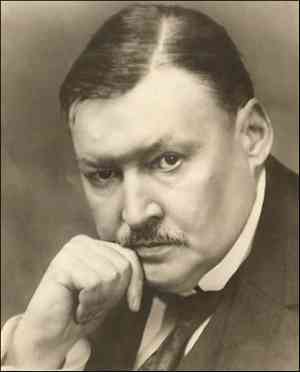
Alexander Glazunov
Source: Dimitri Tiomkin
Born in Saint Petersburg on 10 August 1865, Alexander Glazunov (Алекса́ндр Глазуно́в) was the son of a rich publisher whose major claim to fame would include eight symphonies. He also composed works for chamber, stage, piano and voice along with concertantes and various instrumentals. He began piano at age nine and composing a couple years later. Glazunov's interests were much aligned with Tchaikovsky's toward the internationalization of Russian music, also finding much to be gained in Western Europe. Even so, he was a firm romantic for whom modernistic approaches to composition that arose during his career were "cacophonic" at best. In 1879 he became protégé to Rimsky-Korsakov.
Glazunov's Op 1 is assigned to 'String Quartet No.1' in D major composed in 1882 toward publication in 1887. Glazunov wrote six more such quartets to as late as Op 107 ('Hommage au Passé') in C major in 1930, published in Leipzig in 1931. Glazunov's 'Symphony No.1' ('Slavonian Symphony') in E major Op 5 was composed at age sixteen with a dedication to Rimsky-Korsakov toward premiere in St. Petersburg sometime in 1882.
'String Quartet No.1' Op 1 in D minor Alexander Glazunov
Comp 1882 Pub 1887
Dedicated to Lyudmila Shestakova (sister of Mikhail Glinka)
Shostakovich Quartet
'Symphony No.1' ('Slavonian Symphony') Op 5 in E major Alexander Glazunov
Comp 18801882 Premiere 1882 Pub 1887
Dedicated to Rimsky-Korsakov
USSR Ministry of Culture Symphony Orchestra / Gennadi Rozhdestvensky
Alan Beggerow IMSLP Wikipedia English
Glazunov quickly came to note internationally due to falling in with the Belyayev Circle, a loose association of composers gravitating about publisher, Mitrofan Belyayev. The Belyayev Circle was successor to the Moguchaya Kuchka (the Mighty Bunch aka The Five) led by Mily Balakirev whose interest had been in developing a distinctive nationalistic Russian music. Belyayev's circle owned the same purpose with the additional task of taking Russia west to Europe, which Belyayev and Glazunov did in 1884 toward the performance of 'Symphony No.1' in Weimar, Germany, in 1885, inaugurating Belyayev's greater project of staging symphonies in Germany by Russian composers in 1886 and 1887 following his establishment of a publishing house in Leipzig in 1885. Though Glazunov was an immediate success in Germany he didn't begin conducting until 1888. He began teaching at the Saint Petersburg Conservatory [Wikipedia] in 1899.
Among Glazunov's most favored works is 'Violin Concerto' in A minor Op 82 which premiered in St. Petersburg on 15 February 1905. Glazunov had dedicated that to violin virtuoso, Leopold Auer, who performed it.
'Violin Concerto' Op 82 in A minor Alexander Glazunov
Comp 1904 Premiere 15 Feb 1905 in St. Petersburg Russian Musical Society
Pub 1905 in Leipzig
Dedicated to violinist Leopold Auer
WDR Sinfonieorchester Köln / Semyon Bychkov
Violin: Hilary Hahn
IMSLP Calum MacDonald Wikipedia English
Glazunov became director at the Petrograd Conservatory in 1905 until 1928 during which latter time he championed young Shostakovich who became a student there in 1919 at age thirteen. Glazunov's 'Symphony No.8' in E flat major Op 83 which is considered by some his best had been composed in 1905 toward publication in 1907.
'Symphony No.8' Op 83 in E-flat major Alexander Glazunov
Comp 1905 Pub 1907
Royal Scottish National Orchestra / José Serebrier
Glazunov was honored with an honorary doctorate at both Oxford and Cambridge in 1907. His prestige at St. Pete's among international peers made his a smooth transition from Imperial to Bolshevik Russia upon the Revolution of 1917-1922. There was no problem with his music and the new regime could use a well-regarded world-class composer. Glazunov may have completed 'Piano Concerto No.2' Op 100 about eight months into the Revolution in autumn of 1917.
'Piano Concerto No.2' Op 100 in B major / E major Alexander Glazunov
Comp 1905 Pub 1907
Symphonia ASSAI / Wouter Lenaerts
Piano: Philippe Lamouris
IMSLP Francis Pott 日本語版ウィキペディア
In 1928 Glazunov left Russia for Vienna, never to return. He toured Europe and the States, then settled in Paris in 1929. The next year he finished his seventh and last string quartet which he titled 'Homage to the Past' and dedicated to the Gordon String Quartet. Among Glazunov's more excursive compositions was per an instrument relatively new and not used a lot in classical composition, that being 'Saxophone Concerto' in E flat major Op 109 premiered in Paris by German saxophonist, Sigurd Raschèr, on 25 November 1934.
'String Quartet No.7' ('Hommage au Passé' = 'A Tribute to the Past')
Op 107 in C major Alexander Glazunov
Comp 1930 Pub 1931 in Leipzig
Dedicated to the Gordon String Quartet
Shostakovich Quartet
'Saxophone Concerto' Op 109 in E-flat major Alexander Glazunov
Comp 1934 Premiere 25 Nov 1934 in Nyköping, Sweden Pub 1936 in Paris
Dedicated to saxophonist Sigurd Raschèr
Saxophone: Juan Pedro Luna Aguda Zagreb, Croatia
IMSLP Wikipedia English Wind Repertory Project
Glazunov's last Opus is 110 assigned to 'Fantasie' in G minor for organ dedicated to organist, Marcel Dupré, with the manuscript dated 12 April 1935.
'Fantasie' Op 110 (final) in G minor Alexander Glazunov
Comp completed 12 April 1935 Pub 1960
Organ: Konstantin Volostnov
Glazunov died on 21 March 1936 near Paris, leaving the first movement of his 'Symphony No.9' in D minor, begun in 1910, undeveloped.
Sources & References for Alexander Glazunov:
Zoran Minderovic (All Music) VF History (notes) Wikipedia English
Audio of Glazunov: Corpora: Classical Archives Hyperion Internet Archive Naxos Presto
Audio of Glazunov: Individual: Chronological:
Symphony No.1 (Op 5 / comp 1882 / Moscow RadioTV Symphony Orchestra / Vladimir Fedoseyev)
Symphony No.1 (Op 5 / comp 1882 / Moscow Symphony Orchestra / Alexander Anissimov)
Violin Concerto (Op 82 / comp 1904 / Royal Scottish National Orchestra / Neeme Järvi / violin: Oscar Shumsky)
Piano Concerto No.2 (Op 100 / comp 1917 / London Symphony Orchestra / Valery Gergiev / piano: Daniil Trifonov / 2013)
Piano Concerto No.2 (Op 100 / comp 1917 / USSR State RadioTV Large Symphony Orchestra / Valery Gergiev / piano: Dmitri Alexeev / 1977)
Saxophone Concerto (Op 109 / comp 1934 / Brevard Music Center Orchestra / JoAnn Falletta / sax: Joseph Lulloff / 2012)
Fantasie (Op 110 [last] / comp 1935 / organ: Nicholas Capozzoli)
Chronology: Alexander Glazunov Foundation (slow)
Compositions:
Alexander Glazunov Foundation (by date / slow)
Classic Cat (by Opus)
IMSLP (by date / genre / key / Opus / title)
IMSLP (Symphonies)
IMSLP (by title)
Klassika (by date / genre / Opus / title)
Rate Your Music (by genre)
Wikipedia (by genre)
Wikipedia (by genre)
Correspondence: Alexander Glazunov Foundation (slow)
Family:
Olga Nikolaevna Glazunova (wife / 1888-1968 / married 1922)
Elena Glazunova-Gunther (daughter / 1905-1999)
Herbert Günther (son-in-law / author / 1906-1978)
Iconography: Wikimedia Commons
Lyrics / Texts: Emily Ezust (LiederNet)
Recordings of Glazunov: Catalogs:
Alexander Glazunov Foundation (slow)
Recordings of Glazunov: Select:
Complete Symphonies & Concertos (Russian National Orchestra / Jose Serebrier / box of 8 CDs)
Scores / Sheet Music:
Abe Books (vendor / Amazon subsidiary)
Musicalics (vendor)
Further Reading:
Alexander Glazunov Foundation (slow)
IMDb (usage of Glazunov in film)
Russian Revolution (8 March 1917 to 25 October 1922):
American Historical Association
Bibliography: Alexander Glazunov Foundation (slow)
Other Profiles:
Bobb Edwards (Find a Grave)
Classical Main Menu Modern Recording
|
|